

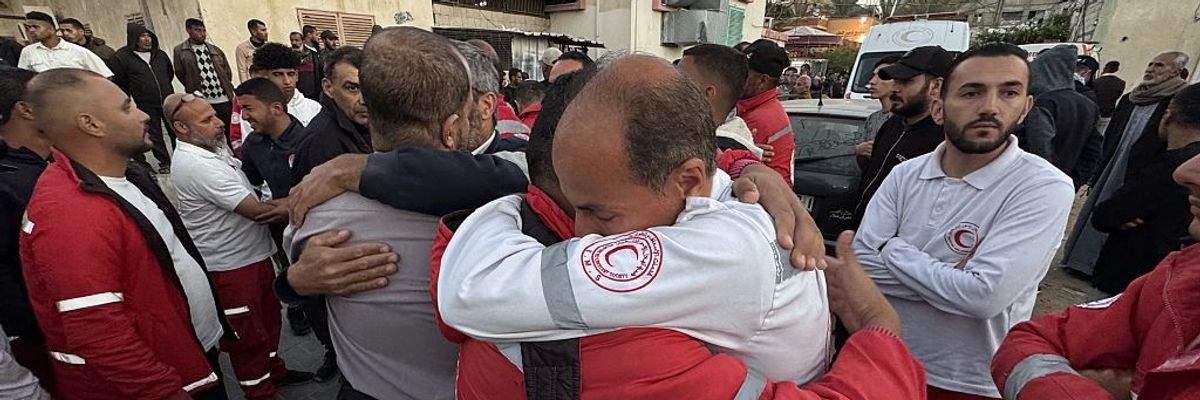
“The technology may change, but the laws of war do not,” said the United Nations’ top humanitarian official on Wednesday as the international community marked World Humanitarian Day—and a record number of violent attacks against aid workers in 2025, with the expanded use of drones partially driving the increased threat to workers’ safety.
According to the Aid Worker Security Database and the UN Office for the Coordination of Humanitarian Affairs (OCHA), 907 aid workers were killed, injured, or kidnapped last year.
Nearly 300 more were detained or arrested, said OCHA.
The number of humanitarians who were killed dropped slightly from the previous year, down to 350 from 387. But the death toll was the second highest ever recorded, and a majority of those killed—186—were attacked in Gaza, despite a “ceasefire” agreement that was reached last October.
More than two-thirds of those killed in Gaza were victims of aerial bombardment.
OCHA noted that “cheap and adaptable armed drones are putting lethal capabilities into more hands,” with armies now able to wage more explosive attacks from afar and reach “deeper into towns and cities.”
The prevalence of armed drones has been linked to 80% of civilian deaths in Sudan in the first four months of this year, while in Colombia, weaponized drone attacks quadrupled between 2024-25.
As the technology of war changes, said OCHA, “our humanity must not… Civilians, including humanitarians, must be protected.”
One aid worker was killed in March in the Democratic Republic of Congo when a drone struck a residential building, while four humanitarian convoys were attacked by drones in a single week in May in Ukraine.
"Weaponized drones have become the new face of an old danger: the deliberate or reckless destruction of civilian life,” said Tom Fletcher, the UN humanitarian chief.
“But just calling it out will not protect the next aid worker," Fletcher added. “States must uphold international humanitarian law and use every tool to protect civilians and our colleagues. And for those who break the rules, there must be real consequences.”
So far in 2026, 82 aid workers have already been killed, while 322 have been injured and 235 have been kidnapped.
“On World Humanitarian Day, we honor humanitarian workers everywhere, and the courage and sacrifices they make every day to help others,” said the global humanitarian group Oxfam. “We stand in solidarity with our staff and partners on the frontlines, often working at immense personal risk, and urge governments to uphold their obligations to protect them.”
From Common Dreams via This RSS Feed.