

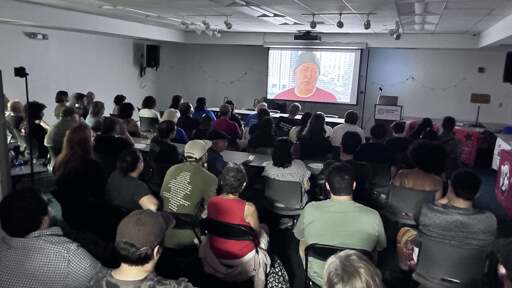
On August 15, Rhode Island DSA hosted an event called “Break the Two Party System: Building a Workers’ Party Through Class Struggle.” The event featured a screening of the documentary, When Ice Melts, and was followed by a panel discussion on the lessons from Minneapolis and the path forward toward the emergence of a new party of the working class. Panelists included Kip Hedges, a union activist from Minneapolis and part of Workers Resist, Brittany Kubicek, a member of Rhode Island DSA and candidate for RI State House District 5, Nick Wurst, a member of the Independent Socialist group and from Railroad Workers United, Rosa Pepper-Macias, a member of Workers’ Voice and a candidate for CT State Senate District 11, and our comrade, Sou Mi, from Left Voice.
Here, we reproduce the text of Sou Mi’s opening remarks.
***
It’s auspicious that we are having this conversation on which way towards a new party after the documentary we saw. I was in Minneapolis in January, reporting for Left Voice. It was inspiring, seeing the city up close, across both the big day of action I was there for (J30) and the everyday “defense” of the city. Everywhere you saw, there were signs and civilian patrols, on foot, in cars, ready to give chase to ICE.
There are important lessons for us in this experience. Such was the pressure from below that it gripped our imagination all across the country. In the face of having to contend with this spreading and growing, Trump felt compelled to withdraw some forces in Minneapolis. In Minneapolis itself, unions were compelled to join the fight, leading to the important day of shut down on January 23.
At the Labor Notes conference this year, union leaders talked about how they had to join because the membership was already moving and mobilizing, organizing to keep their communities and coworkers safe. There was no way they could sit it out. In my time in Minneapolis, I saw this, in the people organizing in their workplaces and communities, organizing to keep each other safe, or taking food and to families who needed it. Most significant were the teachers who were at the front lines. It’s undeniable, this role that schools played, as centers of this struggle in the neighborhoods, coordinating the protection of their immigrant students and their families. As teachers said to us then, it was solidarity built meticulously and through common struggle, from the experience of mobilizing after George Floyd was murdered in the city in 2020, and then after, going on strike together in 2021, not just for better conditions for themselves, but also their students.
The people of Minneapolis are not alone. Trump’s ICE surges have animated people across the country. And like the teachers in Minneapolis, they are all part of a generation, now fighting against ICE and Trump’s vicious attacks, forged in the experiences of the last years, from the consequences of a global pandemic to the movement for Black lives, the movement within labor of new generations unionizing their workplaces, and then, especially since 2023, in the fight for Palestine.
And this anger now swirls together with everything else: the consequences of a genocide in Palestine that has persisted with the backing of the U.S. despite the ceasefire, has only been compounded by the continuation of the war in Iran, from which there has been no easy exit for Trump; the kidnapping of Venezuela’s president Nicolas Maduro; and the blockade and the threats against Cuba, all while conditions get worse here at home, where inflation far outpaces our wages. There’s always money for war and repression, but there’s never anything for working people who are constantly turned against each other.
Yet, as imperialist intervention continues in force and the billionaires continue to make record profits, working people across the country are recognizing how this system has nothing to offer to us. And that this isn’t a result of Trump and the Far Right alone. Despite their rhetoric or posturing of fighting Trump and the Far Right, the Democratic party has no real alternative vision to get us out of this conundrum.
Indeed, a huge part of why Harris lost in 2024 is that she represented much of the same: in the face of the fight against Trump and the Right, she offered an empty defense of “democracy” with nothing to show for it, all the while that she and the Democratic party maintained its support for the state of Israel as it continued the genocide in Gaza. The autopsies since then have only emphasized how much the genocide cost the Democratic party. Indeed, that same fever — the one we saw give some fuel to the “Uncommitted” campaign — is exactly what has ballooned since then. The Zionist consensus is wearing thin and proving costly for the Democratic party, and, combined with the experiences since then with the second Trump presidency, is fueling this incredible surge of progressive wins across the country. What began with Zohran Mamdani is continuing through this primary season, with the likes of Abdul El-Sayed, Chris Rabb and others.
We should be clear though: these victories that DSA-backed candidates are racking up have little to do with the Democratic party, and much more with this deep desire for a political alternative. The success of these candidates is precisely because they represent something different. The polls back this up: 62 percent of U.S. adults believe the Republican and Democratic parties do such a poor job representing the people that a third major political party is needed. Les Leopold from the Labor Institute released a book this year called A Party of Our Own where he presented a study finding that 57 percent of 3,000 Rust Belt voters were in favor of a new organization (posed in the survey as the Independent Workers Political Association) to run working-class candidates independent of both parties. This primary season is showing some expressions of this, too. Kshama Sawant’s results in Seattle, where she won over 17 percent of the vote, are significant. Running against a 15-term incumbent, without the backing of DSA, major unions, or mainstream media, and as an openly revolutionary socialist, Sawant won one in six voters in the primary season.
So where do socialists go from here?
We have real opportunities, in this moment, to fight for the emergence of our class. After the recent wins, DSA has grown to 125,000 members. It is larger than even the Socialist Party ever was in its height. This growth is because people are looking for a political home — something to fight for a different future with**. Yet, the more DSA ties its fate to the Democratic party, the less relevant it is going to become in its task of posing an alternative.**
The question of what type of political party, what kind of state, what kind of future we need for the working class is constantly being posed. People are seeing capitalism and the state for what it is, even its undemocratic nature. DSA’s own program speaks to this, with demands like abolishing the Senate.
And yet, at the same time, DSA chapters right now are passing resolutions like “Run, AOC, Run” — urging her to run for president, saying they’ll endorse her if she does. While she says she’s still thinking about it, she distances herself from DSA’s program. So what does it mean, then, for DSA to back the campaign of someone who doesn’t stand for the very program that it’s rallying tens of thousands in this organization around?
In Jacobin, Eric Blanc posed the question last week that if AOC doesn’t run, the U.S. Left should run a worker. And a couple of weeks ago, the UAW released a video where Shawn Fain said labor needs to back candidates who are workers and of the working class. Those would be great advancements, if they happened. But there is no path forward without addressing the elephant in the room, which is this relationship with the Democratic Party. Is all of this momentum and energy going to go toward reviving an imperialist party and negotiating with them? Or is it possible to seize the moment and put forward an independent campaign toward 2028, one that captures the aspirations of fighting against the Far Right, against Trump, and the billionaires, and point toward a new horizon?
This is a central task of the time, to fighting for the working class’s democratic right to put forward its own candidates. It goes against the bipartisan regime as a whole. DSA as a national organization of over 100,000 members, with the infrastructure it has built, has the strength to drive forward an independent worker candidate, whether for the races in November or for the presidency in 2028. And such a campaign needs to be linked to a program that actually represents the aspirations of the social base who are voting for socialists and are eager for a change. A program that ensures it is the rich and the bosses who pay for the capitalist crisis, not workers, and one with a strong anti-imperialist stance — all of which are fundamentally at odds with the Democratic Party.
The emergence of a new working-class party, and with it, the intervention of the working class as a political subject, with its own banners and program, can’t be accomplished with the gradual accumulation of our forces, as if the arc of history only trends upwards. It will and must be forged in this common struggle, organizing new layers in this fight to create the social force for a new party of the working class.
At Left Voice and our international current, the Current for Permanent Revolution — Fourth International, we are acutely aware of this tension, especially with the emergence of our comrade, human rights lawyer and congressmember Myriam Bregman as the most popular politician in Argentina. She is far more popular than President Javier Milei, former president Cristina Kirchner, and Axel Kiciloff, the presumed Peronist candidate for 2027, even as Bregman’s popularity isn’t yet expressing itself in electoral results.
How do we transform that passive support into an active one? We want to organize not just the people who already support the organizations of the Left and Workers Front (FIT-U), but fight alongside them to bring new sectors closer, uniting them in the fight against Milei and imperialism, and presenting new alternatives for a future.
Here in the United States, at a moment when tens of thousands are joining DSA because it represents something in the fight for socialism, and even more are backing candidates who represent a break with the old, we on the Left have to bring this political struggle to the open.
At Left Voice, we are excited to bring these discussions and debates forward in the next period and contribute with our small forces where we can. We open our pages and invite people to write and contribute and participate in this debate with us.
The post Which Way Forward Towards a Workers’ Party? appeared first on Left Voice.
From Left Voice via This RSS Feed.