
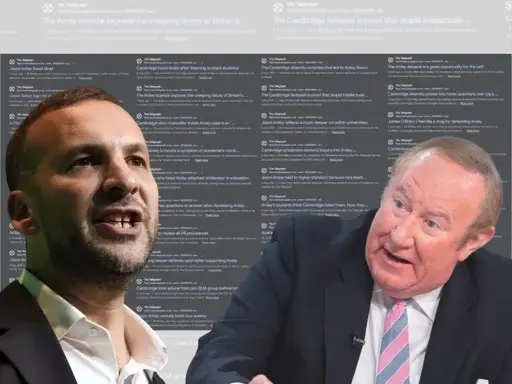

In the aftermath of the media witch hunt against Jason Arday, people are once again talking about the need for media reform. Unsurprisingly, the people saying we don’t need any further regulation are the hack journalists who’ve made a killing towing the establishment line – as Green Party leader Zack Polanski has highlighted:
Andrew Neil really having a meltdown in real time.
What is it about some actual press regulation that sends them like this?
A few billionaires owning the majority of the press and behaving however they want is not a free press.
Change is coming. https://t.co/MaCurX0wn4
— Zack Polanski (@ZackPolanski) August 18, 2026
Polanski: change is needed
As Polanski notes, the big issue is that almost all of the British media is owned by a handful of billionaires. Of course this is going to result in bad outcomes.
In an article looking at alternatives to our bought-and-paid-for media, Reuters Instituteinterviewed several media companies with different structures. The story covered some local outlets:
Some media companies have decided to forge their own path in these countries, defying the traditional ownership structures of the news industry. But there is not a single model when it comes to journalist-owned media.
The West Highland Free Press became an employee-owned newspaper in 2009. After the original owners retired, they gave their employees an opportunity to take control of the company.
It also covered national outlets:
In… Uruguay, one of the most widely-read newspapers in the country is La Diaria, a profitable outlet with more than 21,000 subscribers in a country with a population of three million people. With 170 employees, La Diaria operates within the same cooperative model. After three months of working for the newspaper, employees have the choice to join the cooperative or simply be only employees.
When I asked editor-in-chief Natalia Uval why an employee would want to join the cooperative, she said that journalists are attracted to having decision-making power over the future of the newspaper.
“We haven’t distributed any dividends and we are not planning to do it in the short term,” she said. “If we make a profit, we want to reinvest it, or maybe generate a fund to support journalism. So the real benefit of being a shareholder is to be able to make strategic decisions for the company.”
Collective models won’t always ensure ethical journalism. At the same time, media concentration does seem to consistently produce journalism that benefits the wealthy owners.
Trouble ahead
Of course, it’s not wrong to argue that media regulation could go too far. In fact, Britain also has problems on that front – most notably with the government’s National Security (State Threats) Bill. As we reported in July:
Kim Johnson (Labour) and Jeremy Corbyn (Your Party) raised significant concerns about the legislation’s potential impact on journalists in the final debate on amendments.
Johnson warned that under the legislation as drafted, “journalists could still face a prison sentence of 10 to 14 years for working with or even approaching sources in hostile Governments.”
The absolute last thing we want is a situation in which actual news cannot be reported on. At the same time, it is possible for us to establish that certain behaviours fall outside of what could be considered ‘journalism’. The phone hacking scandal was one example of that. Pushing misinformation that genuinely puts lives at risk is another, although trickier to regulate, because consensuses can change.
Another thing to consider, of course, is the recent hounding of Jason Arday.
Jason Arday
One thing that’s clear about the Jason Arday story is that the primary driving force was racism. The campaign against him was started by known “race realist” Nathan Cofnas who believes there would be no Black people in academia if not for social engineering. The fact that some outlets chose not to make this clear suggests they’re sympathetic to Cofnas’s beliefs.
Another factor in the Arday story is the profit motive. Stories and social media posts about Arday clearly generated a lot of attention, and with that attention comes profit. Because media outlets are pretty much exclusively owned by billionaires who expect a return on investment, it’s not surprising that the people who get elevated to positions of power are those who think first and foremost about the bottom line:
“Combined, The Times and The Telegraph produced 87 articles in 22 days, and most of those came AFTER Jason Arday resigned on August 4th 2026…”
Well worth a read. https://t.co/m2G83wLfvD
— Lorna_TVeditor (@Lorna_TVeditor) August 18, 2026
This obscene desire to profit from Arday was most notable in Rupert Murdoch’s Times’ decision to use stories about him as part of an ad campaign:
Did @thetimes ever put an ad budget behind a story about British royal family member Prince Andrew Windsor fucking babies on Epstein Island? Did they spend money to boost a story about Peter Mandelson , Epstein’s British bestie, and chase you around Twitter with it for days?… pic.twitter.com/8GUMBoPzSi
— David Hundeyin (@DavidHundeyin) August 15, 2026
We’re not noting the above to diminish the racism at the heart of the Arday story; we’re noting it to highlight that several things have gone wrong at once.
Of course, moving away from a billionaire-bought media ecosystem would not mean outlets could ignore the need to make money. At the same time, it would make two things less likely:
- Outlets primarily being driven by profit concerns.
- Outlets pursuing class warfare in a way that favours the billionaire class.
Change
In the UK, journalists are among the least trusted professions. This is obviously a huge problem, and one that needs to be tackled. While we certainly don’t think all regulation is good, we do need to be talking about how we can ensure our media is finally fit for purpose.
Featured image via PA / Channel 4
By Willem Moore
From Canary via This RSS Feed.