

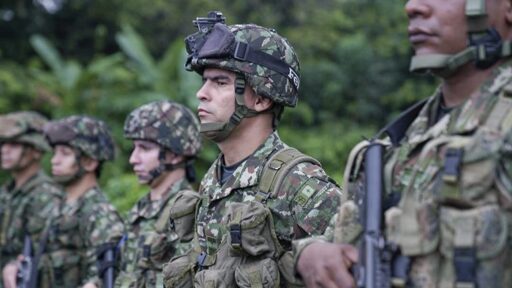

In his first week in office, despite fumbling the response to the devastating earthquake, Abelardo De la Espriella made good on his promise to end the state policy of promoting peace and launch military actions against armed groups in the country.
Beginning on August 9, the Armed Forces launched an offensive in which, according to the Army, four members of the FARC dissident group were killed in Meta, and two others from the Clan del Golfo were killed in Antioquia. Between August 10 and 11, in Catatumbo, authorities reported the deaths of two ELN members, as well as the destruction of two bunkers and five camps. In addition, the government celebrated the death of Dubán Ramiro Castillo, identified as the leader of the Mordisco dissident group, in an attack by military forces in Valle del Cauca on August 12.
The response from dissident groups was swift. Using drones and other methods, these irregular groups have launched counterattacks. On August 12 in Huila, one officer was reported killed and several soldiers wounded. Another attack in Cauca left several service members wounded.
However, the most significant attack occurred on August 14, in which a sergeant was killed and four soldiers were wounded when they were attacked by drones in El Carmen, Catatumbo. This attack comes on top of another carried out in the days prior in Northern Santander, where the Army stated that 43 drones carrying explosives were used against a military base.
Likewise, human rights organizations reported that military operations had caused serious injuries to three farmers in the Catatumbo region, as well as damage to homes and the displacement of people toward the El Tarra area. The government, for its part, stated that it has not deliberately harmed civilians.
Thus, Colombia appears to be gradually returning to the days of all-out war. De la Espriella has already warned that the offensive will be carried out forcefully until total submission is achieved, and that there will be no room for dialogue.
This approach is not new in Colombia. In fact it was employed extensively by the administration of far-right former president Álvaro Uribe Vélez and it not only failed to end the violence in Colombia, but intensified it and affected, in particular, the civilian population of the rural areas where the conflict is primarily taking place. Now once, again, in many regions of the country that have consistently ratified the need for peace at the ballot box and in the streets, this peace seems to be slipping through their fingers.
Abelardo’s promise to end peace
One of the most persistent arguments of the then-Colombian presidential candidate Abelardo de la Espriella was the suspension and dismantling of the state’s peace-promotion policy. The initiative, launched by the right-wing government of Juan Manuel Santos, aimed to de-escalate violence in a country that has been embroiled in armed conflict for several decades.
Santos succeeded in signing a peace agreement in 2016 in Havana, Cuba, with the Revolutionary Armed Forces of Colombia (FARC), the country’s largest insurgent group. The former president also made significant progress in talks with the National Liberation Army (ELN), which opened up a potential path toward an end to the violence. True avenues towards peace had been largely blocked until then. Santos was awarded the Nobel Peace Prize in 2016, the same year the Havana Accords were ratified.
A large portion of the Colombian right wing (especially its most radical faction) opposed the peace agreement. This faction has historically advocated for total war against insurgent groups – that is, until they are completely subdued by force. In a country as vast as Colombia, with so many internal contradictions, however, no government has ever achieved this goal, despite grandiloquent declarations of war and victory.
De la Espriella has now once again embodied this rhetoric, which seeks to make constant internal conflict a way of life for society. There have been many arguments regarding the drive to normalize violence, ranging from the economic benefits that various Colombian and foreign groups derive from fomenting war, to the desire to keep the left off the electoral stage and constantly associate it with armed factions.
A new US-backed military offensive
Whatever the case may be, De la Espriella has decided to continue a radical right-wing political tradition and declare an end to the state’s “Peace” policy, in favor of resuming widespread military operations against irregular armed groups. To this end, he has once again, as tradition dictates, turned to Washington, which, according to its Secretary of War, Pete Hegseth, would launch military operations “on the ground” in Colombia and other countries in the region.
If we add to this the nearly $1 billion that the Trump administration disbursed to the recently inaugurated Colombian president, we gain a clearer picture of the course that the close alliance between Bogotá and Washington will take – an alliance that has been one of the most valued and carefully nurtured relationships in US history.
Yet we should also not discount that the previous government, led by the progressive Gustavo Petro, did not carry out any military operations against insurgent groups. The Colombian Army has not ceased its fight against these groups since they first emerged. But it is true that certain truces and ceasefires had been established until several splinter groups of the former FARC and ELN resumed armed operations in response to what they considered a breach of the agreements. Between August 7 and 8 alone, the first 48 hours of his mandate, six incidents carried out by FARC dissidents and other groups were reported in areas such as San Roque, Tolima, Cauca, etc.
Thus, De la Espriella inherits a country embroiled in armed conflict. But, as he has stated, De la Espriella, like other right-wing Colombian leaders, hopes to shift the strategy from containment and dialogue to an all-out offensive. With support from an even more aggressive US administration, the result could be devastating for the people of Colombia.
From BT News via This RSS Feed.