

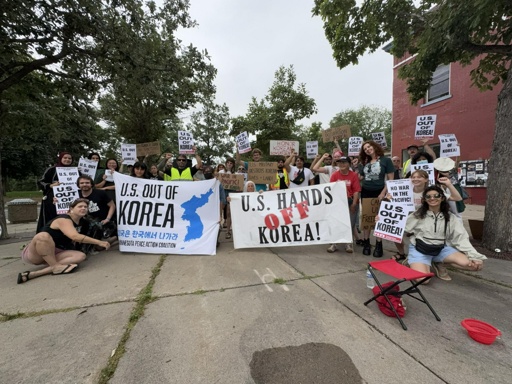
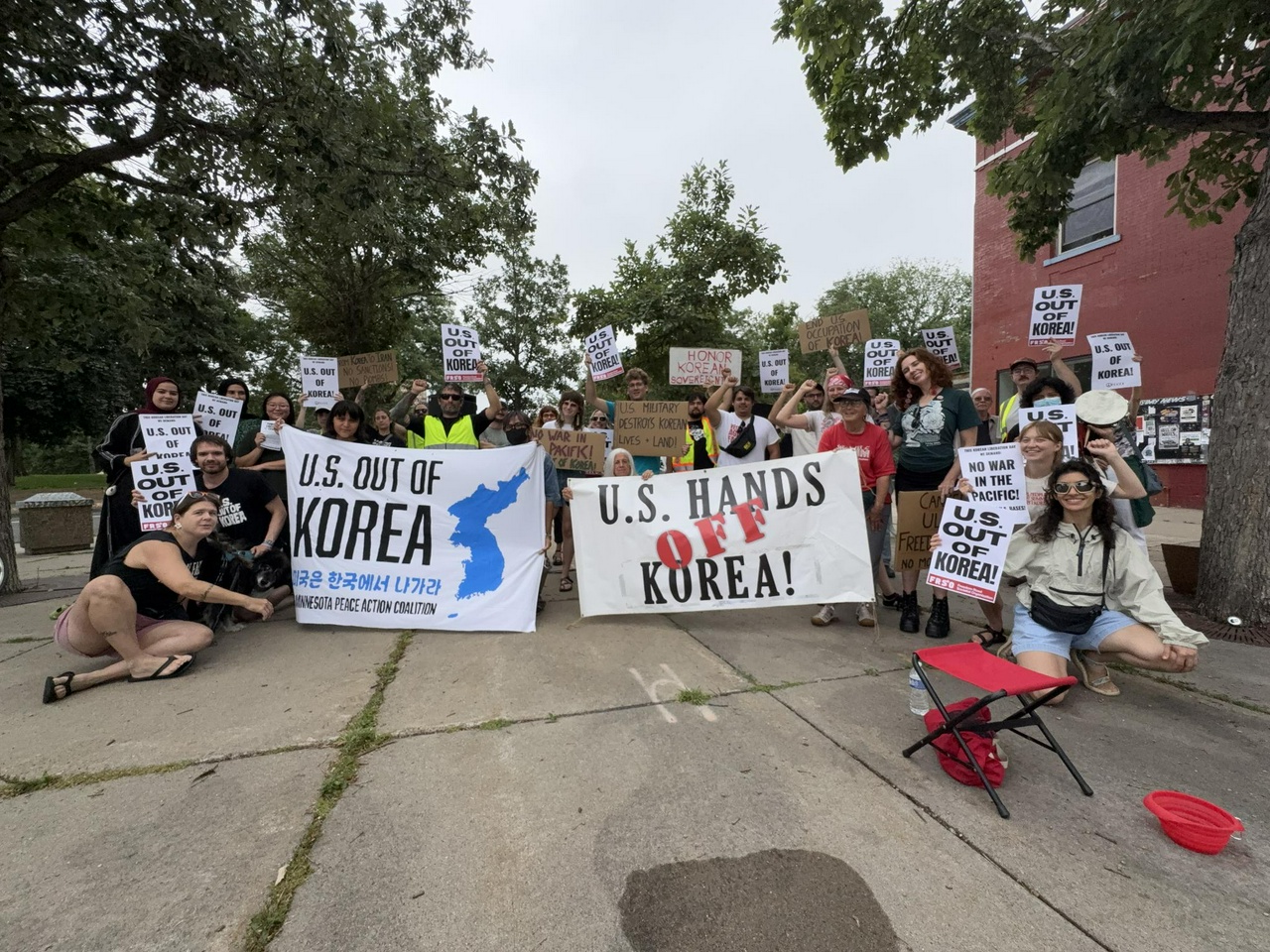
Minneapolis, MN – On August 15, community members gathered at Mayday Plaza to honor the 81st anniversary of Korean Liberation Day. The event was held in the Cedar Riverside neighborhood, right outside of Mayday Books.
The action was emceed by Trent Fast from the Minnesota Anti-War Committee and Leo Del Rio from About Face, who began with the acknowledgement of the U.S.’s ongoing presence and occupation in Korea.
One occupation replaced by another
Fast explained to the crowd that the first liberation day in Korea was in 1945, after World War II ended. This marked an end to decades of Japanese colonial rule. Soon after, however, the United States military “showed up and established its own, brand-new occupation.” Thus, the Korean War began.
From 1950 to 1953, the U.S. government killed over two-and-a-half million Koreans and nearly decimated every major North Korean city. At the end of those three long years, the Mutual Defense Treaty was signed. Even though the war had “ended,” the U.S. remained in Korea as an imperialist force, occupying newly-designated South Korea. This occupation still lasts today. On average, there are about 28,000 U.S. troops that are living in Korea, and South Korea has the largest overseas U.S. Army base in the world.
Cedar Larson, representing WAMM, educated the crowd around the Mutual Defense Treaty and other similar agreements, calling them, “political tools to increase U.S. domination and control” over the land. They said the treaty gave the U.S. the “opportunity to threaten their enemies” and had “disastrous effects on the lives of the people.”
Forced prostitution
Larson also drew attention to the human rights violations that have been occurring since the 1960s. For example, the governments of the United States and South Korea established areas around military bases known as “special tourist zones for foreigners” – meaning soldiers. In these designated areas, South Korean, American and United Nations troops introduced forced prostitution. Women and girls, as young as 15, were “deceived, kidnapped, and forced into sex labor,” said Larson.
These crimes have continued to the present day. Even though laws have been put into place, they are rarely followed. The areas discussed above are often now branded as “tourist stops” but have a dark underbelly.
Ecological consequences of imperialism
Liz McLister from FAMM brought up the ecological effects that the U.S. occupation has had in Korea. McLister said that from “contaminating water supplies and arable land” to “disrupting wildlife habitats,” the U.S. has only brought destruction to the country. As climate change continues to worsen, the Pacific region is experiencing extreme heat, rising sea levels, coastal erosion and severe storm systems.
U.S. activities in the region are accelerating ecological damage and leaving its communities traumatized by decades of systemic abuse. Emily Newberg from WAMM stated, “Occupation is wrong. To occupy another’s land to take away their sovereignty and their self-determination. It leads to catastrophe in almost every way: economically, environmentally and nationally as the people are torn apart by propaganda and false promises.”
Not only does this occupation affect the communities living in Korea, but also U.S. citizens. U.S. tax dollars are being used to maintain around 80 military bases in Korea, using “$6 billion to maintain U.S. bases and troops in South Korea,” according to Larson. McLister pointed out that the “Korean peninsula is of immense strategic value to U.S. military operations.”
Korea’s proximity to China and other strategic locations makes it the perfect target for the U.S. military and imperialist interests.
Simulated invasion
Along with the maintenance of military bases, the United States also engages in staged military exercises or “war games.” Since 2021, the U.S. government has stolen $60 billion from U.S. taxpayers to fund war games like Ulchi Freedom Shield, RIMPAC and Balikatan. These military exercises are conducted in “preparation” for a war with other countries in the area, such as China and Japan.
Fast noted that during the upcoming week, the United States and South Korean militaries were planning to hold “one of the largest annual war drills on earth.” This exercise is named Ulchi Freedom Shield.
During these drills, tens of thousands of troops are deployed to the border with the North, simulating an invasion. Fast said that these war games could quickly escalate to actual war if there is a simple misunderstanding by either side, and have a heavy psychological toll on the people of Korea, who fear an uncertain future.
The day after the protest, President Donald Trump announced a reduction of the scope of this year’s Ulchi Freedom Shield, in apparent reaction to depleted U.S. military capacities stemming from the ongoing U.S. war on Iran.
As Naveen Borojerdi from MPAC put it, Korea is a “country that has paid a massive toll for its right to self-determination.”
A speaker from Anakbayan asked rhetorically, “For whom? For whom was the United States liberating countries across Asia? It was not for those people.”
Organizations were represented at the action, included About Face: Veterans Against the War, Women Against Military Madness (WAMM), Families Against Military Madness (FAMM), Minnesota Peace Action Coalition (MPAC), Anakbayan Twin Cities, and the Minnesota Anti-War Committee (AWC).
#MinneapolisMN #MN #International #AntiWarMovement #Korea
From Fight Back! News via This RSS Feed.
Americans are the stupidest people in the universe.
