

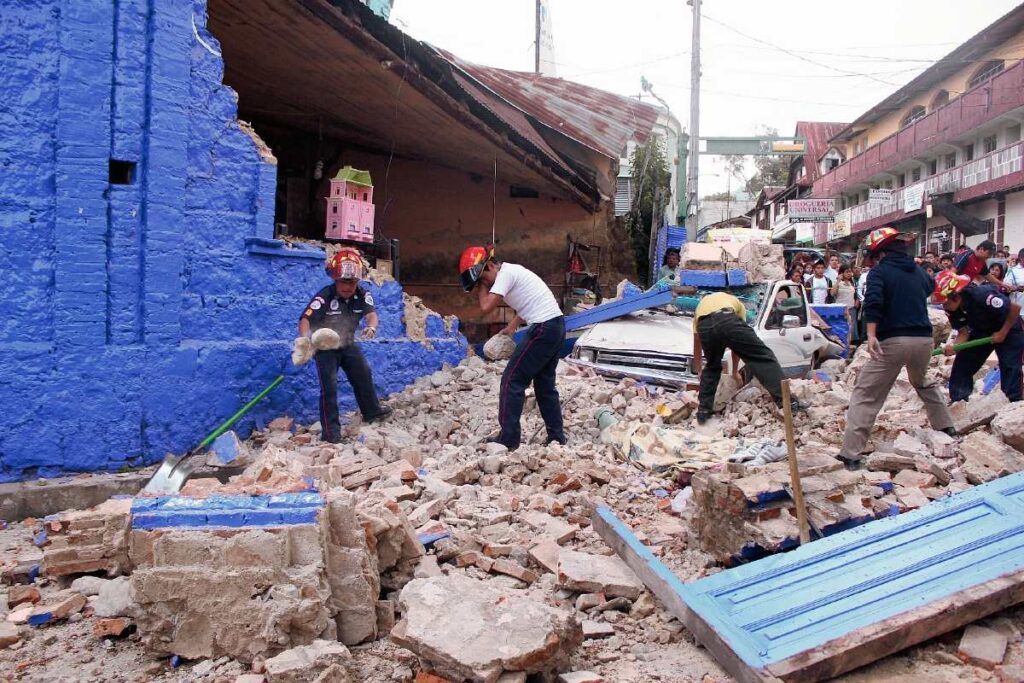
The reconstruction of the Colombian city of Cali after last week’s 7.4 magnitude earthquake could take about three years, Mayor Alejandro Eder stated. The mayor reported that the emergency is entering a new phase focused on assisting those affected and restoring urban infrastructure, following the initial search and rescue efforts.
“We are experiencing (…) an emergency that will last about three years. We are in the phase of assisting the victims, but then we have to rebuild Cali: a resilient Cali, an inclusive Cali, a Cali with a future, a Cali for young people. Cali will emerge stronger, we will move forward,” Eder told the press agency.
RELATED:
Cali City Extends Search-And-Rescue Operations After Deadly Earthquake
Regarding the death toll, the earthquake has left at least 304 people dead in the country, 139 of them in Cali, the capital of the Valle del Cauca department and one of the cities hardest hit by the quake, according to data from the Institute of Legal Medicine (IML). For his part, Colombian President Abelardo de la Espriella lowered the death toll to 289 in a nighttime address to the nation.
The mayor detailed the transition of the emergency response efforts. “At first, there was only one mission: to save lives,” Eder stated, explaining that in the areas where buildings collapsed, authorities shifted, after the first week, from search and rescue operations to the recovery of bodies.
Institutional attention is now focused on the thousands of people affected by the earthquake. “It has clearly been a very difficult week, requiring a great deal of assistance and close attention to the population. At this moment, my only concern is that the people of Cali are safe,” the mayor declared. To achieve this goal, more than thirty city departments have been mobilized to address the emergency, and the Infrastructure Secretariat has removed 25,032 tons of debris so far.
#FromTheSouth News Bits | Colombia: In the area known as Altos de Santa Elena, the streets have become shelters for thousands of residents, who sleep outdoors, exposed to the elements. #WeStandWithColombia pic.twitter.com/Fz9LKhhK3P
— teleSUR English (@telesurenglish) August 18, 2026
One of the main operational challenges after the earthquake was restoring public services, especially electricity. The quake left 350,000 users without power, equivalent to more than 50% of the city, and knocked 44 electrical circuits offline. Roger Mina, manager of Cali’s Municipal Enterprises (Emcali), reported that the response of the technical teams allowed them to restore power to 99% of Cali’s users in less than two days.
Connectivity also proved to be a key tool during the emergency. “At Emcali, we installed twelve mobile satellite internet access points in different parts of Cali to facilitate communication for rescue workers and affected families. When Cali needs us, we’re there,” Mina stated. The restoration of these services allowed progress in assisting communities while debris removal and structural assessments continued.
Regarding cooperation, the mayor highlighted the international and national aid received during the emergency. “Cali has received aid and support from El Salvador, Peru, Mexico, and the United States through their governments; also from Bogotá, other cities, but above all from the people of Cali, who have been very generous,” Eder stated. The Mayor’s Office has set up coordination centers to organize the reception of food, humanitarian aid, and other items destined for the affected families.
Finally, Eder acknowledged the emotional impact of the tragedy on those leading the response. “One cannot lose sight of the main objective, which is to save lives. There is nothing more important for a leader than safeguarding life. However, there are obviously moments when one breaks down,” he admitted. For the mayor, the emergency is just beginning, and the challenge will be to rebuild a city that not only recovers what has been lost but also uses the process to transform itself.
From teleSUR English via This RSS Feed.