

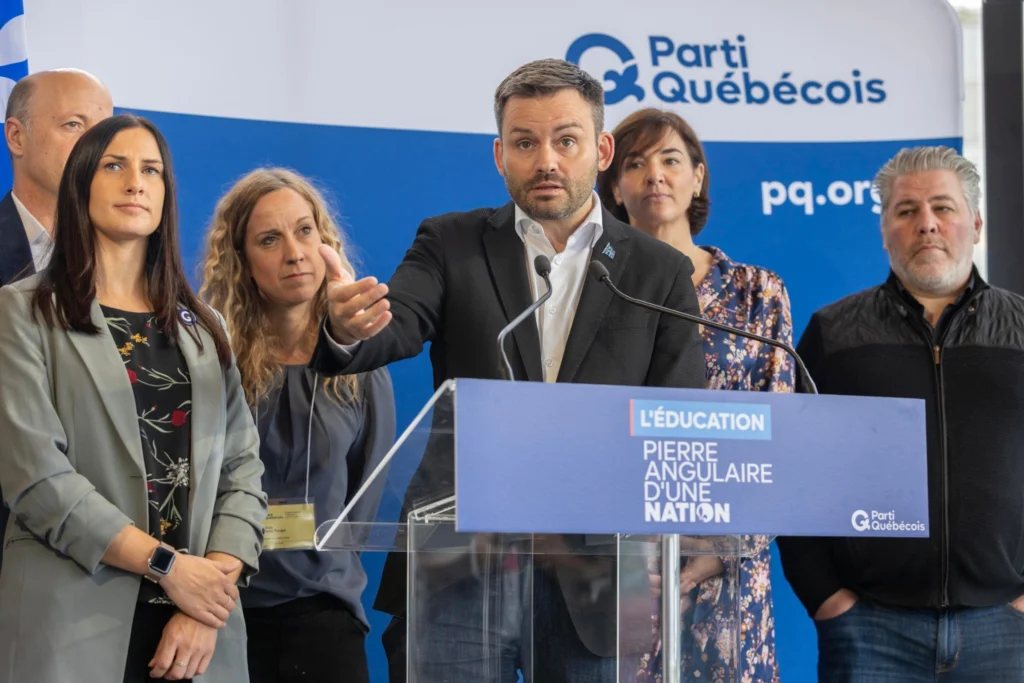
Parti Québécois Rules Out Independence Referendum While Donald Trump is U.S. President
On Tuesday, the leader of the pro-independence Parti Québécois (PQ), Paul St-Pierre Plamondon, announced that his party will not hold a referendum on Quebec’s separation from Canada while Donald Trump remains in the White House.
The decision rules out any sovereignty referendum before January 20, 2029, the date on which the US president’s second term ends, even though the PQ maintains its intention to pursue independence if it wins the provincial elections on October 5.
RELATED:
Canada Considers Full Range of Retaliation if Trump’s Tariffs Take Effect
The political leader emphasized that such a crucial issue for the province’s future requires optimal conditions to guarantee an informed and calm debate. In this regard, he warned that the unpredictability of the U.S. administration will harm our process, as well as the quality of the debate about our future as a nation.
The announcement comes in the final stretch of the provincial elections. Although the PQ has led in the polls for months, public support for Quebec independence remains stable at around 30 percent. A recent survey shows that support for sovereignty reaches 31 percent, compared to 69 percent of the population who would vote against separation.
The regional political climate is also marked by disinformation campaigns. Reports from Canadian researchers reveal that groups associated with Russia and the MAGA movement are amplifying separatism in the province of Alberta. Brian McQuinn, co-director of the Centre for Artificial Intelligence, Data and Conflict at the University of Regina, confirmed the involvement of MAGA influencers in the monetization and disinformation of separatism in Alberta, a factor that adds complexity to the Canadian political landscape.
Alberta’s Oct 19 vote is just the first step for secession!
Chances it succeeds? Decent shot at winning the non-binding question if turnout is high and anger at Ottawa peaks.
Recent polls sit around 33% for starting the process vs 61% stay.
Separatist energy is real in…
— Mario Nawfal (@MarioNawfal) August 17, 2026
Alongside its electoral strategy, the PQ has produced a “Blue Book” detailing the structure of an independent Quebec. This document addresses fundamental aspects of the sovereignty transition, including concrete proposals on the national currency, border demarcation, and the organization of the Armed Forces.
The shadow of the 1995 Quebec referendum still looms large over Canadian politics. That vote was a historically close event, with only 0.6 percent separating the separatists from the federalists—a margin that highlighted the deep identity divide.
The context of the 1980s, marked by failed constitutional reforms and discontent among the French-speaking population, fueled a polarizing campaign. The Parti Québécois used emotional messages about cultural pride, while the federalists, led by Jean Chrétien, focused their narrative on the economic dangers of separation.
Furthermore, the media played a decisive role. According to Professor Marco Bélanger, media coverage influenced public perception more than any political discourse, creating an environment where misinformation could flourish. The repercussions of that event remain relevant, keeping the debate about autonomy, culture, and language at the center of the political agenda.
The 1995 referendum represented a turning point for Quebec and Canada, demonstrating that the idea of a sovereign Quebec has never disappeared, and each election reopens those old wounds in a society that continues to evolve.
Ecuador and Canada signed a Free Trade Agreement (FTA) on Friday in Ottawa, expanding market access by eliminating tariffs on 99.6% of Ecuador’s exportable goods and establishing new mechanisms for the exchange of goods and inputs.
The agreement was signed by Ecuador’s Minister… pic.twitter.com/szoMZZPJMC
— teleSUR English (@telesurenglish) July 24, 2026
From teleSUR English via This RSS Feed.