

What happens to the communities beyond the last point a land vehicle can reach?
By Viviana Vargas Ávila – Aug 17, 2026
On Monday, August 10, 2026, Colombia faced one of the strongest earthquakes in its recent history. The magnitude 7.4 tremor, with its epicenter in San José del Palmar, Chocó, caused damage across a wide swath of national territory. Five days later, the country is still taking stock of an emergency whose true magnitude can hardly be reduced to a national tally—especially when a significant portion of the affected communities are in rural, dispersed areas with enormous connectivity challenges.
As of 6:30 a.m. on August 15, the National Unit for Disaster Risk Management recorded 294 deaths, 3,935 injuries, and 320 missing persons. In total, 54,008 families—equivalent to 115,461 people—have been affected across 448 municipalities in 15 departments. The same report counted 14,493 homes destroyed and another 81,506 damaged, along with damage to 241 health centers, 2,612 educational centers, 298 roads, 59 aqueducts, 44 vehicular bridges, five pedestrian bridges, and five airports.
These figures allow the scale of the tragedy to be gauged but not necessarily understood. Statistics can say how many homes were destroyed, but they cannot explain what it means for a family to lose the only house they had. A report can count how many people were affected, but it does not show the difference between a family living a few kilometers from an urban center and one that is upriver, in a community where transport depends on a boat, fuel represents a cost that often cannot be met, and communication may be intermittent or nonexistent.
This territorial difference is especially important in the case of Chocó. The emergency does not unfold in the same way in Quibdó as in the rural communities of the Medio San Juan region, nor are the possibilities of receiving assistance equal. The very information gathered in these days makes clear that Chocó and Buenaventura face particularly severe challenges related to the lack of drinking water, power, health services, adequate shelters, and humanitarian aid, as well as impacts on ethnic communities.
The questions, then, are how far that aid is actually reaching, and what is happening to the communities beyond the last point a land vehicle can reach. In territories crossed by rivers, jungle, and vast distances, aid delivered to a municipal seat does not necessarily mean it has reached the displaced family. Between a collection center and a rural community, there may be hours of river travel, fuel costs, adverse weather, absence of infrastructure, and in certain areas, difficulties associated with public order and the presence of armed groups.
It was precisely this reality that Diario Red Latinoamérica was able to witness during our journey to Boca de Suruco, in the La Encharca area—a rural, riverside Afro-Colombian community located in the department of Chocó, in the area of influence of the municipality of Medio San Juan. There, the emergency takes on a dimension completely different from what can be observed in the main urban centers.
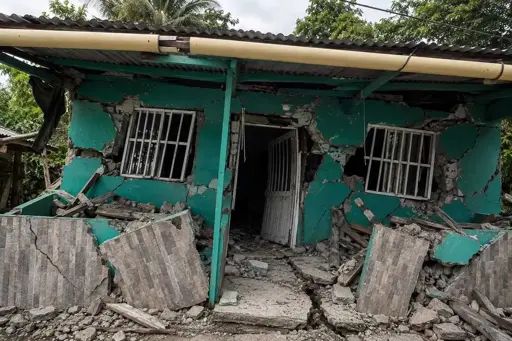
In Boca de Suruco, we found homes completely destroyed and others still at risk of collapse. We found families facing the consequences of an earthquake that struck already vulnerable structures and that struck a territory where the difficulties of accessing basic services and connectivity did not begin with the emergency. But we also found something essential to understanding the human dimension of this tragedy: a community that, once again, is trying to resolve by its own means what it needs to survive.
During our visit, we were able to speak directly with community members. One phrase summed up what is happening there with striking force: “Government aid never reaches here—we always have to resist on our own.” These words should not be understood only as a critique of the days following the earthquake. For those who say them, it is a description of an experience accumulated over years. The seismic event is layered over other emergencies that already existed: poverty, lack of infrastructure, mobility difficulties, limitations in public services, and a state presence that communities consider wholly insufficient to meet their needs.
It is precisely at this point that the natural tragedy begins to become a political and social discussion as well. An earthquake cannot be prevented—but many of the conditions that determine who recovers faster and who is left behind for days are indeed related to institutional decisions, public investment, infrastructure, connectivity, and effective state presence.
In this way, the rural world once again finds itself last in the national consideration. And while that happens, a response has emerged that is asking no questions about ideologies, political parties or electoral positions—because citizens from across the country have organized to collect food, medicines, hygiene items, and other supplies and to find ways to get them to affected communities. People who may never have met are sharing resources, vehicles, time, and labor. Social organizations, volunteers, and communities have become part of a solidarity chain attempting to fill the gaps left by the difficulty of reaching the territories.
This is where “only the people save the people” ceases to be a political slogan and becomes an observable reality. The citizen who donates a few pesos, who hands over a box of food, who gets medicines, who lends a boat, or who decides to travel to an affected community is participating in a response that in many cases is born from below and built among those who understand that an emergency cannot wait for political differences to be resolved.
What is particularly significant is that this solidarity has crossed ideological lines. People who think differently have understood that in the face of a family that has lost its home, it does not matter who they voted for, which party they support, or what their position on the government is. The first question is: what do they need? That should also be the first question of any humanitarian response—not what can be showcased, not what can be announced, but what the community actually needs.
In this context, Diario Red Latinoamérica decided to be part of that response and to carry humanitarian aid directly into the territory. This is not about presenting a journalistic action as a substitute for institutional responsibility but about showing a reality that often cannot be seen from the capitals—because there are communities to which help simply takes far too long to arrive.
The journey to Boca de Suruco confirmed that the logistical challenge is enormous. The territory cannot be analyzed through an exclusively urban lens. Aid must travel by river, navigate distances and absorb costs that multiply when the goal is reaching remote communities. In some areas, security conditions also mean that certain movements must be undertaken with special care. This means that the humanitarian response requires territorial planning, knowledge of local dynamics, and direct coordination with communities.
One of the greatest difficulties in this type of emergency is that collection centers may fill up while some communities continue to wait. The existence of food, medicines, or essential supplies does not automatically mean they have reached those who need them. In rural and riverside territories, the last humanitarian mile may be the most difficult and costly.
It is therefore insufficient to evaluate the response solely based on the tonnage of aid collected, the announcements made, or the institutional visits carried out. The true measure of a humanitarian response lies in the most remote community, in the family that has still not received food, in the house that continues on the verge of collapse, and in the person still waiting for medical attention.
This is one of the main concerns expressed by residents of the territories visited. According to testimonies gathered directly by Diario Red Latinoamérica, there is a perception of delay in the arrival of the institutional response and criticism of visits that, from their perspective, do not always translate into concrete solutions. Some people summed up this perception with the phrase: “They come, take the photo, and leave.”
The fact that an affected community expresses this perception deserves to be heard—because in an emergency, trust is also a form of assistance. When people feel that institutions come, listen, and return with solutions, the relationship between citizens and the state is strengthened. But when they feel their territory is visited only to register an image, the institutional distance deepens.
The national government under Abelardo de la Espriella faces, in this regard, one of its first major tests of territorial capacity. The magnitude of the emergency demands far more than a response concentrated on the most visible cities. It demands reaching the territories where the state has historically had the greatest difficulty guaranteeing rights and where a natural disaster can multiply vulnerabilities that already existed.
This reality also demands a rethinking of the concept of reconstruction. Rebuilding cannot mean simply raising again a house that fell. If a community continues without adequate roads, without connectivity, with difficulties accessing health care, with transportation problems, and without sufficient conditions to respond to an emergency, rebuilding the same infrastructure without transforming the conditions that produce vulnerability means preparing the ground for another tragedy.
Reconstruction must incorporate a territorial and differential perspective. It must recognize that Afro-Colombian and indigenous communities are not simply recipients of humanitarian assistance, they are collective subjects of special protection, with organizational capacity, knowledge of their territories, and the right to participate in the decisions that will determine how their communities are rebuilt.
The earthquake has once again revealed a historic feature of Colombia: the distance between the country that appears in national reports and the country that exists in rural communities. In the first, homes, families, municipalities, and departments are counted. In the second live the people who must decide how they will sleep tonight, how they will get food tomorrow, and how they will prevent a partially destroyed house from collapsing onto their families.
The first hundred hours after a disaster are decisive—but for rural communities, the emergency does not end when that period passes. Then come the days of uncertainty, the loss of income, the rebuilding of homes, the recovery of crops, access to physical and mental health care, schooling for children, and the need to recover the minimum conditions of dignity.
Colombia now has the opportunity to demonstrate that reconstruction will be different, that rural territories will not again find themselves at the back of the attention chain, that Afro-Colombian and indigenous communities will be heard, that resources will reach where they need to reach, that reconstruction will be transparent and participatory, and that the institutional response will not end when the cameras leave.
Because when the emergency disappears from the headlines, the families will still be there. Those who lost their homes will still be there. Those who need food will still be there. Those who must rebuild their schools will still be there. The communities that must navigate for hours to reach an urban center will still be there. And Chocó and Buenaventura will still be there—with their rivers, their communities, their memory, and their historic capacity for resistance.
While the people can save the people in the hardest hours, it is now up to the state to show that it is also willing to reach them—because only the people save the people, but the people should not have to save themselves alone.
Venezuela: Humanitarian Aid and Rescue Teams to Assist Colombia Following Earthquake
Featured image: House destroyed by the earthquake in Boca de Suruco, La Encharca. Photo: Diario Red.
(Diario Red) by Viviana Vargas Ávila
Translation: Orinoco Tribune
OT/CB/SL
From Orinoco Tribune via This RSS Feed.