


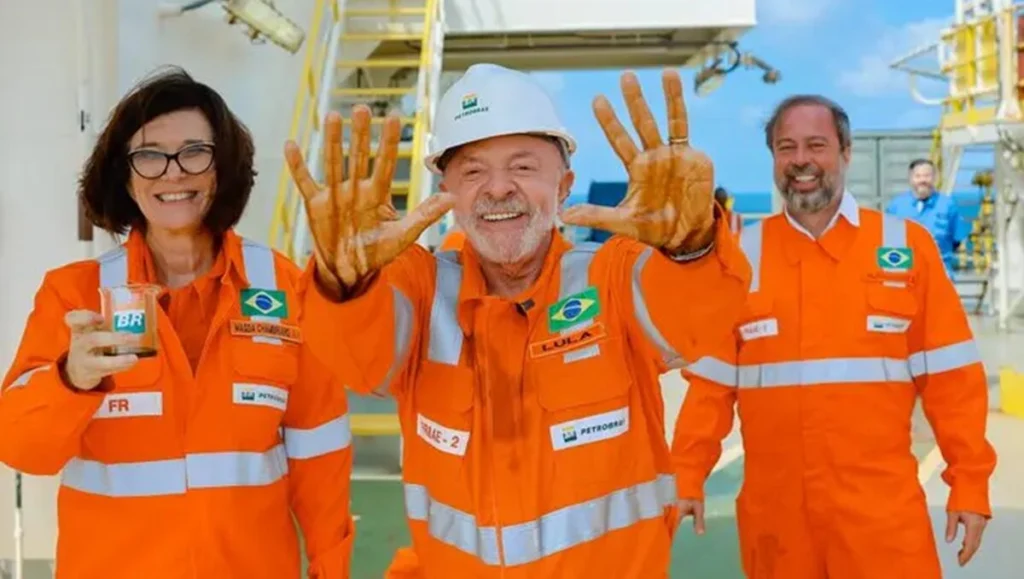
The offshore region could provide Brazilians with years of oil revenue.
On Monday, Brazilian President Lula da Silva defended his country’s right to explore for oil in the “Equatorial Margin,” a strategic offshore region stretching 2,200 kilometers along Brazil’s northern coast from Amapa to Rio Grande do Norte.
RELATED:
Lula Promises A Fourth Term Based on Security and Social Programs
During a visit to the drilling vessel, which is located about 500 kilometers from the mouth of the Amazon River, he said state-owned oil company Petrobras will ensure that the oil project maintains high technological standards and safety protocols.
“A strong Petrobras means a sovereign Brazil. The discovery of high-quality oil in the Equatorial Margin opens new prospects for Brazil’s future and reinforces the country’s energy potential,” he said.
“This is a strong Petrobras: scientific knowledge, technology and innovation at the service of national development and sovereignty,” Lula stressed.
Three days earlier, Petrobras announced the discovery of hydrocarbons in drilling it is conducting about 175 kilometers off the coast of Amapa state. The region could contain huge reserves that could guarantee Brazil many years of oil revenue.
“I’m going to take this home because this could be the passport to the country’s future,” Lula said while holding a tube containing an oil sample.
“When I say this, I do not mean that I am ruling out that we will continue fighting to reach a day when we will not need fossil fuels,” the progressive leader said.
A presença de petróleo na Margem Equatorial, na costa do Amapá, abre uma nova perspectiva para o futuro do país.
É um potencial que sempre defendemos e que pode ajudar a financiar desenvolvimento, infraestrutura e uma bioeconomia amazônica cada vez mais forte. pic.twitter.com/yBCCNp3ZA2
— Waldez Góes (@waldezoficial) August 17, 2026
Brazilian Regional Development Minister Waldez Goes’s text reads, “The presence of oil on the Equatorial Margin, off the coast of Amapá, opens a new perspective for the country’s future. It is a potential that we have always defended and that can help finance development, infrastructure, and an increasingly strong Amazonian bioeconomy.”
Nevertheless, environmental defenders have criticized the new oil drilling, arguing that extracting oil in a region of high biodiversity but great vulnerability carries major risks. They have also said that exploiting the Equatorial Margin contradicts Brazilian policies on decarbonization and the energy transition.
Lula acknowledged that when Brazil was preparing to host the COP30 climate conference in 2025, some advised him not to publicly announce that environmental authorities had granted Petrobras a license to drill in the Equatorial Margin, so as not to sabotage a global meeting intended to discuss the energy transition.
“But I decided that we had to announce it because what is at stake are Brazil’s interests,” he said, pointing out that exploiting the region does not mean Brazil will cease to be a major power in the production of biofuels and renewable energy.
“Here we are standing firm and strong because this will be wealth for the Brazilian population, but I am also not saying that we are not going to take care of the environment,” Lula stressed.
Currently, it is still unknown how long Petrobras will take to complete the studies and determine whether exploiting the region’s reserves is commercially viable. However, indications so far are promising.
“We have already drilled through 3,000 meters of rock in a region where the sea is 3,000 meters deep, and we have another 1,000 meters to go to determine whether what we discovered is quality oil and whether its exploitation is viable,” Lula concluded.
teleSUR/ JF
Source: EFE
From teleSUR English via This RSS Feed.