

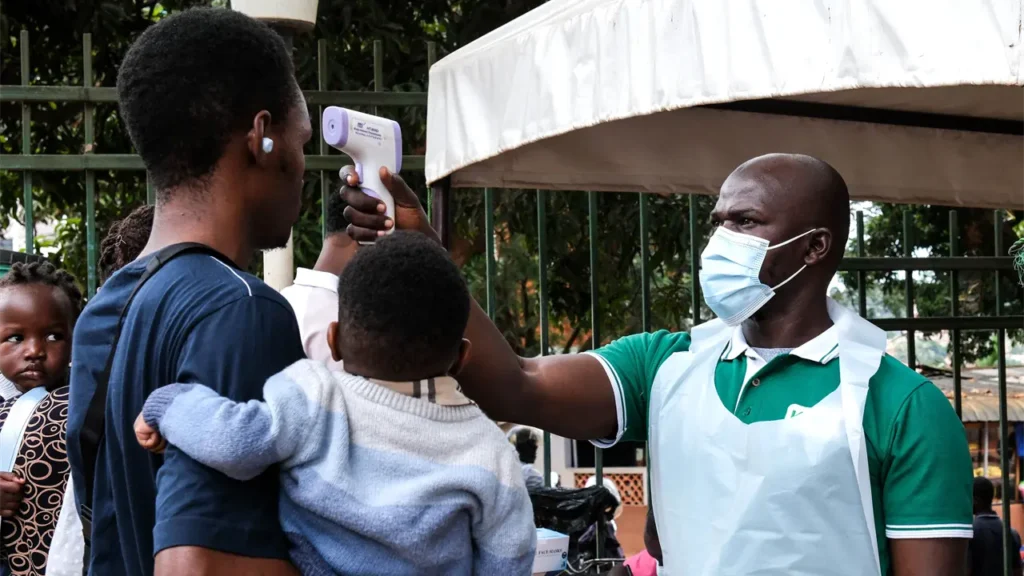
On Tuesday, The World Health Organization’s (WHO) Emergency Committee is meeting to analyze the Ebola epidemic in the Democratic Republic of Congo (DRC). The meeting comes days after the multilateral agency warned of the risk that the health crisis could become the worst in history, driven by logistical, community, and regional security factors.
RELATED:
DR Congo Ebola Outbreak Becomes Second Deadliest Ever
Since May 17, when WHO Director-General Tedros Adhanom Ghebreyesus declared an international emergency due to the outbreak, the committee’s experts have been mandated to meet every three months. Their main objective is to estimate risk levels, evaluate the current health response, and issue potential new recommendations. For now, the WHO considers the risk of the virus spreading to be very high in the DRC, where cases have been reported in six provinces. The risk is high in Uganda and neighboring countries, and low globally.
Official figures reflect a critical situation. According to the Congolese Public Health Institute, the current outbreak has confirmed 4,945 cases and 2,325 deaths. The latest government data, published on Sunday, shows that the total number of deaths has surpassed the 2,299 victims of the 2018-2020 outbreak, which until now was the worst recorded in the country.
This is the seventeenth outbreak in the nation and the second largest worldwide. It is only surpassed by the West African epidemic (2014-2016), which recorded 28,616 infections and 11,310 deaths in Guinea, Liberia, and Sierra Leone.
Stand with the Democratic Republic of Congo.
We call for global solidarity as eastern DRC faces its deadliest Ebola outbreak in the country’s history. The number of cases has exceeded 4,900 and the current death toll of over 2,300 people continues to rise. Human rights must… pic.twitter.com/DjQxHwyhRM— Amnesty International (@amnesty) August 17, 2026
A critical epidemiological statistic reveals that the current outbreak is killing three times faster than the historical West African outbreak. While that outbreak took almost five months from its declaration to reach 1,000 deaths, the Congolese outbreak has surpassed 2,000 deaths in less than three months. The outbreak has gained momentum since it was declared on May 15, as precarious health infrastructure, community resistance, and instability hamper efforts to identify and respond to cases.
“The transport of patients and bodies, as well as other factors related to the insecurity, are the main elements explaining the rapid spread of the outbreak to different locations,” said Thierno Baldé, WHO’s outbreak manager.
From Bunia, the epicenter of the crisis, he told the press accredited to the UN in Geneva via videoconference that the situation is quite difficult, but people are working day and night to try to control the epidemic and keep pace with its rate of spread.
The epidemic corresponds to the Bundibugyo strain, whose case fatality rate ranges between 30% and 50%. There is no authorized vaccine or specific treatment for this variant, although the WHO and other institutions are investigating potential drug candidates, whose testing is limited to animal studies.
The proportion of deaths after a confirmed infection increased from around 20% at the beginning of June to the current 46%, meaning that almost one in two confirmed cases is now fatal.
Thomas Parisch, a public health specialist with Doctors Without Borders, clarified that this trend does not indicate that the virus has become more lethal. On the contrary, it points to persistent shortcomings in surveillance, case detection, and access to healthcare. Normally, as an outbreak progresses, the case fatality rate should decrease. Instead, we continue to see many cases detected very late, when the chances of successful treatment are lower, and many are only identified after they have died in the community, he said.
Before the start of the meeting, WHO spokesman Christian Lindmeier thanked the numerous partners supporting the response, with contributions totaling $69.3 million, more than half of the $115 million needed. He cited governments such as Australia, Germany, the United Kingdom, the European Commission, the African Development Bank, and the Gates and Novo Nordisk Foundations.
The outbreak previously spread to Uganda, but authorities managed to contain it to 20 cases and 2 deaths before declaring it over last month. Ebola is transmitted through direct contact with the bodily fluids of infected people, living or deceased, and can cause fever, vomiting, diarrhea, and, in severe cases, internal and external bleeding.
From teleSUR English via This RSS Feed.