


Sir Keir Starmer has left office almost without noise – and, astonishingly, only now.
He remained Prime Minister despite misleading Parliament and the British public about his knowledge of Peter Mandelson’s ties to convicted sex trafficker Jeffrey Epstein. He remained despite integrating Peter Thiel’s Palantir mass-surveillance and war apparatus into the heart of Britain’s public services. He remained despite bringing Britain to the brink of a nuclear crisis with Russia. And he remained despite his government’s direct participation in the genocide in Gaza.
But Starmer’s most consequential legacy is one that outlives any daily news cycle. His premiership inaugurated a paradigm shift that deserves to be recorded as a watershed in the erosion of fundamental rights and democracy in Britain.
The British Implementation of Washington’s New War on Terror
After Starmer took office as Prime Minister on 5 July 2024, Britain witnessed an unprecedented intensification of the use of terrorism legislation against journalists, activists and civil society, progressively consolidating a new domestic function for Britain’s counter-terrorism apparatus – in large part, to aid and abet the genocide in Palestine.
Starmer put into practice the doctrine that Trump would formalise into a new “War on Terror”. In the 2026 National Counterterrorism Strategy, published in May 2026, Trump expressly placed “violent left-wing extremists, including anarchists and anti-fascists” in the terrorist category alongside Islamist terrorists and transnational criminal organisations. Britain arrived at the same place without any equivalent declaration, relocating the war against jihadism to the heart of the post-October 7th ideological dispute within civil society.
The role of Europe is explicit in Trump’s 2026 National Counterterrorism Strategy. It states that the United States is “coordinating CT [counter-terrorism] operations, sharing actionable intelligence, and providing expertise” with allies that share its assessment of the threat posed by cartels, jihadists and violent left-wing extremists. Elsewhere, it declares that:
Europe must significantly increase its CT efforts immediately.
Abandoning the distinction between ‘terror’ and dissent
Washington and its allies have increasingly abandoned the traditional distinction between organised crime, terrorism and political dissent. Across Europe, this new War on Terror has been implemented domestically through the securitisation and criminalisation of pro-Palestine activism and the so-called radical left.
This trajectory certainly did not begin with Starmer. Conservative governments – with figures such as Amber Rudd, Sajid Javid, Suella Braverman and Priti Patel – played instrumental roles in enacting new national security legislation and policies. Starmer, however, transformed the constitutional function of Britain’s counter-terrorism framework by embedding Washington’s new War on Terror in the institutions of the British state.
This is not a matter of interpretation; the official statistics published by his own government provide the clearest evidence of an unprecedented explosion in the criminalisation of political dissent under terrorism legislation.
Spikes under new leadership
Official Home Office statistics show that the escalation began immediately after Keir Starmer took office in July 2024. The July–September 2024 quarter recorded the highest number of arrests under Section 41 of the Terrorism Act 2000 (TACT) in the preceding nine quarters, accounting for half of the year’s total. Section 41 arrests rose by 166.7% during the previous quarter, by 128.6% during the same quarter in 2023, and by 1,500% during the lowest quarterly figure (October–December 2023).
Section 41 arrests trigger one of the most intrusive investigative regimes available under British law. The provision permits arrest without a warrant, extended pre-charge detention, and severe restrictions on procedural safeguards. In practice, it is frequently combined with other terrorism powers capable of further limiting the right to silence and the protection against self-incrimination, substantially expanding the coercive powers available to investigators before any criminal charge is brought.

The escalation was not confined to Section 41. Home Office statistics also recorded a 519% increase in arrests for terrorism-related offences outside the Section 41 regime compared with the previous year. Although these arrests are made under a wider range of statutory powers, many do not ultimately result in prosecution.
This raises questions as to whether terrorism legislation and related investigative powers are increasingly being deployed despite insufficient evidence to sustain criminal charges. Those arrested nevertheless remain subject to extensive investigative powers, prolonged restrictions and significant reputational harm. As several legal scholars have argued, such patterns may indicate the use of criminal proceedings as instruments of legal harassment and political persecution.

Institutional shift
The statistical trend aligns with an equally significant institutional shift. In November 2023, days after taking office, the Director of Public Prosecutions, Stephen Parkinson, issued a Crown Prosecution Service (CPS) statement declaring that he had:
no doubt that there is a strong public interest in taking forward prosecutions arising from any unrest if the evidence is there.
Although many protesters were initially arrested under ordinary public order legislation, a growing number of cases were subsequently escalated into terrorism investigations.
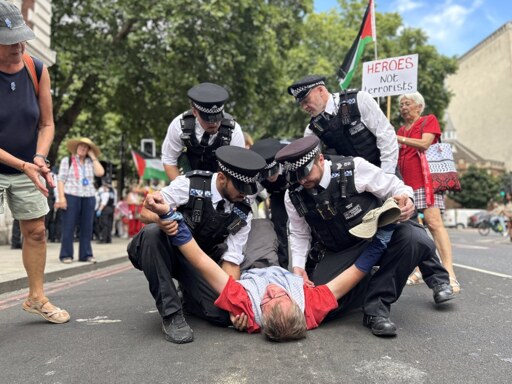
The process accelerated dramatically after Palestine Action, a direct-action protest group, was proscribed as a terrorist organisation in July 2025. Terrorism legislation was then deployed against civil society on a scale without precedent.
After remaining relatively stable between 2019 and 2023, charges for offences relating to Section 12 of the Terrorism Act 2000, which criminalises expressions of support for proscribed organisations, rose sharply in 2024, from five to seventeen. Then, on a single day – 6 September 2025 – 890 people were arrested in Parliament Square while protesting against the proscription, 857 of them under the Terrorism Act for allegedly expressing support for a banned organisation.
Behind these figures lies a consistent pattern: the growing use of counter-terrorism legislation against journalists, human rights defenders and pro-Palestine activists.
Official statistics for the year ending March 2026 recorded 3,061 terrorism-related arrests – an increase of 1,186% compared with the previous year. Of these, 2,819 (92%) were linked to alleged support for Palestine Action following its proscription. By the time the statistics were published, 551 individuals had been charged, including 484 in Palestine Action-related cases, while the overwhelming majority remained awaiting trial.
Legal harassment of civil society
The legal harassment of civil society culminated in Starmer’s government’s efforts to sustain Palestine Action’s proscription through the courts and to extend the attribution of a “terrorism connection” to offences that would otherwise have been prosecuted under ordinary criminal law.
On 17 August 2025, only weeks after proscribing the organisation under the Terrorism Act, the then Home Secretary, Yvette Cooper, published an article in the Observer defending the ban, while criminal proceedings against the Palestine Action activists Charlotte Head, Samuel Corner, Leona Kamio and Fatema Rajwani were under way.
She described the organisation as responsible for an escalation of “intimidation, violence, weapons, and serious injuries to individuals”, and referred to the “terrorism connection” the CPS had attributed to the charges.
Cooper used her ministerial office to intervene publicly while proceedings were under way in a case that would set an important legal precedent. Defence lawyers have called the case an:
egregious example of contemptuous reporting which directly interferes with the court process.
The trial judge later found that she had been:
specifically advised that going ahead with the article might prejudice these proceedings [but] went ahead anyway.
Independent Journalism as a Terrorist Threat
The same pattern emerged in the use of Schedule 7 border powers. Schedule 7 examinations had been in long-term decline for a decade, but that decline was interrupted the moment Starmer took office. In the July–September 2024 quarter, examinations rose by 20.03% and detentions by 13.58% – the sharpest quarterly increase in the period analysed – and the annual totals have been climbing again since the end of 2025.

Journalists interviewed for this investigation described remarkably similar experiences.
Kit Klarenberg, stopped at Luton airport under Schedule 3 of the Counter-Terrorism and Border Security Act 2019, said the examination made clear that the objective was not to investigate terrorism but his journalistic work and professional contacts. He was told he remained under investigation, and police retained his material for more than a year.
Sarah Wilkinson, whose Shropshire home was raided by counter-terrorism officers in August 2024, described being questioned under terrorism legislation over what police referred to as “a year’s worth of tweets”. She also expressed concern that the seizure of her electronic devices had exposed contacts in Gaza and the West Bank:
My sources of video and information are in Gaza and the West Bank. They have now been identified by British counter-terrorism police. I fear their lives are at risk.
Wilkinson has since been charged with seven offences under the Terrorism Act and the Regulation of Investigatory Powers Act. She has pleaded not guilty to all of them and remains on conditional bail; her trial is listed for January 2027 at Birmingham Crown Court.
The same concern was echoed by Asa Winstanley, associate editor of Electronic Intifada, whose home was raided in October 2024 under Operation Incessantness on allegations of encouraging terrorism and disseminating terrorist publications. In an interview for this investigation, Winstanley said police seized devices containing legally privileged journalistic material and confidential source information, despite his repeated objections:
They took all my devices they suspected contained my documents – things that would identify and potentially endanger sources, including sources in Palestine.
Winstanley has never been arrested or charged.

“Dear Phil, … Watch the Racist Thugs”
On 18 January 2025, tens of thousands of people marched peacefully through central London carrying banners reading “Stop Arming Israel” and “Free Palestine”. The Metropolitan Police arrested at least 77 of them. Among them were former Labour leader Jeremy Corbyn and former Shadow Chancellor John McDonnell, both later interviewed under caution.
For the first time, criminal proceedings were brought against prominent organisers of the Palestine solidarity movement, including the Palestine Solidarity Campaign director, Ben Jamal, the Stop the War Coalition vice-chair, Chris Nineham, and Piers Corbyn, on allegations of breaching protest conditions and, in some cases, encouraging others to do so. Jamal and Nineham were convicted in April 2026 and are appealing. According to the organisers, the Metropolitan Police had refused meaningful engagement with pro-Palestine and Muslim organisations before the demonstration.
The following day, however, Metropolitan Police Commissioner Sir Mark Rowley addressed the plenary session of the Board of Deputies of British Jews, assuring delegates that the police had imposed protest conditions “more than we ever have done before” and had, for the first time, adopted “sharper and stronger conditions” against organisers.

The Board’s access to senior British institutions extended well beyond this meeting. In the editorial of its 2024 Annual Review, its president, Phil Rosenberg, stated that the organisation had maintained:
robust engagement with the BBC and Metropolitan Police Commissioner.
Public posts on Rosenberg’s own social media further document repeated meetings with the highest levels of government.
Between September 2024 and January 2025 alone, Rosenberg met Prime Minister Keir Starmer at least seven times, in addition to meetings with Foreign Secretary David Lammy and senior policing figures. He publicly praised the government’s efforts to:
reclaim our streets, campuses and community buildings from racist thugs.
“Dear Phil,” wrote the Prime Minister in a publicly released letter, crossing out the formal “Mr Rosenberg” in favour of a handwritten first name – a familiarity that sat comfortably beyond ordinary official protocol.

On Whose Behalf?
The expansion of Britain’s counter-terrorism powers against pro-Palestine activism has also raised broader questions about the role of Israeli-linked organisations in shaping British policing priorities and counter-terrorism policy.
Although much of this cooperation takes place outside public scrutiny, sufficient evidence exists to demonstrate a sustained institutional dialogue between British policing bodies and Israel’s national security establishment.
Our investigation found that, in 2023, the Home Office, represented by Graham Ellis, participated as a speaker at the International Institute for Counter-Terrorism (ICT) Annual Summit on international counter-terrorism policing, alongside DAC Laurence Taylor of the Metropolitan Police and Andy Harding, a former National Police Chiefs’ Council strategic manager. The ICT, based in Herzliya, has long been regarded as one of Israel’s principal national security think tanks.
Speaking to this investigation, the Israeli-born academic and former IDF soldier Professor Haim Bresheeth-Zabner, of SOAS University of London, explained that the Metropolitan Police Service (MPS) and Israeli authorities maintain close collaboration, despite official denials. A Freedom of Information request revealed that the MPS acknowledged hosting a “Visit of Colleagues from Israel” in 2022.
According to Bresheeth-Zabner, these off-the-record collaborations include not only operational tactics but also ideological training and cooperation in the identification and arrest of British citizens. These tactics are often coordinated and facilitated by Israeli authorities and organisations such as the Community Security Trust (CST), a UK-based charity that describes itself as protecting the British Jewish community from antisemitism, hate crime and terrorism.
Bresheeth-Zabner was arrested on 1 November 2024 during a peaceful protest near the residence of the then Israeli ambassador, Tzipi Hotovely. Initially detained on allegations of “hate speech” for quoting reports of Israeli military defeats, the investigation was later escalated into an alleged offence under Section 12 of the Terrorism Act.
During his detention, he observed the custody sergeant repeatedly receiving instructions by telephone from unidentified “high-up” authorities on how to proceed with the case. One police officer, upon learning that his parents were Auschwitz survivors, told him she had visited the Holocaust Museum in Israel. He recalled:
I asked whether she had been to Israel as a tourist, and she didn’t answer.
The case against him was later dropped.
David Miller, formerly professor of political sociology at the University of Bristol and himself stopped by counter-terrorism police at Heathrow in February 2025, likewise identified the CST and similar organisations as influential actors lobbying British institutions to conflate Palestine solidarity activism with antisemitism and extremism. In his assessment, these organisations have become significant intermediaries between Israeli interests and British policing, prosecution and public policy.
Intelligence Networks
The policing of Palestine solidarity activism increasingly appears embedded within a broader counter-terrorism intelligence architecture.
SO15, the Metropolitan Police’s Counter Terrorism Command, operates within the United Kingdom’s Counter Terrorism Policing network, working alongside MI5 and the Joint Terrorism Analysis Centre under the CONTEST strategy and routinely sharing intelligence generated through counter-terrorism investigations.
Public reporting further reveals sustained institutional cooperation between British and Israeli security bodies. Between 2013 and 2022, senior Metropolitan Police officers regularly attended conferences organised by the ICT, and in 2022 officers accepted hospitality from the Israeli Embassy in London.
Among the speakers at these conferences was Sir Mark Rowley, then the Met’s Assistant Commissioner for Specialist Operations and now its Commissioner. Leaked Israeli military files revealed exchanges between the British Army’s 77th Brigade and the Israel Defense Forces, while senior British police officers made visits to Israel, disclosed only through Freedom of Information requests, to discuss future counter-terrorism operations.
This is the war Starmer leaves behind. It is not fought on distant battlefields, but within Britain’s own constitutional order, where a state of exception has been extended to journalists, academics, protesters and political movements whose ideas increasingly fall within the expanding reach of the state’s counter-terrorism machinery.
Featured image via Defend Our Juries / Marly Lyman
From Canary via This RSS Feed.