

Bullets:
Silicon Valley startups are flying to China and buying robot parts, putting them into their luggage, and flying back.
Meanwhile, the Trump Administration has enacted import bans on new humanoid robots, to protect the American AI industry, and the nascent supply chains for robots.
Tesla is far along in its development for the Optimus humanoid robot, with deep relationships with Chinese components vendors, who are not under the new restrictions.
The Optimus is unlikely to challenge Chinese robot makers, who have far lower costs and stronger use cases and industrial applications across Asia.
But Tesla may have the humanoid market to itself in North America and Europe, because of its China-focused supply chains and protection from those same firms selling in Western markets.
Inside China / Business is a reader-supported publication. To receive new posts and support my work, consider becoming a free or paid subscriber.
Report:
Good morning.
Another trade war is underway, this time in humanoid robots. Last month the White House banned the import of new models of robots, with the idea of protecting the American Artificial Intelligence industry. Washington also hopes to move the manufacturing of humanoids to the United States, and out of China. They point to the rare earth industry, as an object lesson they don’t want a repeat of.
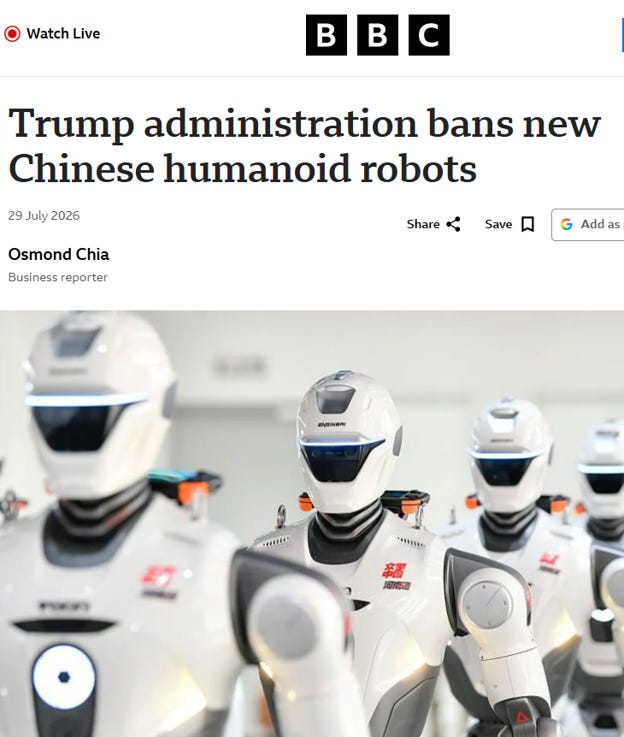
The new policies aren’t just against China—they’re directed at any and all “new foreign-built robotic devices”. Models previously allowed for sale are still permitted, but new models will require new licenses from the FCC. But it’s the Chinese robotics industry that has leapt ahead of everyone else, and Chinese-built machines have been adopted widely, here, while American firms like Tesla and Boston Dynamics are trying to catch up, at least in the US market.
Chinese companies build four times more robots than the rest of the world combined, and four of the top ten manufacturers of humanoids are from China. The ruling instructs the FCC to ban new imports of the machines, based on supply chain and cybersecurity risks. Again, the regulation doesn’t specifically target China, but everyone who understands the industry, and the math, knows what it’s about. China dominates the robotics industry, and companies with new models cannot sell those in the United States.
Naturally, the United States government is exempt from its own laws; Washington can continue buying and using new machines. The ruling applies, then, to state and local governments, and companies. And that makes for a big problem—several major companies are already in partnership with Chinese hardware vendors to build their robots, including Tesla, and Nvidia.
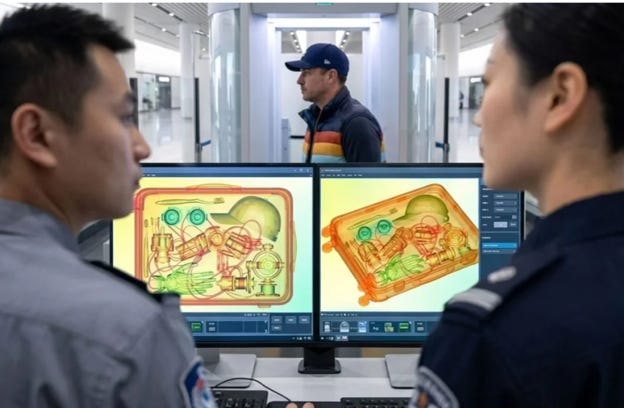
So a new industry has sprung up, for smaller companies and startups. Silicon Valley engineers are flying to China, buying up robot parts, stuffing them in their suitcases, and flying back. That’s not illegal under the new ruling from the Trump Administration: key components like reducers, motors, and sensors are not – yet – covered by the import bans. But these parts are not—yet—being manufactured in the United States, at scale. So “a new breed of middlemen” bundle orders from American buyers, get a factory in China to build them, then fly over and pick them up.
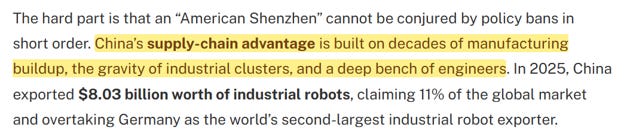
There is Chinese industrial clustering again: an enormous supply chain, with hundreds of thousands of engineers, all within a short distance of each other.
It’s not possible to scale those “suitcase runs” into mass production. And it’s also hard to see how they can move the needle, at all, on China’s dominance of humanoid production and utilization. From January through June, 97% of all the robots shipped came from Chinese labs. That is up 3.7 times over the first half of last year. Factory and other commercial applications were over 70% of the robot shipments, up from 50% a year ago.
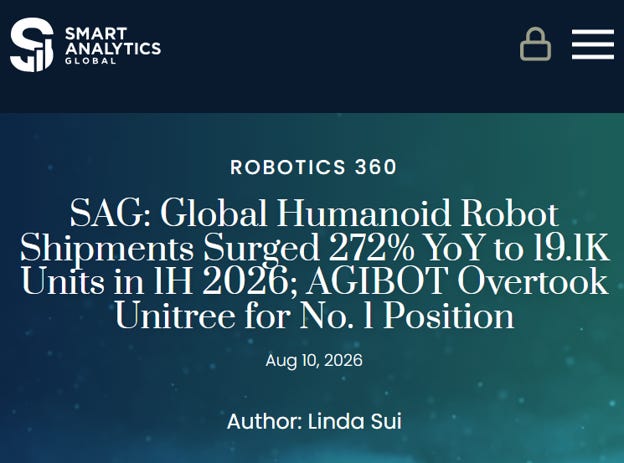
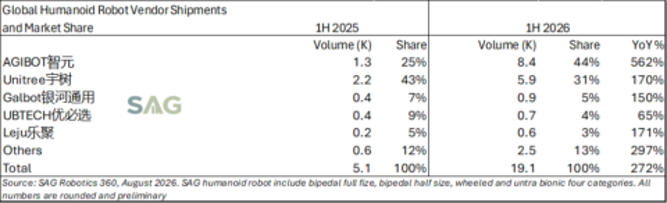
Chinese companies are building, by far, most of the robots, but it is also Chinese companies who are buying most of them. Almost all of the supply and almost all of the demand for humanoid robots come from Chinese companies. Of the hundred key vendors for the industry worldwide, over half are Chinese. That allows the industry here to innovate faster, and drive down costs, which in turn drives new adoption:
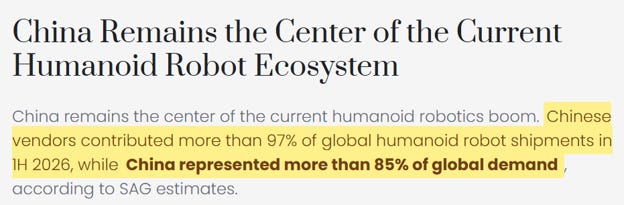
Investment is pouring in, and half of all the VC funding for robots goes to China, or rather remains here. The industry is a high priority for the national government, here.
As the production volumes rise, it’s a virtuous circle with more installations, more use cases, more learning, and falling costs. The only hope for American companies, and for the US government, is that Western AI models can keep up and be the brain for the robots at work in Europe and North America.
That strategy is the only one that makes sense, in the short term at least, given where the industry costs are. Had Washington outright banned the import of Chinese robotics components, American firms would be out of business, along with the guys flying to Guangdong with empty suitcases.
But American firms are still able to source components from China, and Tesla has a huge head start.
Tesla is developing Optimus robots; the parts for the Optimus total $46,000, IF Tesla gets its parts from China. Those charges nearly triple, to $131,000 per, if Tesla decides to source only from non-Chinese suppliers.
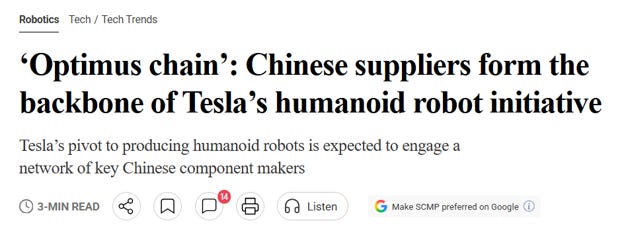
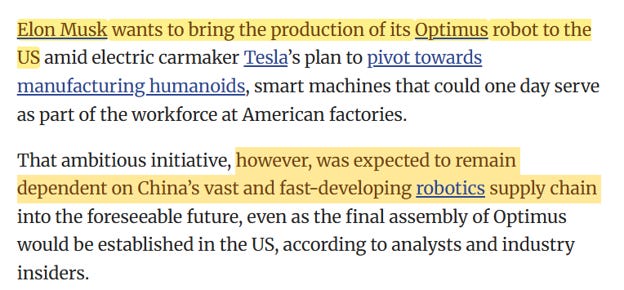
Tesla says that the production of the Optimus will be in the United States, and they will enjoy booming sales of Optimus robots to American factories. But Tesla still is reliant on Chinese suppliers, who ship the components for assembly in the United States. Hundreds of Chinese vendors are in the Optimus supplier program.
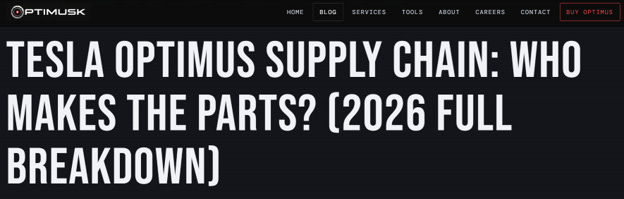
And the breakdown of the bill of materials shows the problem for Tesla, and the other humanoid robot makers. There is heavy dependency on China for the most important parts. Tesla’s supply chains for actuators, reducers, screws, and battery packs all run through Mainland China. Without Sanhua, for example, the Optimus can’t move. Tuopu builds the chassis for the Optimus, just as they do for Tesla’s cars.
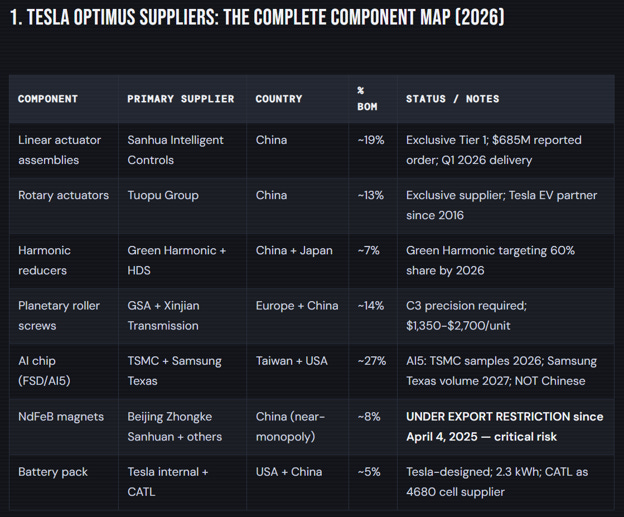
Tesla has a similar relationship with CATL, who is the primary battery maker for Tesla’s electric vehicles, and also a Tier-1 vendor for Optimus.
Tesla’s manufacturing bases and supply chains for EV’s already run through China, and so Tesla will enjoy strong advantages in building Optimus, simply by exploiting many of those same vendor relationships. And given Tesla’s history and reputation here—which are solid—and the new import restrictions from Washington on new humanoid models, Elon Musk’s strategy may be the only one that works.
Chinese companies build the parts, ship them to the Optimus plant in the US where they’re put together, and bundled in with xAI or whatever the Tesla wants for the brain.
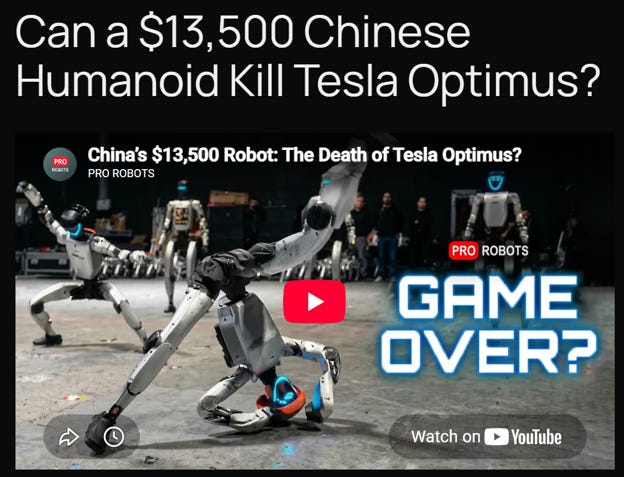
Optimus will not be competitive outside the US, because they’re up against Chinese brands selling at far lower cost.
But Tesla may have the American market to itself. Foreign manufacturers are banned, so Tesla’s competition for the US market will be American companies whose parts inventories are limited to how many robot components their mules can jam into their carry-ons.
Be Good.
Resources and links:
Trump administration bans new Chinese humanoid robots, to protect US AI buildout
https://www.reuters.com/world/trump-administration-ban-new-chinese-robots-inverters-protecting-us-ai-buildout-2026-07-28/
Trump administration bans new Chinese humanoid robots
https://www.bbc.com/news/articles/cp9e2ex3ekyo
US bans foreign-made humanoid robots, targeting China over national security
https://apnews.com/article/china-us-humanoid-robots-ban-tech-c9f5e3c94d91d00eff3b61b141fab366
United States Bans Chinese Humanoid And Quadruped Robots, Citing National Security
https://www.forbes.com/sites/johnkoetsier/2026/07/28/united-states-bans-chinese-humanoid--quadruped-robots-citing-national-security/
Why U.S. Robotics Startups Are Stuffing Parts From China in Luggage
https://www.theinformation.com/articles/u-s-robotics-startups-stuffing-parts-china-luggage
Chinese Robots Are Blocked From the U.S. Market. Silicon Valley Engineers Are Filling Suitcases With the Parts Instead
https://robots-daily.com/chinese-robots-are-blocked-from-the-u-s-market-silicon-valley-engineers-are-filling-suitcases-with-the-parts-instead/
China Humanoid Makers Hold 97% of Global Shipments, Report Says
https://www.bloomberg.com/news/articles/2026-08-10/china-humanoid-makers-hold-97-of-global-shipments-report-says
SAG: Global Humanoid Robot Shipments Surged 272% YoY to 19.1K Units in 1H 2026; AGIBOT Overtook Unitree for No. 1 Position
https://smartanalyticsglobal.com/global-humanoid-robot-shipments-2026-agibot-unitree/
China now builds almost every humanoid robot shipped worldwide
https://thenextweb.com/news/china-humanoid-robots-97-percent-global-shipments
Tesla’s Optimus Can’t Be Made Without Chinese Components
https://www.chosun.com/english/industry-en/2026/02/03/ANUC5SME6ZDXNDIPYCUFPN3YAU/
Excluding Chinese parts could triple Tesla Optimus costs
https://www.techdigest.tv/2026/02/excluding-chinese-parts-could-triple-tesla-optimus-costs.html
Humanoids: A $5 Trillion Market
https://www.morganstanley.com/insights/articles/humanoid-robot-market-5-trillion-by-2050
Tesla Optimus + Grok xAI Integration: What It Means for the Robot’s AI Brain
https://optimusk.blog/blog/tesla-optimus-grok-ai-integration/
Can a $13,500 Chinese Humanoid Kill Tesla Optimus?
https://spotmini.co.uk/ai/can-a-13500-chinese-humanoid-kill-tesla-optimus/
Tesla Optimus Supply Chain: Who Makes the Parts? (2026 Full Breakdown)
https://optimusk.blog/blog/tesla-optimus-suppliers/
Inside China / Business is a reader-supported publication. To receive new posts and support my work, consider becoming a free or paid subscriber.
From Inside China / Business via This RSS Feed.