

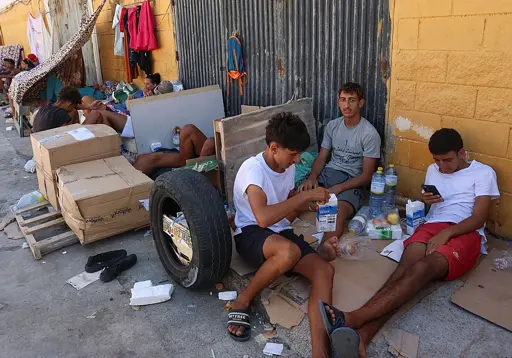
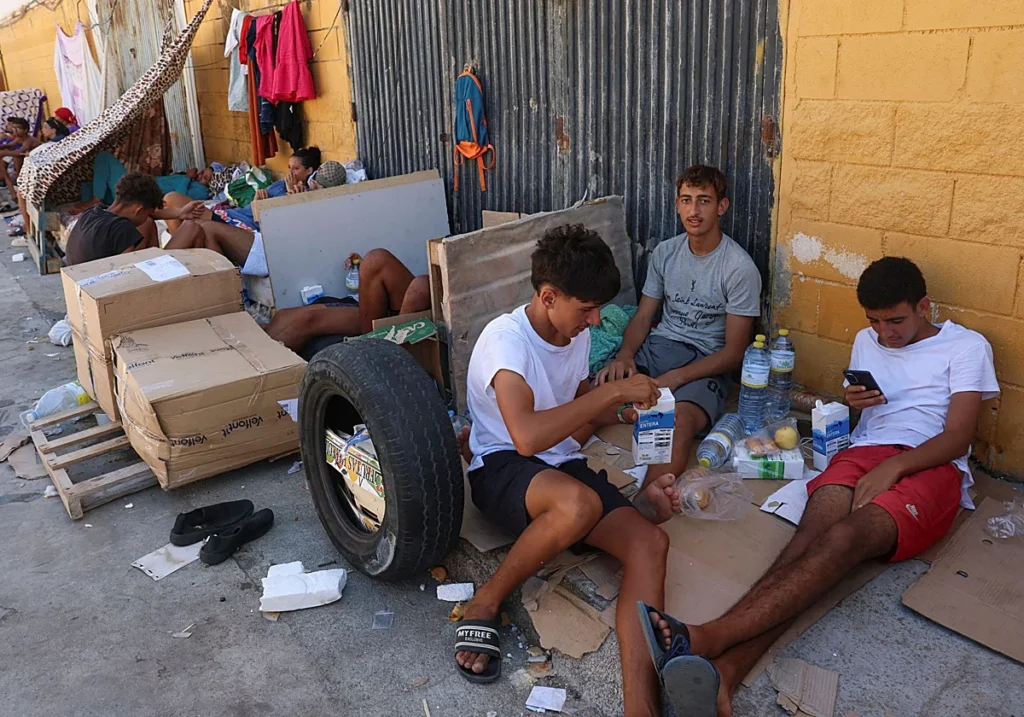
Spain announced this Monday the deployment of temporary humanitarian care devices in the autonomous city of Ceuta, enabling the immediate opening of 1,500 new reception places in response to the overcrowding caused by the late-July migration influx.
The measure was ratified by the Minister of Inclusion, Social Security and Migration, Elma Saiz, during a press conference in the North African enclave, in response to overcrowding and welfare overflow affecting the population after the mass influx recorded at the end of July.
Central authorities will condition three urban sites for the installation of these modules.
RELATED: Migration Through Ceuta Reignites Debate on the Schengen Area
The government will also allocate €6.5 million to the Red Cross to strengthen food distribution and socio-healthcare attention for vulnerable sectors, tasks that require the daily delivery of some 4,000 food kits to sustain basic needs in the area.
The measure responds to growing popular demands and local authorities’ complaints over the saturation of public spaces and social infrastructure in Ceuta, where thousands of people remain after the arrival of around 72,000 migrants at the end of last month.
Text reads: “The Ministry provides four sites for humanitarian care of migrants in Ceuta and assumes immediate initial provision of 1,500 new seats.”
Ceuta Denounces Inaction
The announcement coincides with harsh criticism from the Ceuta mayor-president, Juan Jesús Vivas, who accused Sánchez’s government of acting with passivity and of trying to hide the real impact of the crisis on the well-being of citizens, as well as masking the true figures on the people who remain in the territory after the incursion recorded in late July.
While Madrid authorities affirmed that normality returned within 48 hours and placed the number of migrants at barely 2,500, the local leader denounced a scenario of high risk and unsustainability, estimating that between 8,000 and 10,000 people remain unidentified in the North African city.
Alongside the institutional abandonment denounced by the local administration, the National Intelligence Center (CNI) warned about security threats, while recent episodes such as the crossing attempt called for August 15 evidenced the constant social tension at the border, where Moroccan forces expelled journalists from international agencies during containment operations.
For its part, the central government tried to justify its actions by deploying assistance measures to contain public health emergencies and maintain border control. In this context of institutional disputes and sovereignty clashes fueled by official sectors, Defense Minister Margarita Robles described the situation as a matter of territorial integrity.
Meanwhile, the population of Ceuta suffers the consequences of the collapse of essential services and governmental inaction in the face of the humanitarian impact in the region. The 1,500 new places announced by Madrid represent only a partial response to a crisis that continues to test the capacity of the enclave and the coherence of the government’s migration policy, while local authorities demand structural solutions that go beyond emergency measures.
Ver esta publicación en Instagram
Una publicación compartida de teleSUR English (@telesurenglish)
From teleSUR English via This RSS Feed.