

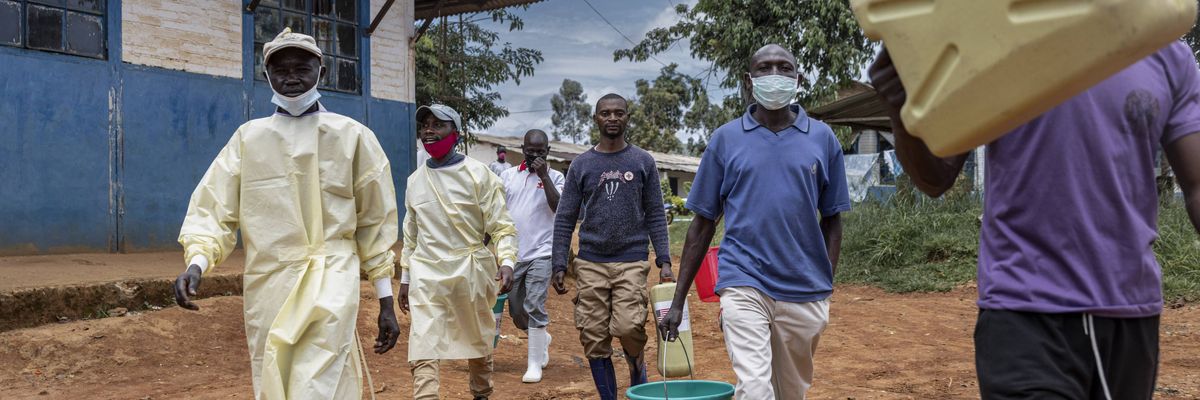
As the Ebola crisis that was first detected in the Democratic Republic of Congo in May became the deadliest outbreak of the disease in the country’s history on Monday, one global public health expert in the United Kingdom pointed to the key difference between the 2014 epidemic in West Africa and the one that has now killed at least 2,325 people in the DRC.
In 2014, wrote Devi Sridhar, chair of global public health at the University of Edinburgh, in The Guardian, the US and other wealthy countries “worked with the World Health Organization (WHO) to escalate a response, bringing military-like coordination, necessary resources, logistics, and trained personnel.”
Now, said Sridhar, “we’ve had two ‘America-First’” terms of President Donald Trump.
“The US is no longer part of the WHO or working multilaterally, favoring a ‘go-it-alone’ response,” she wrote.
In Trump’s second term, the president cut tens of billions of dollars in foreign aid spending. Data released by the Organization for Economic Cooperation and Development in April showed the US spent 56.9% less on foreign assistance last year after Trump dismantled the US Agency for International Development (USAID), cut smaller programs, and demanded that Congress rescind billions that had already been appropriated for countries and programs in need.
Ebola has become the DRC’s worst-ever outbreak in just three months, wrote Sridhar, “in the context of the defunding of foreign aid, the censorship of scientists, the closure of USAID, the implosion of the Centers for Disease Control and Prevention, and a ‘Make America Healthy Again’ movement.”
By the time officials announced that the outbreak had been detected in May, they had already recorded 246 suspected cases and 80 suspected deaths in Ituri province—suggesting that US aid and public health cuts had “undermined some of the surveillance and detection initiatives that might have helped to catch this earlier,” as Jeremy Konyndyk of Refugees International said at the time.
Months after getting a significant head start in spreading throughout the population, Ebola has now been detected in six of the DRC’s 26 provinces, and the country’s public health institute has recorded at least 4,945 cases, with 101 detected in the 24 hours preceding Monday’s announcement.
Ebola "is winning in the Democratic Republic of the Congo,” said the United Nations last Friday, noting that the epidemic was killing one person every 30 minutes.
Amnesty International called on the globa; community to urgently try to make up for the surveillance failures that happened earlier this year and mobilize to slow the outbreak.
“We call for global solidarity as eastern DRC faces its deadliest Ebola outbreak in the country’s history,” said Amnesty. “Human rights must continue to be prioritized as health workers treat the disease across the region.”
The US State Department said earlier this month that it has provided $512 million in direct assistance to help respond to the outbreak—far less than the $5.4 billion the US enacted in December 2014 to fight the epidemic in West Africa.
US spending is lagging as the outbreak has become the fastest-growing in the history of the virus, as The Guardian reported Monday. The 2014 outbreak took five months to reach 1,000 deaths, but more than 2,000 people have died of Ebola in less than three months since the disease was detected.
Thomas Parisch, a public health specialist with Doctors Without Borders in the DRC, told The Guardian that the country still appears to be struggling with the limits imposed by aid cuts.
“Normally, as an outbreak progresses, the case fatality ratio should fall as contact tracing improves and patients are identified and treated earlier,” said Parisch. "Instead, we’re still seeing many cases detected very late, when treatment is less likely to succeed, with many identified only after they die in the community.”
The outbreak also differs from previous epidemics in that the current Ebola infections are being caused by the rare Bundibugyo virus. There are no approved vaccines or treatments for the strain, but WHO Director-General Tedros Adhanom Ghebreyesus said recently that two new vaccines were being tested on people.
Lawyer and advocate Bernice King urged the public to “refuse to look away.”
“Nonviolence is an active commitment to protect life,” said King. “The people of the DRC deserve the world’s attention, resources, care, and solidarity.”
From Common Dreams via This RSS Feed.