

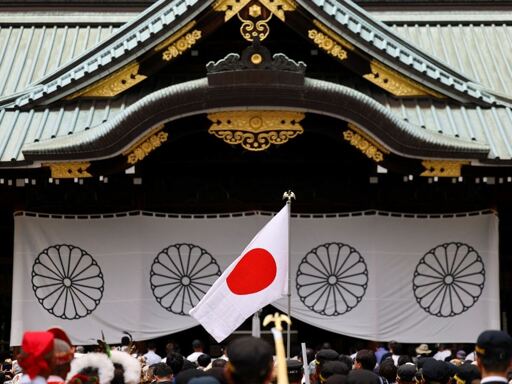

Commemorating the 81st anniversary of Japan’s unconditional WWII surrender in August 1946, Japan’s political leaders honoured a monument to known war-criminals. The infamous Yasukuni shrine commemorates thousands of war-criminals who served in the brutal Imperial Japanese Army.
Leaders included the Prime Minister, defence minister and various cabinet members of the ruling Liberal Democratic Party. Among those to visit the temple was the Japanese defence minister, Shinjiro Koizumi, in charge of Japan’s armed forces. Three other cabinet members visited the Shinto shrine.
Japanese PM Sanae Takaichi has previously attended the war-crimes shrine. This year, however, Western media said she skipped, “did not visit,” stayed away from, or “shuns” the shrine. But this is not accurate.
PM Takaichi, known regionally for her subservience to US imperial interests, sent an honorific gift, including flowers, to the shrine. She also visited the shrine but remained outside, reportedly across the street. She still bowed, in Japanese honorary custom, and reportedly clapped to honour the war-dead.
Apparently aiming to please nationalist elements in Japanese society while avoiding major international scandal, Takaichi both attended and “did not.” Yet, quite clearly, her wishes were with the war-criminals.
View this post on Instagram
No apology: Japan’s imperial history
Japan’s twentieth-century imperial era entered full-scale colonisation with its invasion of mainland China in the 1930s. Its army illegally invaded and occupied swathes of Pacific Asia, notably China and Korea.
From that point until 1946, an estimated 3–10 million civilians died under Japanese rule. Within that estimate range, historian R.J. Rummel writes that the total killed were
most probably almost 6,000,000 Chinese, Indonesians, Koreans, Filipinos, and Indochinese, among others, including Western prisoners of war.
On the mainland, its soldiers became notorious globally for massacres, mass rape, and torturing civilians. Infamous among these events is the 1938 Nanjing Massacre, in which over 300,000 Chinese civilians were massacred. Some 20–80,000 Chinese women were captured, raped and often taken as sexual slaves by Japanese soldiers. Dead to Rights, a heart-wrenching 2025 film, recounts this horrific war period.
Yet the Japanese Empire suffered resounding defeat in WWII, largely owing to China’s war of resistance. Some 15–20 million Chinese soldiers gave their lives in their struggle for liberation. By contrast, fewer than half-a-million British soldiers and civilians died in WWII combined, and fewer still US troops.
Unlike Germany’s national reckoning with its wartime past, Japanese society has not gone so far. Still, in contrast to the current nationalist, conservative leader Takaichi, former president Shigeru Ishiba
vowed to keep in mind Japan’s “remorse” over the war and expressed its “resolute pledge to renounce war” [at the annual war ceremony].
Japan’s official acknowledgement accepts that the “killing of noncombatants,” looting and “other acts occurred.” But, notably, neither mass rape nor actual Japanese culpability for these “acts” is accepted on record. Given Japan’s prominent ‘apology culture‘, apparent absence of remorse is all more insulting.
Trump demands allies — and even enemies — join his unlawful war
Rearmament: present imperial context
Japan’s armed forces are currently rearming and embracing a post-pacification nationalism. Simultaneously, Japanese society is revising history to erase truthful narratives of historical crimes against humanity.
Principal moves to re-militarise Japanese society include lifting post-war bans on arms exports and military exercises. Now, Japan seeks to increase its warship production output and carries out missile launches. Among the elements driving in these trends is Takaichi, described by the New York Times as
a conservative lawmaker, [who] won office last year with nationalist calls to revive the military.
The Yasukuni shrine, visited by Takachi, commemorates these crimes’ architects. Hamza Shehryar wrote of the Japanese war-criminals commemorated at the monument:
This number includes former Prime Minister Tojo Hideki and general Matsui Iwane, who explicitly ordered his soldiers to carry out mass executions of civilians across Nanjing as the Imperial Japanese Army laid siege to the Chinese city from December 1937.
Understandably, manyChinese people feel that Japanese officials’ apologies are weak. Further, “guilt” over crimes like the Rape of Nanjing is contradicted by actions such as visiting Yakusuni. Many Koreans, including South Korea’s president, also feel that apologies to Japan’s colonial victims must go much further.
Many sexual crime victims, so-called ‘comfort women’, died without seeing justice. In late 2025, a Japanese museum moved to revise its name from Nanjing Massacre to ‘Nanjing Incident’. And now, alike its WWII-era Axis partners in Germany, nationalism and rearmament regain momentum in Japan.
Trump demands allies — and even enemies — join his unlawful war
Ukraine: dark wartime parallels
These events in Japan are mirrored by Ukrainian officials, who increasingly appear willing to turn ignoreNazi symbolism and war-criminal worship. Many have observed mainstream media accidentally showing Ukrainian soldiers wearing badges or tattoos of Nazi emblems.
Unfortunately, this trend appears to go right to the top. Ukrainian President Volodymyr Zelensky recently honoured Ukrainian nationalist and Nazi collaborator Andriy Melnyk with a reburial and rebrand.
According to Le Monde, Melnyk and his Organisation of Ukrainian Nationalists [OUN] are part of
the country’s evolving memorial politics, which have been focused on opposition to Moscow since the February 2022 invasion. …
In their struggle for Ukraine’s independence from the Soviet Union, OUN supporters collaborated with Nazi Germany and took part in the Holocaust.
This understandably alarmed many Jews around the world, especially as Zelensky himself is Jewish. Nazis exterminated some six million Jews and a similar number of Romani, gay, disabled and ethnic minority people. But those memory of that Holocaust has not stopped Israel arming neo-Nazis in Ukraine either.
Another prominent OUN Nazi collaborator, Stepan Bandera, is considered a hero by neo-Nazi elements like Azov in Ukraine. While the likes of the Guardian and NYT recognised Azov as neo-Nazis in 2014–15, much coverage has since downplayed the prominence of neo-Nazi elements.
From Japan to Ukraine, revisionism of Axis powers’ WWII crimes must not be excused for the sake of political convenience. Those who fail to renounce that history clearly can only reopen the doorsp to it.
Mainstream media IGNORING Boris Johnson hosting Ukraine neo-Nazi unit in parliament
Featured image via the Canary
From Canary via This RSS Feed.