
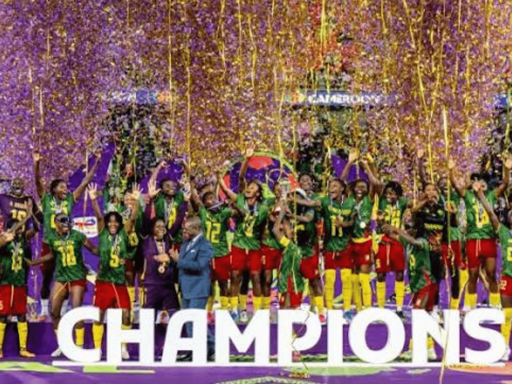

Cameroon claimed their first Women’s Africa Cup of Nations title with a composed 3–0 victory over Malawi, completing a tournament run defined by organisation, efficiency and a clear attacking edge. The result, achieved in the final against a Malawi side making their debut at this stage of the competition, marked a significant moment for Cameroonian women’s football and underlined the team’s steady rise across the past cycle. The scoreline reflected the balance of the contest: Cameroon were sharper in midfield, more decisive in the final third and rarely troubled defensively.
Marie Ngah Manga struck twice, each finish illustrating her instinct and timing, while Naomi Eto added the third to close out a performance that never drifted from Cameroon’s control. The win also confirmed qualification for next year’s Women’s World Cup in Brazil, with Cameroon and Malawi joining Morocco and Algeria as the continent’s representatives. For Cameroon, the trophy itself was the central achievement, but the broader significance of reaching the global stage added further weight to the afternoon.
Cameroon’s route built on consistency
Across the tournament, Cameroon’s approach remained stable: disciplined defensive structure, quick transitions and a forward line capable of converting pressure into goals. Their progression through the group stage showed the same traits visible in the final. The midfield unit, anchored by players comfortable receiving under pressure, allowed Cameroon to dictate tempo in most matches. When possession broke down, the defensive recovery was immediate, limiting opponents to half-chances and isolated breaks.
In knockout rounds, Cameroon’s composure became more evident. They managed game states effectively, avoided unnecessary risks and maintained control even when matches tightened. By the time they reached the final, their rhythm was established. Malawi, energetic and ambitious, attempted to disrupt that rhythm early, but Cameroon’s structure held firm. Once the opening goal arrived, the momentum shifted decisively.
Marie Ngah’s class shines
Marie Ngah Manga’s two goals in the final capped a tournament in which she consistently provided Cameroon’s attacking edge. Her movement between lines created problems for Malawi’s defence, and her ability to finish from both central and wide positions gave Cameroon flexibility in their build-up. The first goal came from a well‑timed run that met a precise pass, finished with calm assurance. The second, arriving after sustained pressure, demonstrated her awareness inside the box and her capacity to react quickly in crowded situations.
Ngah Manga’s contribution extended beyond scoring. She linked play effectively, pressed intelligently and offered an outlet whenever Cameroon needed to relieve pressure. Her performances across the competition placed her among the standout players, and the final served as a fitting conclusion to her tournament.
Significance of Cameroon’s achievement
Winning a first Women’s Africa Cup of Nations title carries weight beyond the immediate celebration. It reflects years of incremental progress, investment in development pathways and the emergence of players capable of performing consistently at international level. Cameroon’s victory also strengthens their position within African women’s football, placing them alongside established contenders and reinforcing their trajectory.
The manner of the win. Which was controlled, measured and built on collective clarity. Has now added further credibility. Cameroon avoided unnecessary drama, maintained discipline and executed their plan with precision. In doing so, they delivered a performance aligned with the identity they have shaped across recent tournaments.
Looking ahead to global competition
Preparation for the Women’s World Cup will now intensify. Cameroon’s coaching staff will assess the tournament, identify areas for refinement and build a programme designed to elevate performance levels. The step up to global competition demands adjustments in tempo, physicality and tactical flexibility. Cameroon’s core strengths, defensive structure, midfield control and attacking sharpness. All will provide a solid base.
Ngah Manga and Eto will remain central to Cameroon’s attacking plans, but depth across the squad will be crucial. The experience gained in this tournament, particularly in managing knockout matches, will support their transition to the global stage. Cameroon’s ability to maintain composure under pressure, evident throughout the competition, will be essential in Brazil.
Malawi’s run still a breakthrough moment
Although defeated in the final, Malawi’s campaign represented a significant step forward. Reaching the final in their first appearance at this stage of the competition highlighted the progress made within their programme. Their performances across the tournament were marked by energy, commitment and a clear tactical identity. While Cameroon’s experience and structure proved decisive, Malawi’s presence in the final added a fresh dimension to the competition and signalled their potential for future tournaments.
Malawi also secured qualification for the Women’s World Cup in Brazil, a milestone that will shape their development over the coming year. Their ability to compete against established sides throughout the tournament demonstrated resilience and adaptability. The final itself may have exposed areas requiring refinement, but the broader achievement remained intact.
Cameroon’s 3–0 win over Malawi delivered a clear, deserved and historic first Women’s Africa Cup of Nations title. The performance reflected consistency, structure and attacking quality, with Ngah Manga and Eto providing decisive contributions. Malawi’s breakthrough run added significance to the final, while both teams secured their place at next year’s Women’s World Cup alongside Morocco and Algeria. For Cameroon, the trophy marks a defining moment and sets the stage for their next challenge on the global platform. Malawi will take this is a huge step in the right direction and prepare for the Women’s World Cup.
Featured Image courtesy of Al Jazeera
By Faz Ali
From Canary via This RSS Feed.