

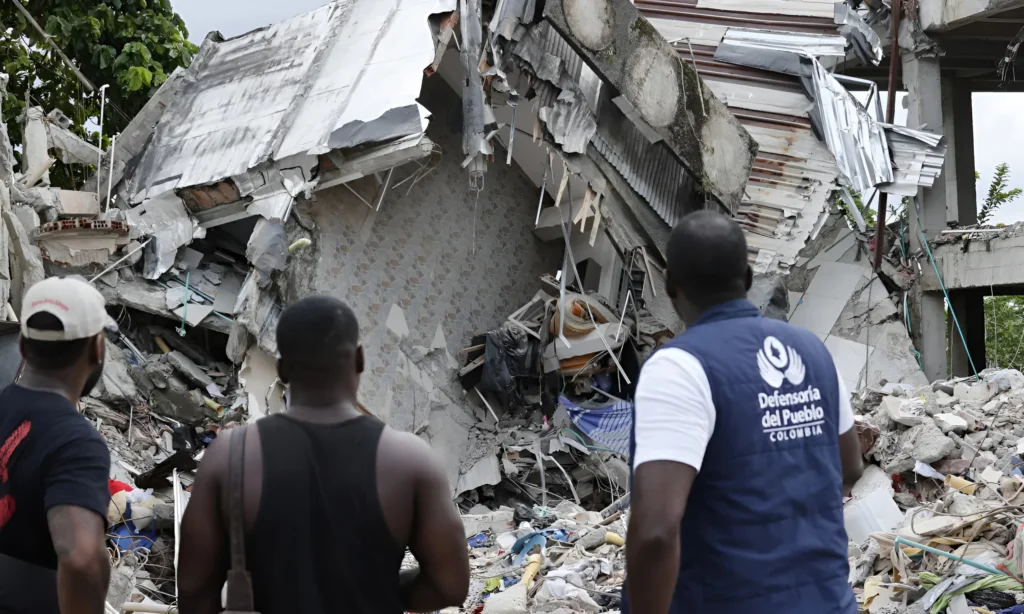
Historical isolation, armed conflict, and poverty have turned a natural disaster into a humanitarian crisis along Colombia’s Pacific coast.
The Department of Chocó, in western Colombia along the Pacific coast, is marked by structural inequality, ongoing armed conflict, and environmental vulnerability.
RELATED:
Heavy Rain Complicates Conditions for Earthquake Survivors in Colombia
Some investigations document a long-standing pattern of state neglect. Although the Chocó is rich in natural resources such as gold, timber, and biodiversity, its population experiences some of the highest rates of poverty and displacement in the country.
On August 10, 2026, a 7.4-magnitude earthquake struck with its epicenter near San José del Palmar, Chocó. Data from the National Unit for Disaster Risk Management (UNGRD) recorded 289 fatalities, 4,100 injured residents, and tens of thousands of displaced families across the region.
The seismic disaster in Chocó highlighted existing infrastructural deficiencies. Emergency relief efforts faced immediate hurdles due to geographic isolation and the ongoing presence of non-state armed groups in surrounding rural corridors.
In response to the crisis, President Abelardo De La Espriella visited Quibdó and proposed a “Marshall Plan” to fund the reconstruction of Chocó. Concurrently, U.S. Secretary of Defense Pete Hegseth announced joint military operations in Colombian territory to combat drug trafficking organizations.
Enslavement, Isolation, and State Formation
The historical trajectory of Chocó is rooted in colonial economic models designed for resource extraction. During Spanish rule in the 17th and 18th centuries, colonial authorities imported enslaved African laborers to mine gold along the Atrato and San Juan river basins.
Following Colombian independence in the 19th century, the central government in Bogotá maintained a distant relationship with the Pacific coast. Economic policies treated Chocó as a resource enclave rather than an integrated administrative region.
Commercial interest in the Chocó focused primarily on timber extraction, gold mining, and potential transoceanic canal routes connecting the Atlantic and Pacific Oceans, leaving the Afro-descendant and Indigenous populations largely excluded from political representation and domestic public spending.
Political organizing by local civil society, Indigenous leaders, and Afro-Colombian intellectuals led to the formal creation of the Department of Chocó in 1947, with the granting of departmental status aimed at decentralizing public funds and providing local governance.
Recent historical analyses emphasize that Chocó’s territorial isolation was not accidental, but the result of specific public investment decisions made by successive national administrations.
Land tenure laws passed in the late 20th century, including Law 70 of 1993, formally recognized collective land ownership for Afro-Colombian communities and Indigenous reserves.
Despite these legal advances, the lack of state protection allowed illegal logging, informal gold mining, and armed groups to expand into community lands throughout the late 20th and early 21st centuries.
Limited access, and urgent humanitarian needs. But there is something we cannot ignore: Chocó and Buenaventura share a long history of government neglect, structural racism, poverty, and inadequate infrastructure.
— Joaquín Alessandro (@Joaquingcll) August 11, 2026
The Political Economy of Poverty and Armed Conflict
Socioeconomic indicators highlight the systemic disparity between Chocó and the rest of Colombia. According to poverty assessments, Chocó consistently registers the highest monetary and multidimensional poverty rates in the country, with over 65% of its population living below the poverty line and extreme poverty exceeding 44,9%.
In rural areas, access to basic public utilities remains severely restricted: less than 30% of households have reliable access to potable water, and coverage for municipal sanitation systems is minimal across most of its 30 municipalities.
The department’s maternal and infant mortality rates also remain well above national averages due to a decentralized health network that lacks primary care clinics, essential medical supplies, and intensive care capacity.
This lack of public services creates an economic environment in which informal and illegal economies become primary drivers of income. The economic deprivation of the population and the expansion of illegal economies reinforce one another.
Resource exploitation plays a central role in this dynamic. Mechanical alluvial gold mining, conducted using heavy machinery along major river systems, along with illegal timber logging and monoculture agriculture, alters local ecosystems.
Some reports show how these extractive operations pollute vital water sources with mercury and cyanide, destroying traditional agricultural and fishing activities.
Armed groups systematically extract protection payments from illegal mining operators and commercial ventures, using these revenues to sustain their military structures and territorial control.
Territory Under Siege: Groups and Disputes
The territorial control of Chocó is divided among several non-state armed organizations that dispute strategic corridors connecting the interior of Colombia to the Pacific Ocean and the Panamanian border.
The primary groups operating in the region include the National Liberation Army (ELN), the Gaitanista Self-Defense Forces of Colombia (AGC), and dissident factions of the former FARC-EP.
The geopolitical value of Chocó stems from its natural corridors. The Atrato and San Juan rivers serve as primary highways for the transport of weapons, troops, and illicit goods.
Coastal inlets along the Pacific Ocean offer clandestine departure points for maritime drug trafficking routes toward Central and North America. Control over these waterways allows armed groups to regulate movement, tax local commerce, and secure transit routes for illicit supply chains.
The ongoing disputes between the ELN and the AGC for dominance over these corridors directly impact local communities. According to documentation by human rights organizations and independent media, armed groups frequently enforce armed strikes, river blockades, and anti-personnel landmine placements. These actions result in severe humanitarian consequences:
– Forced Confinement: Entire Afro-descendant Community Councils and Indigenous Reserves are routinely cut off from food supplies, medical care, and schools due to river blockades.
– Forced Displacement: Direct clashes between competing armed factions trigger mass displacements of rural communities toward urban centers like Quibdó or Istmina.
– Gender-Based and Selective Violence: Community leaders, ethnic authorities, and women face targeted threats, assassinations, and gender-based violence for defending territorial rights or opposing illegal activities within their collective lands.
Hegseth Says Colombia Will Conduct Joint Military Operations with U.S., Urges Partners to Reject ICC https://t.co/YKo2089QS1
— Democracy Now! (@democracynow) August 13, 2026
The August 2026 Earthquake: Amplifying Structural Vulnerabilities
The 7.4-magnitude earthquake on August 10, 2026, centered near San José del Palmar, accelerated the existing crisis across Chocó. Landslides triggered by the seismic movement blocked major unpaved arteries, including the primary road linking Quibdó with Medellín, effectively severing overland supply routes.
Precarious housing structures built along riverbanks collapsed, leaving thousands of Afro-descendant and Indigenous families without shelter.
The impact of this disaster in Chocó was bigger because of the department’s inadequate medical infrastructure. Municipal hospitals in Istmina and Condoto lacked operational capacity, clean water, and emergency electrical power to treat injured survivors, forcing air evacuations to urban centers in neighboring departments.
The disaster demonstrated how historical deficits in public engineering and physical health infrastructure turn natural events into systemic humanitarian emergencies.
Humanitarian relief delivery encountered immediate barriers due to the presence of non-state armed actors. River blockades maintained by the ELN along the San Juan River and security checkpoints controlled by the AGC delayed the arrival of international aid convoys.
According to media reports, several rural Indigenous reserves remained entirely isolated for days following the earthquake, unable to receive food rations, clean drinking water, or medical supplies due to ongoing military confrontations between competing illegal factions.
Reconstruction, Militarization, and the “Marshall Plan”
President Abelardo De La Espriella proposed a “Marshall Plan” that covers a post-earthquake reconstruction of Chocó around foreign investment, state infrastructure spending, and increased security presence.
Speaking in Quibdó on August 14, 2026, De La Espriella advocated for a centralized development model for integrating Chocó into national and global markets. De La Espriella stated to journalists, “I want to propose a special plan, a Marshall Plan for Chocó. Chocó has been abandoned to its fate by the centralism of power in Bogotá”.
However, social organizations and community councils highlighted that top-down development initiatives historically prioritized large-scale extractivist projects over local ethnic autonomy and basic social services.
The economic proposal coincided with security announcements regarding foreign military involvement. Statements by U.S. Secretary of Defense Pete Hegseth confirmed that the De La Espriella administration authorized joint military operations with U.S. forces within Colombian territory. These operations focus on deploying security personnel and technology to combat drug trafficking organizations along the Pacific coast.
This integration of disaster response with militarized counter-narcotics policy raises significant concerns among local communities. Civil society organizations argue that addressing the emergency through increased security operations risks further entrenching the armed conflict in collective territories.
Critics maintain that long-term recovery in Chocó requires addressing the root causes of poverty, protecting ethnic territorial rights, and implementing structural social investments rather than expanding external military footprints.
Colombian President Abelardo de la Espriella said he wants to implement a “Marshall Plan” to carry out reconstruction efforts in Choco, the department where the epicenter of the earthquake that struck Aug. 10 was located.
“I want to propose a special plan, a ‘Marshall Plan’ for… pic.twitter.com/Z1jcPRkq9l
— teleSUR English (@telesurenglish) August 14, 2026
Sources: RTVC – Radio Nacional Colombia – La Silla Vacía – Vorágine – Rutas del Conflicto – Volcánicas – El Tiempo – El Espectador – Centro de Memoria Histórica – teleSUR
From teleSUR English via This RSS Feed.