

As with the GOP’s 2017 tax legislation, experts warned that big businesses and ultrarich individuals would benefit from President Donald Trump signing the One Big Beautiful Bill Act last year, while everyday Americans would suffer, and a Monday analysis identifies some of the companies now paying billions of dollars less in taxes.
The Institute on Taxation and Economic Policy (ITEP) “has tracked $204 billion in federal tax breaks disclosed by publicly traded US companies so far for 2025,” the report says. “But those benefits were not spread evenly across the corporate sector: Six companies alone accounted for $83 billion of them.”
The publication points out that “the stunning size of the federal income tax breaks corporations claimed this year dwarfs past corporate tax breaks, themselves sizeable. Microsoft received $18.7 billion in federal income tax breaks, a record high for single-year federal tax breaks for one publicly traded company. Alphabet claimed a staggering $18.4 billion, and Amazon walked away with $17.4 billion in tax breaks. Meta received $13.7 billion, JPMorgan Chase received $8.3 billion, and Nvidia received $6.8 billion.”
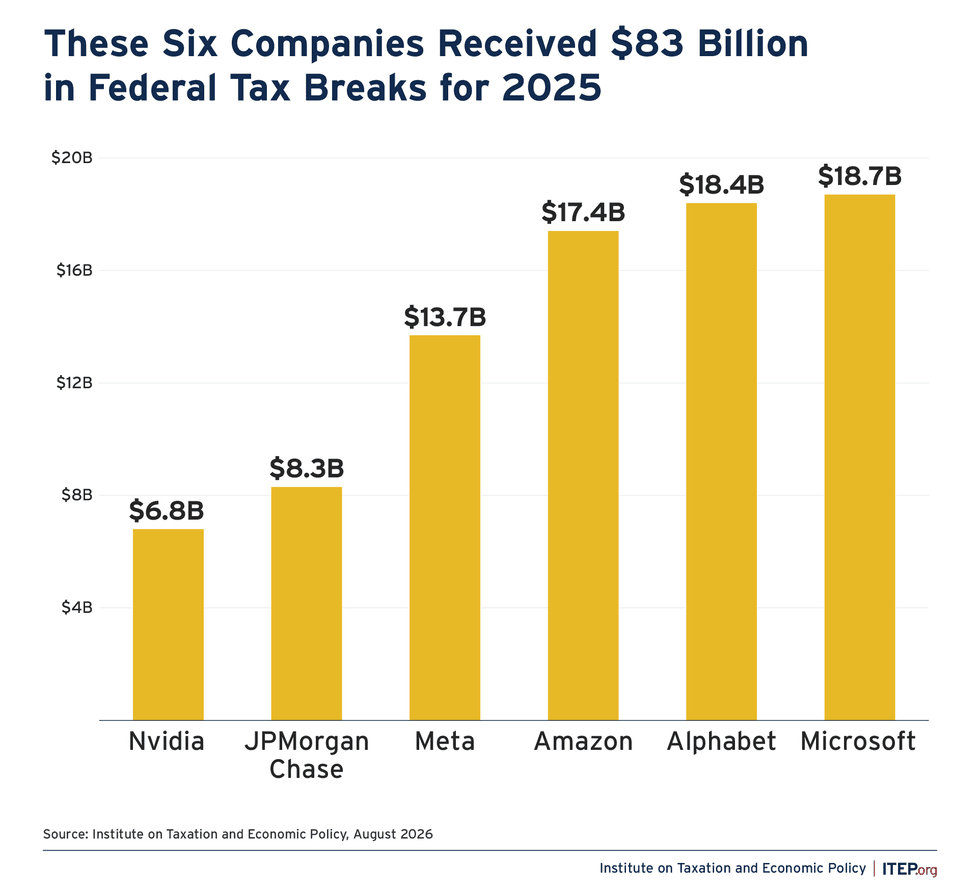
To put that $83 billion into context, the report highlights that it “represents nearly 18%, or almost $1 out of ever $5, of total federal corporation tax collections according to the Congressional Budget Office.” It also “exceeds the entire annual discretionary budget of the US Department of Education,” which Trump is notably aiming to eliminate as part of a broader mission to gut the federal government in his second term.
“This is an extraordinary concentration of tax benefits among some of the biggest and most profitable companies in the world,” report co-author and ITEP senior fellow Matthew Gardner said in a statement. “When six companies can collect tax breaks equal to nearly one-fifth of what the federal government raises from the corporate income tax altogether, policymakers should be asking whether these provisions are serving the public interest or simply rewarding companies that are already enormously profitable and politically influential.”
Gardner and his co-author, ITEP intern Sarah Buttikofer, emphasized that the top four firms featured in their analysis are tech giants: “Microsoft, Alphabet, Amazon, and Meta collectively received $68 billion in federal income tax breaks—which represents roughly 33% of the overall total.”
“These figures show what Americans intuitively know: Corporate profits and economic power are increasingly concentrated among a relatively small number of extremely large companies,” the pair wrote. “The presence of half a dozen tech CEOs at Donald Trump’s January 2025 inauguration was a stark reminder that the economic leverage these companies are gaining is being translated into political power as well. That makes the tax treatment of these companies especially important.”
Amazon founder Jeff Bezos and Meta CEO Mark Zuckerberg were among the Big Tech executives with prime seating at the inauguration. There was also the world’s richest man, Elon Musk, who went on to help Trump rip apart the federal workforce as the de facto leader of the so-called Department of Government Efficiency.
To put these enormous tax breaks in context, the largest single-year tax break we’ve documented for any corporation before 2025 was J.P. Morgan’s $5.2 billion haul in 2024.itep.org/six-companie…
[image or embed]
— ITEP (@itep.org) August 14, 2026 at 12:18 PM
Musk leads various businesses, including Tesla, which was among 88 companies that paid no federal income tax last year, despite making almost $5.7 billion, according to an April analysis from ITEP. The others range from airlines and banks to energy, entertainment, and tech companies, such as Citigroup, Edison International, Palantir, United, and Walt Disney.
Meanwhile, near the end of last year, as Trump dismissed affordability concerns, an Associated Press-NORC Center for Public Affairs Research poll found that only 31% of voters approved of Trump’s handling of the economy, the survey’s lowest figure for his two terms.
Then, a January analysis by Democrats on the Joint Economic Committee revealed that the average American family paid $1,625 in higher costs last year as his policies drove up prices.
That was followed by a February warning from the Economic Policy Institute that Trump’s economic agenda “will make ordinary families reliably poorer in the future.” EPI’s chief economist, Josh Bivens, pointed to the president’s anti-labor policies, cuts to federal spending and jobs, mass deportation efforts, and tariffs—as well as the OBBBA, which gave tax breaks to the rich while stripping healthcare and food assistance from Americans in need.
With the US now enduring the consequences of Trump’s war of choice on Iran, inflation remains high. Americans are struggling with the cost of gasoline, groceries, healthcare, housing, and more. After the latest figures were released last week, Alex Jacquez, a former Obama administration official who is now senior vice president of policy and advocacy at Groundwork Collaborative, said that “prices started climbing again in July, and Trump’s catastrophic mismanagement of our economy means more spikes in the months ahead.”
From Common Dreams via This RSS Feed.