

By Kimberly D. Miller – Aug 10, 2026
Less than a year after the deadly January 3 U.S. military attack on Venezuela that abducted President Nicolás Maduro and First Combatant Cilia Flores, Venezuelan sovereignty is being spoken of in the past tense.
What was once held up as one of the hemisphere’s most consequential experiments in anti-imperialism is increasingly described as a memory. Rhetoric has proliferated that Venezuela represents a revolution defeated, betrayed, a state reduced to vassalage, and a government administering the terms of its own subordination to Washington.
There is no question that Venezuela suffered an extraordinary blow on January 3 which marked a qualitative change in a state already battered by years of sanctions, economic blockade, political destabilization, and U.S. military pressure.
The balance of forces has deteriorated significantly. The interim government of Delcy Rodríguez has made concessions and diplomatic overtures that would have been difficult to imagine at earlier stages of the Bolivarian project, as Washington’s leverage over Venezuela’s economic and geopolitical realities has expanded considerably, especially in the wake of two catastrophic earthquakes. The immense reconstruction and capacity to recover already hampered by years of U.S. economic warfare, created new openings for foreign influence, including the deployment of hundreds of U.S. troops and an unprecedented SOUTHCOM presence at critical Venezuelan infrastructure.
But retreat is not the same thing as political closure
In the months since January 3, I have been troubled by a prevalent narrative of Venezuela, primarily from the Global North but also international left, that moves seamlessly from recognizing these shifts to treating the Bolivarian struggle as already defeated. In this telling, the Rodríguez government becomes the entirety of the political condition of understanding Venezuela itself. The longer struggles that produced the present moment recede from view—as does the communal circuit, grassroots sectors, and Chavista bases that continue to fight for popular sovereignty and the direction of the Bolivarian process in their country.
I call this the ‘Delcyification’ of analysis: Every concession made under the post-January 3 period of more severe U.S. coercion becomes evidence that Chavismo’s internal political struggles have been settled and its broader possibilities, exhausted. That does not mean that major concessions—including foreign ownership stakes in oil production, U.S. custodianship of Venezuelan oil rents even as billions of dollars in those revenues remain unaccounted for, mining and other strategic sectors, should escape criticism. They should not. The problem is what disappears when these accommodations become the totality through which Venezuela is understood and more importantly, when decisions of a government under threat become grounds for the Global North left to condition or withdraw solidarity from Venezuela’s struggle for sovereignty altogether. What disappears first, is history.
Before the breaking point: The Bolivarian Revolution navigating new constraints
Concessions did not begin with Delcy Rodríguez. To treat January 3, 2026 as a clean dividing line between a romanticized sovereign Bolivarian Revolutionary state under Maduro and a neocolonial Venezuela under puppet Rodríguez, is to mistake a qualitative alteration for the origin of contradictions that had been developing for many years.
Maduro’s time in office was neither a period of uncomplicated revolutionary advance nor one of capitulation. His government confronted what would increasingly shape the Bolivarian process: a revolutionary project struggling to survive an imperial siege while confronting how the very strategies necessary for that survival could reshape what it sought to preserve.
Long before U.S. forces removed Maduro from power and imprisoned him and his wife at New York’s Metropolitan Detention Center, his government had already begun modifying features of the political economy, and to some extent even geopolitical posture inherited from Hugo Chávez—modifications that cannot be detached from rapidly changing regional and international conditions.
However, a dialectical analysis reminds us that this inherited legacy was itself contradictory and incomplete. Chávez never abolished private capital, nor did Venezuela cease to depend on the world oil market. But that cannot be understood as failures of revolutionary will, as some on the international left seem to think. Chávez himself acknowledged Venezuela remained a “bourgeois state” and Venezuela entered the Bolivarian Revolution as a postcolonial country whose possibilities for socialist transformation were conditioned by an international division of labor constructed through centuries of Western colonialism and imperialism.
Like much of the Global South, its productive development had been distorted by relations that concentrated industrial capacity, technology and finance in the imperial core, while relegating peripheral economies to dependence on commodity exports, imported manufactured goods and foreign-controlled technologies. Venezuela entered the Chávez era carrying decades of oil dependency, in which petroleum revenues financed a reliance on imported food, while domestic agriculture was comparatively underdeveloped. Chavismo sought to reverse this through land reform, expanded public food systems, and an explicit commitment to food sovereignty. Yet these efforts never fully displaced the structural weight of the petroeconomy, leaving even a government committed to breaking with neoliberalism dependent upon such revenues, imports and participation in a capitalist world market it did not control.
Nonetheless, Venezuela moved toward greater state ownership of key industries, expropriations and nationalizations, an enormous expansion of social spending, worker managed enterprises, and the communes as the social and political foundation for a transition beyond the capitalist state. Whatever the limitations of that experiment, the direction was toward expanding the social and public sphere at the expense of private capital and a U.S.-led imperial order that sought to dictate the terms of independent development paths and U.S.-dominated economic integration, especially for the Caribbean.
Petrocaribe was one material expression of that anti-imperialist project, using Venezuelan oil wealth to expand Caribbean states’ room for maneuver beyond Western finance that notoriously conditioned access to credit and development resources to small islands while imposing neoliberal economic models. Its collapse under Maduro, as U.S. sanctions broadened despite strong opposition from CARICOM, illustrate how imperialism was already narrowing the scope of geopolitical options available to the Bolivarian Revolution well before January 3rd, 2026.
Thus, the direction of the Bolivarian project under intensifying assault produced an uneven and at times contradictory trajectory. This was less an ideological departure from the Chávez era, than a changing political terrain both within and outside of Venezuela.
Like Chávez, Maduro inherited an economy already constrained by oil dependence and the realities of Venezuela’s subordinate position within the global capitalist system. But the collapse in global oil prices beginning in 2014, amid opportunistic geopolitical alignment between Washington and Riyadh, placed additional economic strain on oil-exporting “adversaries” such as Russia, Iran, and Venezuela. With that, came ongoing U.S.-backed political subversion, the loss of access to international credit and comprehensive U.S. sanctions. The extent of that political subversion is further realized in recent declassified CIA records revealing they could not substantiate claims of Venezuelan electoral fraud circulating during much of this period.
In 2015, the Obama administration declared the situation in Venezuela an “unusual and extraordinary threat” to U.S. national security, invoking emergency economic powers while imposing sanctions on seven Venezuelan officials, freezing U.S.-linked assets to them, and restricting their entry into the United States.
Then Trump’s 2017 sanctions aimed to cut off the government’s access to financing. Sanctions against PDVSA, the country’s state-owned oil company and a central source of state revenue and foreign exchange, followed in 2019. These measures struck an economy whose state expenditures, imports, and social programs were overwhelmingly dependent on those revenues.
It was in this context that the Maduro government began searching for mechanisms of survival through market accommodation. Exchange and price controls were relaxed. The government tolerated the dollarization of large parts of the economy. Private commercial activity was given greater latitude. Capital that the Chávez-era state had sought to discipline, was increasingly courted as a source of investment, production and foreign exchange.
Venezuelan journalist Andreína Chávez Alava has noted the historical irony. During the crisis years of 2016–2021, she writes, “Maduro himself was denounced by sections of the Venezuelan and international left as a betrayer of Chávez because of his economic policies under sanctions.” That matters because some narratives now reconstruct the Maduro period as the sovereign baseline against which Rodríguez’s concessions appear as an entirely novel break.
Between roughly 2018 and 2020, this turn was also reflected in the government’s evolving relationship to the communes. Researcher and longtime organizer within Venezuela’s communal movement, Cira Pascual Marquina describes this as a “pragmatic” period in which the government had little interest in advancing the communal project, which she regards as vital to Venezuela’s socialist future. This at times produced “friction” between the communes and the Maduro government, but not a “political rupture” because communal bases continued to see U.S. imperialism as the principal enemy even while contesting some of the government’s direction. Pascual Marquina argues that the government subsequently “corrected” course, renewing its attention to communal development. Political struggle within Chavismo did not require popular sectors to choose between criticizing the government and defending the Bolivarian process against imperial aggression.
Thus, the pre-January 3rd assault on Venezuela’s room for maneuver was already severe and not just limited to sanctions. In January 2019, Washington recognized opposition leader Juan Guaidó as Venezuela’s “interim president,” eventually joined by dozens of governments in propping up a parallel authority with no effective control over the Venezuelan state. Recognition was not merely rhetorical as it had grave material consequences for the Venezuelan people. It provided a political and legal framework through which state assets abroad could be denied to the Maduro government or placed under the authority of the opposition, while Washington transferred control over their diplomatic properties and sought to redirect control of their overseas assets. That precedent also helps contextualize the post-January 3 government’s willingness to lean into Washington’s recognition of Delcy Rodríguez. The Guaidó saga demonstrated the material consequences of U.S. hegemonic non-recognition.
Combined with sanctions on PDVSA, Washington’s strategy produced a peculiar attack on Venezuelan sovereignty. Maduro continued to govern the country and Venezuela possessed immense oil wealth while its ability to access, commercialize and exercise control over portions of that wealth was increasingly determined outside of the country.
This is important for understanding what sovereignty meant under Maduro. Caracas-based professor Chris Gilbert has captured this succinctly in arguing that “sitting on oil you can’t sell” under a crushing blockade is hardly the best exercise of sovereignty either. Formal ownership of a vast resource does not by itself constitute economic sovereignty if an imperial power can prevent its sale, seize or inhibit the resulting revenues, punish intermediaries willing to facilitate transactions, and recognize a parallel government empowered to claim assets belonging to that very state.
The 2020 Anti-Blockade Law made this turn particularly visible. As an instrument for circumventing unilateral coercive measures, the law gave the government flexibility to reorganize state enterprises, modify ownership and management arrangements in joint ventures, devise new financial mechanisms and enter contracts capable of shielding economic activity from sanctions. It could therefore both facilitate sanctions evasion and create legal pathways for much greater participation by private capital in sectors previously dominated by the state. Critics within and outside Chavismo understood it as a shift from an earlier economic model.
Thus, the same mechanisms used to shield economic arrangements from sanctions enforcement, could also make those arrangements more difficult to subject to democratic oversight within a socialist project.
The 2022 Special Economic Zones law deepened the opening. Its objectives included attracting national and foreign investment, encouraging industrial development, diversifying exports and establishing investment incentives in manufacturing, agro-industry, energy, technology, finance, tourism and other sectors. His government identified La Guaira, Paraguaná, Puerto Cabello–Morón, Margarita and La Tortuga as the first five zones targeted for this development.
Chávez-era Venezuela had increasingly struggled over how oil rents and state power might be used to socialize production and construct alternative forms of ownership and political authority. The Maduro government, confronted with vastly diminished revenues and a siege designed precisely to deprive the state of those resources, confronted a different reality: How could private and foreign capital be induced to restore productive capacity without surrendering political control of the Bolivarian state?
Dollarization and market stabilization helped end some of the worst shortages and hyperinflation, but access to the recovery was still unequal. Workers dependent on bolívar-denominated wages, especially in the public sector did not experience the emerging dollarized economy in the same way as households receiving remittances, private-sector professionals or those connected to new commercial circuits. The state could therefore recover a degree of macroeconomic stability while sectors of labor absorbed some of the cost of that adjustment.
But I still think it would be insufficient and simplistic to describe the Maduro era as “neoliberal betrayal” of Chavismo. The sanctions were not incidental background conditions. They materially narrowed the options available to the Venezuelan state and made access to capital, foreign currency and commercial intermediaries a matter of political survival. The strategies through which a leftist Global South government survives imperialist siege can themselves complicate the sovereign project it is attempting to preserve.
**After January 3: What survives “defeat”?**January 3 transformed the terms of this immensely. The military assault, indictment and removal of Maduro, and subsequent expansion of Washington’s leverage, did not originate the constraints on Venezuelan state sovereignty, but dramatically deepened them. While previous iterations of the Bolivarian process had to maneuver within an economic blockade while preserving the political gains of the revolution, the immediate impact of January 3 was if those gains could survive after the U.S. demonstrated its capacity to militarily penetrate their territory. This violation led to removing its head of state, further conditioning access to the country’s principal source of revenue, and exercising unprecedented influence over the terms of their own reconstruction.
But I am also interested in what happens to the political processes operating beneath state power in this critical moment. If the Bolivarian Revolution has been reduced to U.S. vassalage, then that question cannot be answered solely by listing the extensive concessions made under Delcy Rodríguez. This article also aims to center popular power constructed over the preceding decades, the Chavista bases struggling over the direction of this process, and the capacities through which Venezuelans continue to exercise popular sovereignty under unimaginably difficult circumstances.
Encountering the Bolivarian process from below
Two months after the January 3rd attack, I traveled to Venezuela as part of an international peace delegation that visited Caracas, Mérida and other parts of western Venezuela. The effects of Washington’s long economic war were palpable, now compounded by the aftermath of the military attack. We visited bombed sites and damaged infrastructure, while the power asymmetry since January 3 lingered in my conversations with Chavistas about survival and the political choices now confronting the Bolivarian process.
At Venezuela’s Anti-Blockade Observatory, one official spoke candidly about the imperative of preserving the continuity of the state under these conditions. Invoking Simón Bolívar’s dictum that “it is always better to be than not to be,” he framed survival itself as a political necessity. A representative of the Simón Bolívar Institute, meanwhile insisted that Venezuela’s geopolitical realities had not simply disappeared: “Iran and Venezuela have the same enemy” he told us. But I did not encounter a political landscape in which popular Chavista organization had simply evaporated beneath the decisions of a government with a “gun to its head.”
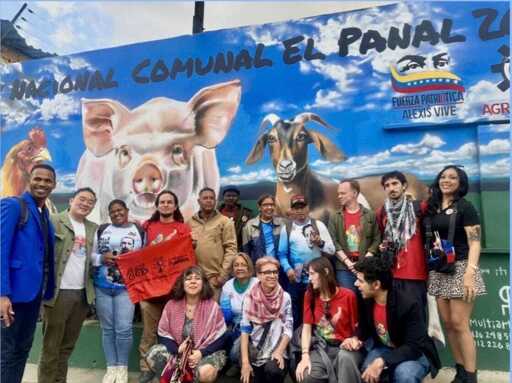
On International Working Women’s Day, I observed Venezuela’s National Popular Consultation, a nationwide electoral process through which communities developed proposals, deliberated through communal structures, and voted on projects to receive public funding. At voting sites in Caracas, residents were deciding among projects addressing water access, infrastructure, transportation, food production and local enterprise. At El Panal in 23 de Enero and Santa Rosa Commune, I encountered communal organization operating food distribution, maternal health, political education and the everyday work of social reproduction.
This popular infrastructure was not politically homogeneous. Women were central to the communal spaces we encountered, including Indigenous women organizing through collective forms of political leadership. Engagement with the National Afro-Venezuelan Cumbe situated the Bolivarian process within a longer history of African descendant and maroon political agency. I met Casimira Monasterios, Spokeswoman of the Venezuelan National Assembly for the Zulia state and former parliamentarian in the Venezuela-Haiti friendship group. The encounter was significant because solidarity with Haiti represents a continuity within the Bolivarian project’s wider conception of Latin American and Caribbean sovereignty.
Across the Chávez and Maduro governments, Venezuela opposed foreign intervention in Haiti and situated Haitian self-determination within their same struggle against imperial domination. Monasterios told me she wanted Haitians to know that Venezuelans understood what it meant to have their country stigmatized in the media and their “people demonized.” In the aftermath of Venezuela’s devastating June earthquakes, Haiti sent a medical team to assist with relief efforts, remembering the solidarity Venezuela showed them after their massive 2010 quake, despite Haiti’s own infrastructural limits.
These encounters challenged conceptions of the Bolivarian process as something located exclusively in the presidency. What persisted after January 3 was communal governance, women’s organization, Afro-Venezuelan political formation and internationalist consciousness whose histories preceded the Rodríguez government’s choices and whose political horizons could not be reduced to those decisions.
This distinction also became visible around Iran. Following the February 28 U.S.-Israeli attack on Iran, former Foreign Minister Yván Gil issued a communiqué that, while condemning the initial aggression, also characterized Iran’s military response as “improper and condemnable.” The communiqué was subsequently withdrawn after grassroots criticism.
Among Chavistas we encountered in March, expressions of solidarity with Iran remained emphatic, framed through a shared anti-imperialist struggle and gratitude for medical supplies Iran sent Venezuela during the roughest times of the sanctions-induced shortages. The divergence showed how the changing diplomatic calculations of the government had not traveled downward into the political consciousness of the Chavista bases. Thus, state power and popular political orientation were related, but not identical.
The earthquakes that devastated Venezuela months later would test this distinction under far more extreme scenarios. In her reporting from Catia La Mar, Pascual Marquina documents how communal structures became mechanisms of emergency response, coordination and collective survival amid the destruction. What I had encountered in March as everyday networks capable of organizing food, care and local decision-making, were now being activated under greater conditions of heartache and catastrophe.
This matters for how we understand what remains of Venezuelan sovereignty after January 3, 2026. The commune is not simply an ideological relic of Chávez, nor does its continued existence prove that power asymmetries haven’t dramatically changed. But it does represent capacity for collective action that cannot be measured solely through the executive. When formal institutions are overwhelmed, the ability of organized communities to coordinate resources, identify needs and reproduce daily life becomes itself an expression of popular power.
The earthquakes also intensified Venezuela’s dependence on the same external powers against which these structures had been built. The enormous demands of reconstruction collided with a state already weakened by years of sanctions/blockade and newly subjected to a vastly more coercive post-January 3 relationship with Washington. The Rodríguez government’s acceptance of U.S. and Israeli technical and military assistance opened another terrain of contradiction. Resources urgently needed for survival arrived through powers responsible for the assault on Venezuela’s own sovereignty and at what many feel, the expense of decades of Palestinian solidarity.
Venezuelans have not acquiesced to that presence either. Popular sectors have mobilized against both U.S. and Israeli involvement, just as Chavista expressions of solidarity with Iran persisted despite the government’s diplomatic posture in this “new phase.” Again, the point is not that resistance from below somehow cancels accommodation from above. It is that both are occurring simultaneously. The post-January 3 political landscape contains a government maneuvering within an extraordinarily diminished range of choices and popular forces continuing to contest what those maneuvers should mean for the future of their country.
By August 2026, this has moved directly into the question of electoral negotiations with Washington. A U.S.-backed political dialogue involving representatives of Venezuela’s now-defunct 2015 National Assembly has generated disagreement within Chavismo itself. Negotiation with Washington over electoral conditions is not itself a post-January 3 development, however. The Maduro government had already entered negotiations with the opposition during the 2023–24 Barbados process, while simultaneously negotiating with Washington over sanctions relief tied to electoral conditions.
What has changed is the balance of forces under which such negotiations now take place. Interior Minister Diosdado Cabello has defended participation while insisting that “attending is not capitulation,” framing engagement as an opportunity to press for the removal of sanctions rather than an acceptance of Washington’s political terms. Other figures like Chavista National Assembly deputy Mario Silva called for Chavista supporters to mobilize, arguing that “executive power is now in the hands of the U.S.” The disagreement reveals that the line between tactical retreat and political surrender is itself being contested within the Bolivarian process.
This is what disappears when Delcyification substitutes the conduct of factions within the state for a political analysis of Venezuela as a whole. Washington’s leverage has reached a level not seen in previous Bolivarian periods. The Rodríguez government has made profound concessions. Neither fact should be minimized. But a government negotiating under extreme coercion, communes exercising capacities of governance, popular sectors protesting foreign presence, and Chavista tendencies openly struggling over the limits of negotiation, do not describe a political process whose contradictions have been resolved.
And distinguishing grassroots Bolivarian processes from the state, does not make state power irrelevant to the popular forces that developed alongside it. As Pascual Marquina has stressed, the prospect of the Venezuelan far right returning to power is not an abstract question for popular sectors whose organizations, communities and political gains would live with its consequences. What remains then, is an ongoing struggle over what can still be defended, recovered, transformed—and over who will determine what comes next.
Beyond Venezuela: The Battle for Our Americas
These struggles for sovereignty are also unfolding within a hemispheric shift much larger than Venezuela. The post-January 3 order is taking shape alongside an expanding U.S. military footprint that seeks to recolonize the Americas, consolidate SOUTHCOM’s regional reach, and the advance of far right Latin American governments, (not outside of U.S.-Israeli electoral meddling), willing to further incorporate their countries into Washington’s political and “security” orbit. Therefore, Venezuela’s diminished room for maneuver must not be understood as just a story of one leftist government’s “cowardly” retreat, but as part of a wider effort to reverse the gains in regional sovereignty produced during the preceding decades.
This is also where the responsibilities of the international left become more difficult. Andreína Chávez Alava put the problem to me sharply, criticizing what she sees as an “exoticism” through which sectors of the Global North and international left approach Venezuela now: “We are carne de cañón—cannon fodder—for anti-imperialism and nothing else. We are meant to suffer or else we are useless or somehow responsible for U.S. crimes against others.”
Confronting the ongoing project of U.S.-led hemispheric recolonization requires recognizing Venezuela not simply as a symbol of past resistance, but as a living political process within which popular forces continue to struggle over what sovereignty can still mean under conditions they did not choose.
Kimberly D. Miller is an environmental sociologist and postdoctoral researcher whose work examines Caribbean sovereignty, ecotourism, and climate resilience under imperial constraint, with focus on Afro-Indigenous cultural revival and neocolonial development in the Lesser Antilles.
(Substack)
From Orinoco Tribune via This RSS Feed.