

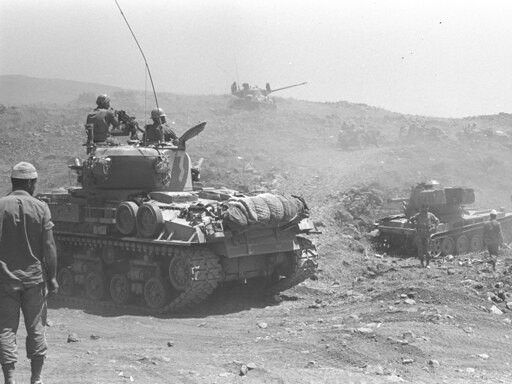

The June 1967 Arab-Israeli War dramatically altered the geopolitical landscape of the Middle East, leaving Israel in firm military occupation of the Sinai Peninsula, the Gaza Strip, the West Bank, and the Golan Heights.
Israel’s subsequent strategic decision to retain control over these conquered territories – rather than restore them to Egypt, Jordan, and Syria – fundamentally severed the alignment between the 1949 General Armistice Agreements (GAAs) and the reality on the ground.
The Post-1967 Legal Vacuum
Following the second week of June 1967, three of the four armistice demarcation lines established in 1949 lay deep behind Israel’s forward military positions.
Had the 1949 armistice agreements remained legally valid, Israel would have been under a strict international obligation to withdraw its armed forces behind the designated 1949 demarcation lines. However, the Zionist Israeli government harboured no intention of undertaking such a withdrawal.
Instead, Tel Aviv adopted the official legal position that the ‘Arab aggression’ of June 1967 had completely destroyed the legal validity of the entire 1949 armistice regime. Furthermore, Zionist legal scholars and diplomats argued that the explicit language of the armistice agreements signed with Egypt, Jordan, Syria, and Lebanon clearly demonstrated that the demarcation lines were strictly provisional and non-political in character, never intended to constitute permanent, internationally recognised state boundaries.
This repudiation of the armistice framework presented a complex legal and diplomatic dilemma regarding Lebanon. Unlike Egypt, Jordan, and Syria, Lebanon had remained ostentatiously non-belligerent during the June 1967 conflict. No ground combat operations had occurred across the Israeli-Lebanese frontier.
The critical question facing international observers and regional strategists was whether Israel’s scuttling of the 1949 armistice regime extended to its quiet northern neighbour, and whether this decision signaled a renewed Israeli ambition to adjust the northern border and seize the valuable water resources of the Litani River.
The Manufactured Casus Belli
According to General Odd Bull, the Norwegian Commander of the United Nations Truce Supervision Organization (UNTSO) during the 1967 war, there were no military hostilities between Israel and Lebanon throughout the June War, despite reports that Israeli military aircraft had violated Lebanese airspace. Nevertheless, immediately following the cessation of hostilities on other fronts, Israel formally declared that its General Armistice Agreement with Lebanon was void and terminated.
To justify this unilateral repudiation, Israel maintained the legal fiction that Lebanon had indeed been an active, legal participant in the conflict, despite having conducted no offensive military operations whatsoever.
The primary pretext cited by Zionist officials involved a minor procedural incident: during the war, a junior Lebanese military officer had declined an Israeli request for a formal meeting of the Israeli-Lebanese Mixed Armistice Commission (ILMAC), stating that such a meeting was impossible because the two nations were technically in a state of war. Israeli diplomats seized upon this isolated verbal exchange, claiming it constituted a formal Lebanese ‘declaration of war’ that invalidated the armistice.
This narrative was further bolstered by an unverified report published in the New York Times in June 1967. The article alleged that the Prime Minister of Lebanon had issued a direct order commanding the Lebanese Army to launch an invasion of Israel, but that the Army Commander had refused to obey. The report implied that sheer military insubordination within the Lebanese high command had prevented an invasion.
However, this news report was fundamentally flawed: under the Lebanese constitutional framework, the Prime Minister lacked the legal authority to order the army into combat without cabinet approval. Furthermore, the article erroneously asserted that Lebanon had actively participated in the 1956 Suez Crisis alongside Syria.
This combination of misleading press reporting and the junior officer’s procedural refusal was systematically leveraged by Tel Aviv to construct a public justification for holding Lebanon responsible for the collapse of the 1949 GAA.
The Realpolitik of Legal Consistency
Despite initial fears in Beirut, Israel’s repudiation of the armistice was not intended as an immediate prelude to territorial conquest or the seizure of southern Lebanese water resources. By refraining from advancing into southern Lebanon during the June War itself – when an adequate military pretext could have been easily manufactured amid the regional chaos – Israel demonstrated that its motives were driven by broad legal realpolitik rather than immediate territorial expansion in the north.
Instead, Tel Aviv’s decision to terminate the GAA with Lebanon was dictated by the imperative to maintain a legally and logically consistent posture towards the entire Arab-Israeli armistice structure. Article VIII of the Israel-Lebanon GAA, mirroring identical clauses in the agreements signed with Egypt, Jordan, and Syria, stipulated that the accord could only be modified or terminated ‘by mutual consent’ of both signatories, or superseded by a formal peace treaty. None of the GAAs contained provisions permitting unilateral repudiation.
Because Israel was determined to retain the vast Arab territories overrun in June 1967, it was legally compelled to argue that the 1949 armistice regime in its entirety had been rendered null and void by Arab military action.
Israeli legal strategists recognized that Tel Aviv could not logically insist on the complete invalidity of the armistice lines with Egypt, Jordan, and Syria while simultaneously recognizing the legal validity of nearly identical contractual language in the GAA with Lebanon. To uphold the legal standing of the Lebanese GAA would be to implicitly validate the legal framework governing the 1949 demarcation lines on the other three fronts, thereby undermining Israel’s legal arguments for its continued occupation of the Golan Heights, the West Bank, and the Sinai Peninsula.
Consequently, Israel was obliged to repudiate all four armistice agreements simultaneously. To achieve this consistency, Tel Aviv seized upon the manufactured ‘declaration of war’ by the junior Lebanese officer, supplemented by international media reports, to argue that Lebanon had formally terminated the agreement through its own actions.
This legal strategy was explicitly articulated in a March 1971 position paper issued by the Israeli Ministry of Foreign Affairs entitled The Provisional Nature of the 1949 Armistice Lines. The document carefully included Lebanon within its purview, despite its primary objective being to construct the legal foundation for Israel’s continued occupation of Egyptian, Jordanian, and Syrian territories.
The Expanding Frontier and the Impending Storm
While the collapse of the GAA dismantled the legal framework governing the northern border, the 1967 war also altered the physical geography of the Israeli-Lebanese frontier. The rapid advance of the so-called Israel Defense Forces (IDF) into the Syrian Golan Heights effectively extended the common boundary between Israel and Lebanon by approximately twelve miles towards the east.
Prior to June 1967, the easternmost point of the common Israeli-Lebanese demarcation line had terminated just north of the Hula Valley, where the borders of Israel, Lebanon, and Syria intersected. Following the occupation of the Golan Heights, however, Lebanon found itself facing an Israeli military presence extending along the strategic slopes of Mount Hermon to a point situated directly south of the Lebanese border village of Shab’a.
This territorial extension of the frontier might have remained a manageable tactical detail were it not for another monumental consequence of the 1967 war: the rapid rise of Palestinian “fedayeen” commando activity. The catastrophic defeat of the regular Arab armies in 1967 shifted the vanguard of the Palestinian national struggle away from state-sponsored diplomacy towards independent armed guerrilla resistance. Deprived of their operational bases in the West Bank and facing tight military control along the Jordan River and the Golan Heights, Palestinian armed factions increasingly viewed the rugged terrain of southern Lebanon as their primary operational sanctuary.
By declaring the 1949 armistice void, Israel abandoned the established bilateral mechanisms of ILMAC that had successfully maintained a deceptive frontier stability for nearly two decades. By the end of 1968, Tel Aviv officially adopted a doctrine of holding the Lebanese state directly and retaliatorily responsible for any armed Palestinian fedayeen operations launched from within its sovereign territory.
Lebanon’s long-standing strategy of local appeasement along the border – which had successfully shielded its territory from Israeli military incursions since 1949 – was rendered completely obsolete. The quiet interlude had come to an abrupt end, and a fragile, militarily weak Lebanon was inexorably drawn into the volatile vortex of the broader Arab-Israeli conflict.
Featured image via Wikimedia

From Canary via This RSS Feed.