

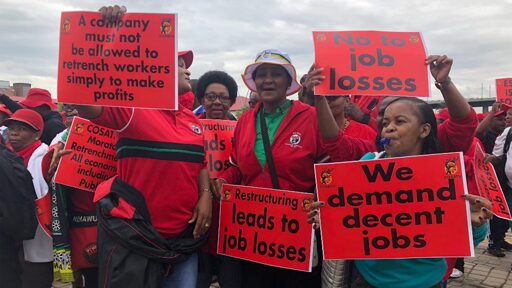

South Africa’s unemployment crisis has deepened, with the latest labor-market figures showing a rise in the official unemployment rate to 33.6% in the second quarter of 2026, up from 32.7% in the first quarter. The figures underline the persistent difficulty South Africa faces in generating sufficient decent and sustainable employment, particularly for young people and women.
According to Statistics South Africa (Stats SA), the number of unemployed people increased by 345,000 to 8.5 million in the second quarter, while employment declined by 16,000 to 16.7 million. The labor force consequently increased by 329,000, or 1.3%, over the quarter.
The official unemployment rate, also referred to by Stats SA as the LU1 measure of labor underutilization, therefore increased by 0.9 percentage points, from 32.7% in the first quarter to 33.6% in the second.
Formal employment under pressure as informal work grows
The employment figures also point to continuing changes in the structure of the labor market. Employment in the formal sector fell by 41,000, while employment in the household sector declined by 9,000. Informal-sector employment, by contrast, increased by 34,000.
The latest figures point to deeper problems in the country’s economic structure, including its capacity to generate productive employment on a scale sufficient to absorb a growing working-age population.
Stats SA’s labor-force data also shows the particular vulnerability of young South Africans. In the first quarter of 2026, the official unemployment rate among people aged 15–34 stood at 45.8%.
A crisis rooted in South Africa’s economic structure
Speaking to BreakThrough News in a personal capacity, Dr. Phillip Dexter, former African National Congress (ANC) member of Parliament and South African Communist Party (SACP) member, says that South Africa’s employment crisis has deep historical roots.
“The unemployment crisis must be understood as the result of two key factors. First is the structural crisis caused by colonialism, apartheid and imperialism.”
According to Dexter, South Africa’s economy was historically structured around the extraction of resources and the utilization of low-waged and relatively low-skilled labor. In his assessment, the persistence of unemployment therefore reflects structural features of the country’s political economy rather than simply inadequate short-term economic growth.
He argues that these historical problems were compounded by the economic changes of the 1980s and 1990s, including deindustrialization and the adoption of neoliberal economic policies.
Read more:South Africa’s anti-immigrant protests expose a deeper national crisis
“The system was thrown into a crisis in the 1980–1990 period when deindustrialization started,” Dexter said, arguing that the influence of the IMF and World Bank and subsequent neoliberal policies contributed to the difficulty of transforming the inherited economic structure. He also pointed to state capture, corruption and maladministration as factors that have further complicated attempts to transform the economy.
The unfinished transformation
More than three decades after the formal end of apartheid, South Africa continues to grapple with highly unequal patterns of ownership, wealth, and economic opportunity.
Dexter says, one of the central failures of the post-1994 period has been the inability to fundamentally alter these structures.
“The failure to adopt radical, progressive policies and implement strategies to reform land ownership, create economic opportunities, to consistently fail to plan to build infrastructure beneficiated minerals,” he said, has contributed to the continued reproduction of what he describes as the political economy of apartheid.
While successive ANC-led governments introduced social programs and measures aimed at reducing poverty and expanding social protection, Dexter argues that these interventions did not fundamentally transform the ownership and accumulation patterns underlying the economy.
“The political economy of apartheid is alive and well and reproducing,” he said.
This assessment comes against a labor market in which formal employment remains under pressure while informal employment has continued to absorb some of those unable to find work in the formal economy.
The latest Stats SA figures show a decline in formal-sector employment alongside an increase in informal-sector employment. For Dexter, this is part of a longer-term trend rather than an entirely new development.
“This trend started in the 1980s and continues,” he said.
He adds that South Africa’s industrial policy has failed to deliver the scale of transformation required to rebuild productive capacity and create mass employment.
Read more: “A declaration of war against the poor”: AbM leads resistance against South Africa’s anti-occupation bill
“The ANC-led governments have paid lip-service to industrial policy measures that should have transformed the economy,” he said.
The consequence, in his view, is an economy that continues to reproduce substantial inequalities in wealth and employment, despite the political transition to democracy.
Young people carry the heaviest burden
The unemployment crisis is particularly acute among young South Africans. With the youth unemployment rate already at 45.8% in the first quarter of 2026, the transition from education into employment remains one of the country’s most serious socioeconomic challenges.
Dexter is critical of approaches that place excessive emphasis on entrepreneurship, skills development, and individual employability without addressing the limited capacity of the economy to create jobs.
“While any measures, such as promoting entrepreneurial opportunities, learnerships, apprenticeships etc. are welcome, it is the failure of capital to invest and of the state to discipline capital to invest” that remains a fundamental problem, he said.
South Africa’s mineral wealth and the employment question
South Africa possesses substantial mineral resources; an established industrial base and sophisticated financial institutions compared to other African countries. But these advantages have not translated into employment on the scale required to substantially reduce joblessness.
For Dexter, a different development strategy would require greater emphasis on industrialization, infrastructure, public investment, and the ability of the state to direct economic resources towards productive purposes. He points to a range of international examples of both progressive and reactionary development models that have overcome similar economic crises. He points to countries such as Japan and South Korea, which benefited from massive Western investment as part of efforts to develop them as bulwarks against socialist countries, as well as Malaysia, Indonesia, and Taiwan, which followed different paths of state-supported development. He contrasts these experiences with China and Vietnam, which he argues have pursued models designed to ensure that society as a whole benefits from the wealth it creates. “This requires vision and planning,” Dexter said. He also points to Scandinavian countries, the Netherlands, Germany and, later, Ireland, arguing that even these social-democratic economies have developed more progressive economic models than South Africa.
For South Africa, he argues that the essential priorities should include investment in people, infrastructure and the social wage, alongside stronger efforts to prevent the continued extraction of wealth from developing economies.
A structural crisis requiring political choices
The latest unemployment figures therefore raise questions that extend beyond the immediate movement of the unemployment rate.
The increase from 32.7% to 33.6% in a single quarter, accompanied by a fall in employment and an increase in the number of unemployed people to 8.5 million, demonstrates the scale of the challenge confronting South Africa.
Dexter believes that addressing the crisis ultimately requires political choices about who controls investment, how natural resources are used, the role of the state and how economic growth is distributed.
“Ultimately it’s about the political will of leaders to act against exploitation and to lead the drive for people-centered development,” he said.
The persistent unemployment and broader economic difficulties have also contributed to the recent scapegoating of migrants in South Africa, as frustration over limited employment opportunities is increasingly directed towards foreign nationals. The question for South Africa is therefore not simply whether the economy can grow, but what kind of growth is being produced, who benefits from it, and whether it can create secure and dignified livelihoods for the millions of people excluded from meaningful employment.
Read more:Over half of Africa’s population suffered from food insecurity: UN report
From BT News via This RSS Feed.