

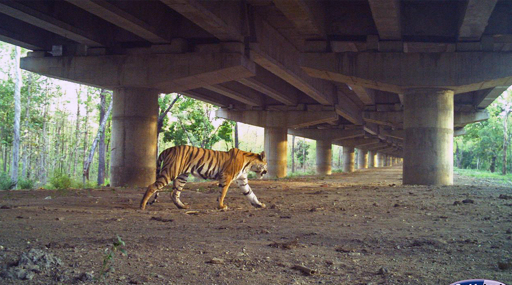
As Bengal tiger numbers rebound in India and increasingly disperse into human-dominated areas, conservationists are urging the government to prioritize protecting ecological corridors that connect vital habitats and tiger populations. But they also warn that corridors shouldn’t become sticking plasters for compromised core habitats, reports contributor Nirmal Ghosh for Mongabay. India is home to roughly 75% of the world’s wild tigers. The national population has more than doubled from an estimated 1,827 in 1972 to an estimated 3,682 in the 2022 census. However, this conservation success has created new challenges. Experts estimate that 35% of India’s wild tigers (Panthera tigris tigris) now live outside protected areas. Young tigers leave their mothers to establish large home ranges, which for males can cover up to 200 square kilometers (77 square miles). In doing so, tigers frequently navigate a highly fragmented matrix of roads, railways and urban sprawl. Without safe pathways, isolated tiger populations risk inbreeding and local extinction. In response to rapid infrastructure development, India has constructed more wildlife underpasses and overpasses than any other Asian country, according to Bilal Habib, a scientist at the Wildlife Institute of India (WII), a government-run research center. This includes the world’s 10 largest wildlife mitigation structures built since 2017, such as a 12-kilometer (7.5-mile) underpass beneath a newly opened expressway connecting New Delhi to the city of Dehradun. “I don’t think anywhere in the world, any developing country has spent as much money as we have on mitigation, exclusively for wildlife conservation,” Habib told Mongabay. At the…This article was originally published on Mongabay
From Conservation news via This RSS Feed.