

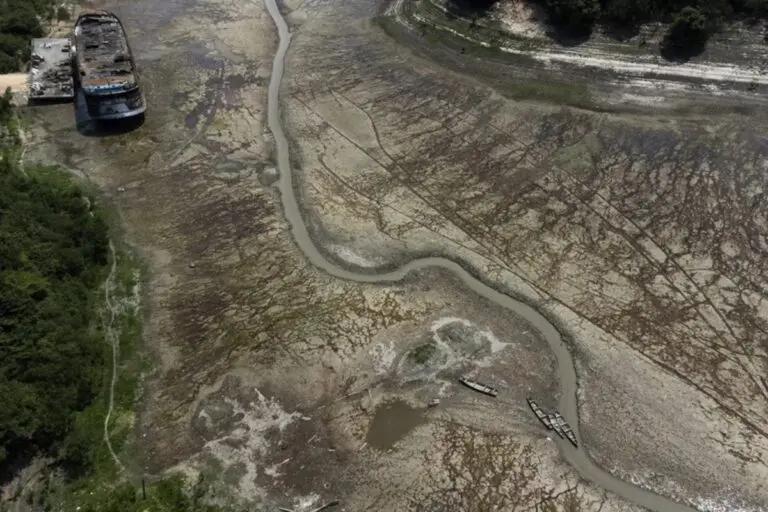
Drought frequency and duration have risen nearly 30% since 2000, with severe conditions affecting the Amazon and other regions.
Droughts are becoming more frequent and longer-lasting, with severe conditions affecting Brazil’s Amazon region and parts of Europe as an intensifying El Niño raises concerns about worsening dry conditions later this year.
RELATED: El Niño Raises Heat, Drought and Cyclone Risks in Cuba
The frequency and duration of droughts have increased by nearly 30% since 2000, according to a report by the United Nations Convention to Combat Desertification (UNCCD). The trend is extending drought beyond traditionally arid regions to areas previously considered less vulnerable.
The issue is among the central concerns at the 17th UN Conference to Combat Desertification, or COP17, being held in Ulaanbaatar, Mongolia, through Aug. 28.
Ola de calor y sequía extrema en Europa colapsan el transporte fluvial y reducen la generación eléctrica
Los ríos Rin y Danubio cayeron a mínimos históricos, los barcos operan a capacidad reducida, los costes logísticos se dispararon y las centrales nucleares e… pic.twitter.com/BRJlq3a9Lm
— teleSUR TV (@teleSURtv) August 10, 2026
Text Reds: Heatwave and extreme drought in Europe collapse river transport and reduce electricity generation
The Rhine and Danube rivers have fallen to historic lows, ships are operating at reduced capacity, logistics costs have skyrocketed, and nuclear and hydroelectric power plants have cut production due to a lack of water for cooling. Does this water crisis expose the urgency of climate adaptation policies that Europe has yet to implement?
UNCCD Executive Secretary Yasmine Fouad said the focus now needs to shift toward implementing measures quickly enough to contain the effects of drought.
“The question is no longer whether to recognize drought as a global risk, but whether to act early enough to prevent its impacts from spreading across communities, economies and borders,” Fouad said.
Projections indicate that by 2050, three out of every four people worldwide could be affected by drought. Global demand for water is also expected to exceed supply by as much as 40% by 2030.
Severe drought hits Brazil’s Amazon
Brazil, home to the largest share of the Amazon rainforest, recorded drought conditions of varying intensity across all five of its regions in July 2026. At least 157 municipalities were classified as experiencing severe drought, marked by sharp declines in soil moisture and water stress in vegetation, with agricultural losses reported.
The number of Indigenous territories affected by severe drought rose from three in June to 17 in July, according to recent monitoring by Brazil’s National Center for Natural Disaster Alerts. The agency identified worsening conditions in the Alto Rio Negro, Parintins, Kaiapó do Pará, Tocantins and Araguaia special Indigenous health districts.
Rural settlements have also been increasingly affected. The number of areas experiencing extreme drought rose from two to 44, while those classified as facing severe drought increased from 102 to 309. Pará, Tocantins, Mato Grosso, Rondônia and Amazonas accounted for most of the affected areas.
Toya Manchineri, an Indigenous leader and general coordinator of the Coordination of Indigenous Organizations of the Brazilian Amazon, said drought and wildfires were threatening territories and the livelihoods they sustain.
“What we are experiencing is not an isolated drought, but an ongoing environmental collapse. The climate crisis is manifesting itself in the daily lives of communities. When the river dries up, the fish disappear, the boat cannot arrive and the forest, once wet, begins to burn,” Manchineri said during the release of a COIAB bulletin in late 2025.
Droughts are also changing in duration as well as frequency and intensity. Humberto Alves Barbosa, coordinator and founder of the Laboratory for Analysis and Processing of Satellite Images at the Federal University of Alagoas, said severe droughts driven by global warming are lasting longer.
Drought conditions spread across regions
The impacts are not confined to South America. The Global Drought Observatory reported that Europe experienced above-average temperatures in July, along with a prolonged heat wave and more intense drought conditions across Europe, Africa, Western Asia and Asia.
The emergence of El Niño is adding to concerns about drought later in 2026. The weather phenomenon is characterized by unusually warm surface waters in the equatorial Pacific Ocean and can alter atmospheric circulation and rainfall patterns in different parts of the world.
The latest forecasts from the World Meteorological Organization indicate that El Niño is expected to be strongest between August and October 2026. The projected rainfall pattern points to drier-than-normal conditions mainly in India and parts of South Asia, southern and eastern Australia, Central America and the Caribbean, northwestern South America and northern Europe.
The World Food Programme estimates that drought and other climate-related events associated with El Niño could significantly worsen food insecurity in 45 countries. A recent analysis projects that the number of people facing acute food insecurity could rise from about 225 million to 275 million if the expected conditions materialize.
From teleSUR English via This RSS Feed.