

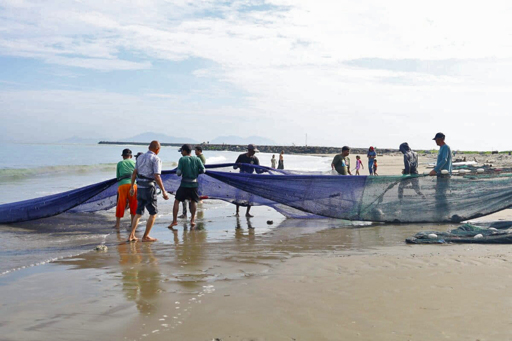
BANDA ACEH, Indonesia — Seven fishers moved in concert along the shore of Gampong Jawa Beach in Banda Aceh, Indonesia’s westernmost city, hauling in a blue net nearly half a mile long from the Indian Ocean. “Forward … Keep it going … Now, move back!” instructed Surya Abid, the panglima laot, or “sea commander,” of the Gampong Jawa community. The practice known as tarek pukat is a form of community fishing dating to the Aceh Sultanate, which ruled here from the 15th century until defeat to the Dutch colonial navy in 1903. Its rules are overseen by the panglima laot, an Indigenous Acehnese institution that governed fishing through customary law long before the existence of the modern Indonesian state. Toward the end of 2004, a 9.1-magnitude earthquake under nearby Simeleue Island triggered the infamous Indian Ocean tsunami — a disaster that, in Gampong Jawa, wiped out more than 90% of the population. Memorials in and around Banda Aceh are built 30 meters (100 feet) high to honor those lost and remind future generations of the wave height that left 167,540 people dead or missing in Indonesia alone. Today, only a small number of fishers still work together handling these vast nets to catch fish, following unwritten customary rules to protect threatened marine species including sea turtles and their eggs. In Gampong Jawa, those rules are overseen by Surya, the local panglima laot. Efendi, an assistant to the panglima laot (customary fishery lead), mends a torn fishing net. Image by Nurul…This article was originally published on Mongabay
From Conservation news via This RSS Feed.