

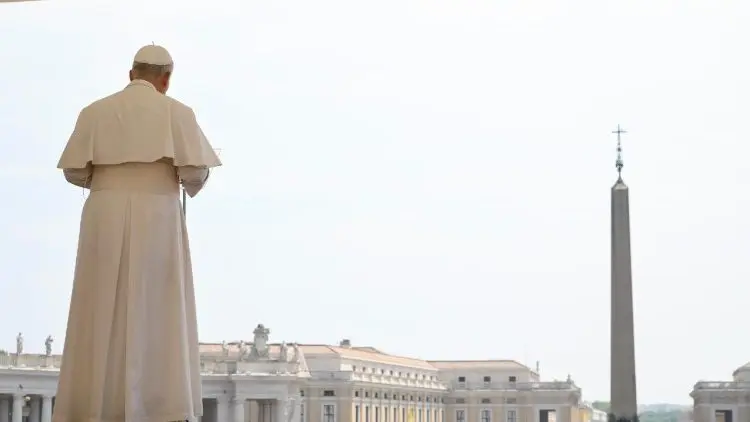
West Bank violence prompts Pope Leo XIV to urge international action, protection for Palestinians and renewed progress toward a two-state solution.
Related: Europe Wildfires Trigger Pope’s Urgent Prayer Appeal 2026
West Bank Violence Prompts Pope Leo XIV Appeal
West Bank violence has prompted Pope Leo XIV to call on the international community to accelerate efforts toward a two-state solution and protect Palestinian civilians in the occupied territory.
The pontiff made the appeal on Sunday, August 16, after reciting the Angelus before pilgrims gathered at the Pontifical Villas in Castel Gandolfo, south of Rome.
“I renew my appeal for an end to the repeated violence against the Palestinian civilian population in the West Bank,” Pope Leo said.
He also urged the international community to work urgently toward a two-state solution capable of producing “a just and lasting peace” in the Middle East.
The Pope’s statement came as the United Nations warned that violence by Israeli settlers and military operations in the occupied West Bank had reached unprecedented levels.
UN officials have called for accountability and urged all parties to reject the idea that the conflict can be resolved through military force. They have also warned that settlement expansion, forced displacement and collective punishment are undermining any future political agreement.
Pope Leo’s appeal did not identify specific incidents or name individual Israeli officials. However, it addressed the broader pattern of repeated attacks against Palestinians and the growing insecurity in cities, towns and rural communities across the West Bank.
The pontiff’s comments reflect the Vatican’s long-standing support for a political agreement in which Israel and Palestine coexist within secure and internationally recognized borders.
The Holy See has consistently stated that a two-state solution is the only viable path toward a just and durable peace, provided that both peoples are guaranteed equal dignity, security and rights.
The Pope’s intervention also comes as Israeli authorities advance or approve new housing units in settlements across the West Bank and occupied East Jerusalem.
UN officials say the expansion of settlements, together with settler attacks and military restrictions, is contributing to the de facto annexation of Palestinian land.
West Bank Violence Draws UN and Vatican Concern
United Nations Office for the Coordination of Humanitarian Affairs | United Nations Special Coordinator for the Middle East Peace Process
The escalation of West Bank violence has drawn growing concern from the United Nations, which has described the territory as being at a breaking point.
UN officials reported that Israeli forces and settlers had killed 76 Palestinians in the West Bank during 2026, including 18 children.
They also said approximately 3,800 Palestinians had been displaced, nearly half of them children, because of settler violence, demolitions and evictions.
The UN documented more than 1,430 settler attacks that caused casualties or property damage across approximately 260 Palestinian communities.
Many of those incidents allegedly took place in the presence of Israeli forces. UN officials have urged Israel to prevent settler attacks, protect Palestinian communities and hold perpetrators accountable.
The United Nations also reported that Israeli authorities had advanced or approved approximately 12,360 settlement housing units across the West Bank during the year, including 5,160 units in occupied East Jerusalem.[aljazeera]
The settlements are considered illegal under international law by most countries and the United Nations. Israel disputes that position and maintains that the final status of the territory should be determined through negotiations.
The settlement expansion has practical consequences for Palestinians. New roads, security zones and military restrictions can separate communities from farmland, schools, health centers and places of employment.
In some areas, Palestinian families have been forced to leave their homes after attacks, demolition orders or the creation of new outposts.
The UN has described these developments as interconnected rather than isolated. Officials say the combination of settlement growth, violence and displacement is weakening Palestinian governance and changing the territorial reality on the ground.
Pope Leo’s appeal comes amid those warnings. The Vatican has also emphasized that a political solution requires the protection of civilians and an end to unilateral decisions that undermine the status of holy places and internationally recognized borders.
The Catholic Church in the region has reaffirmed its support for local communities. Church representatives have visited Palestinian towns, including Taybeh, described as the last entirely Christian village in the occupied West Bank.
The visits were intended to demonstrate solidarity with residents facing violence, land seizures, movement restrictions and economic pressure.
Christian communities in the West Bank have declined over the past decades because of emigration, insecurity and economic hardship. Church leaders have warned that continued violence threatens the survival of historic Christian communities in Palestine.
The Catholic Church has called for international action to prevent further displacement and protect the rights of all civilians, regardless of religion.
The Pope’s message also included a call for international institutions to prioritize the protection of civilians in the occupied Palestinian territories.
He said peace would require more than temporary reductions in violence. It would also require addressing the political and territorial issues that have sustained the conflict.
Two-State Solution Faces Mounting Obstacles
United Nations and the Question of Palestine | Vatican—Holy See and the Middle East
The West Bank violence is taking place as the two-state solution faces increasingly serious political and territorial obstacles.
The proposed framework would establish an independent Palestinian state alongside Israel, generally based on the borders that existed before the 1967 war, with negotiations over final-status issues.
Those issues include Jerusalem, settlements, borders, security arrangements, refugees and the distribution of water and other resources.
The expansion of Israeli settlements has reduced the geographic continuity of Palestinian communities. Many analysts argue that the growth of settlements and outposts is making it more difficult to create a viable Palestinian state.
The Palestinian Authority exercises limited self-government in parts of the West Bank, but Israeli military control remains extensive.
The territory is divided into areas with different administrative and security arrangements. Checkpoints, road closures and military orders affect movement between Palestinian towns and villages.
The situation has become more severe in the northern West Bank, where Israeli forces have imposed military closures on refugee camps in Tulkarm, Nur Shams and Jenin.
The closures have restricted access to homes and services and have contributed to the displacement of Palestinian families.[news.un]
Israel says military operations are necessary to prevent attacks and dismantle armed groups. Palestinian officials and human rights organizations say the operations impose collective punishment and violate the rights of civilians.
The dispute over security measures is central to the political conflict. Israel demands guarantees against attacks, while Palestinians say permanent military control and settlement expansion prevent the establishment of a sovereign state.
Pope Leo called for an end to violence and renewed diplomatic efforts, but the political conditions needed for negotiations remain absent.
The war in Gaza has further weakened prospects for dialogue. The destruction and mass displacement in Gaza have deepened mistrust between Israelis and Palestinians and intensified regional tensions.
The West Bank has also become a focal point for international diplomacy. European governments and the United Nations have called for the protection of civilians, an end to settlement expansion and the preservation of the possibility of a two-state agreement.
Some countries have imposed sanctions on individuals or organizations connected to settler violence. Others have called for stronger international measures against the occupation.
The Vatican has maintained diplomatic relations with Israel and supports recognition of Palestinian statehood. It has repeatedly urged both sides to return to negotiations and reject military solutions.
The Pope’s statement therefore combines a humanitarian appeal with a diplomatic position. He is asking for immediate protection for civilians while supporting a long-term political framework.
Geopolitical Context
The escalation of West Bank violence has consequences across the Middle East and beyond.
Continued attacks and settlement expansion can trigger wider confrontations involving Palestinian armed groups, neighboring countries and regional actors aligned with either side.
The situation also affects relations between Israel and European governments, many of which support Israel’s security but oppose settlement expansion and the displacement of Palestinians.
For Arab governments, the West Bank remains central to the Palestinian question. Any perception that annexation is advancing could undermine diplomatic initiatives and increase public pressure on governments to act.
The conflict also has implications for international law. UN officials say settlements lack legal validity and constitute a violation of international law, while Israel disputes that interpretation.
The Pope’s appeal reflects the position of many international institutions that neither military occupation nor settlement expansion can produce lasting peace.
The future of the two-state solution will depend on whether international actors can halt violence, protect Palestinian communities and prevent further changes to the territory.
Pope Leo also referred to the Mediterranean Games, which opened in Taranto, Italy, bringing together athletes from Africa, Asia and Europe.
He expressed hope that the sporting event would become a symbol of peace and fraternity among the peoples of the Mediterranean and the wider world.
The reference connected sport with diplomacy and cooperation at a time of deep regional division.
For the Vatican, the message is clear: peace requires both an immediate end to attacks and a credible political process based on equal rights.
Without those conditions, the West Bank violence is likely to continue undermining the prospects for negotiations and deepening the humanitarian crisis.
Papa León XIV exige detener la violencia contra civiles palestinos en Cisjordania ocupada y urge a garantizar la solución de dos Estados para una paz justa. #teleSUR #PalestinaLibre #Cisjordania #16Ago pic.twitter.com/SUr5xbKKI2
— teleSUR TV (@teleSURtv) August 16, 2026
From teleSUR English via This RSS Feed.