

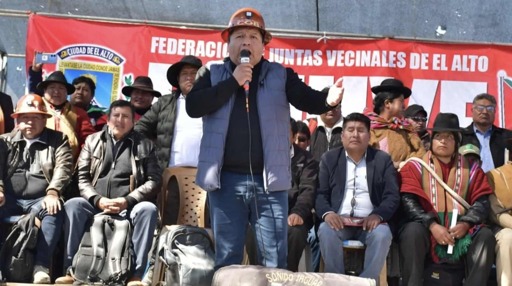
For 50 days, from May to June, the Bolivian people carried out a relentless struggle against their right-wing, Trump-allied government. Through roadblocks and other direct actions, the popular masses — workers, peasants, Indigenous people, and the poor — shut down the capital city of La Paz to incoming and outgoing traffic. This popular rebellion was one of the world’s most advanced examples of class struggle in recent times. The struggle persisted even though it received little support from the mass organizations that claim to represent the working class and the oppressed, including the MAS, the party of former presidents Luis Arce and Evo Morales, and the COB, the largest trade union federation.
The Bolivian people fought with the methods at their disposal, setting up roadblocks around the cities to snarl traffic and bringing the transport of goods to a halt. At the height of the struggle, there were almost 100 roadblocks across the Andean country; demonstrators used rocks, scrap, burning tires, and their own bodies to block the flow of traffic. Actions were typically organized and debated democratically in neighborhood assemblies and councils. One advanced example of this was the District 8 Blockade Coordinating Committee. It was organized by the movement’s rank and file in the working-class District 8 of El Alto and held town halls and assemblies to democratically discuss and debate next steps for the movement. They stood firm in defense of the rebellion’s demand for Paz’s resignation, rejecting any dialogue with the government until their demands were met. They also opposed any leaders who abandoned that demand made by the rebellion.
The rebellion demonstrated that though the Right has temporarily, and with the complicity of the largest unions in the country, dispersed the demonstrations, it will not implement its plans with ease. The struggle in Bolivia has not been buried. A new chapter will soon be written.
Paz Exacts Retribution on the Bolivian People
Bolivian state forces, under the direction of Paz, an ally of the Trump administration, are carrying out a brutal crackdown across Bolivia against the members of the country’s poor who led the rebellion.
At the end of June, Paz declared a “state of exception” across the country to break up all road blockades and direct actions by the Bolivian people. “I have instructed the Bolivian police and the armed forces to take necessary action to restore transport,” he announced.
As part of the “state of exception,” the government instituted sweeping restrictions on democratic rights, prohibiting all public meetings and demonstrations. It empowered the military to support the police in breaking up roadblocks and to set up military checkpoints along highways and at electrical plants, airports, and other sites.
The government has already arrested various leaders of unions and peasant and Indigenous organizations, including David Quispe Machaca of the United Rural Workers Union Federation (CSUTCB), as well as David Mamani and Vicente Salazar of the peasant group Federación Tupac Katari. Police raided Mamani’s home and arrested his wife for “the purpose of investigation.” They also took into custody Shirley Prieto, a mother of three and the wife of a Blockade Coordination Committee leader in the city of El Alto.
To these names, at least dozens, if not hundreds, more could be added. The Prosecutor’s Office for the Department of La Paz reported that it has opened criminal proceedings against 114 people. The prosecutor himself, meanwhile, has said 335 people are under investigation and 26 are under “preventive detention.” In many cases, the Bolivian state has leveled charges of “terrorism” against several demonstrators and social movement leaders; in some cases, these charges carry a sentence of up to 20 years.
In response, organizations like Professionals for Human Rights and against State Repression have denounced the repression and prosecution of the rebellion’s leaders by the Paz government. La Izquierda Diario Bolivia, the socialist publication of Left Voice’s sister group in Bolivia, the LOR-CI (the Revolutionary Workers League — Fourth International), has fought to break the media blackout of the repression and has called for a broad and internationalist campaign against the state of emergency.
A Historic Rebellion
The Paz administration launched its wave of repression as a direct response to the popular rebellion. Though the unifying demand of the Bolivian people was Paz’s removal from office, various struggles were expressed within this demand. For example, there was the fight against land consolidation, the fight to reverse Paz’s new tax breaks for the rich, and the struggle by transport workers to reinstate the subsidies on gasoline and stop the proliferation of “junk gasoline,” which caused widespread breakdowns of their vehicles.
In each of these fights, the target was not only the right-wing president but also the neoliberal agenda demanded by Trump for Latin America. The most glaring expression of this is Paz’s promise to enter into a loan agreement with the International Monetary Fund, a measure that no previous government could impose, given the massive popular rejection of all institutions of international finance capital and U.S. domination. Toward the end of July, the IMF announced it would issue a $1.9 billion multiyear loan to Bolivia, which would be accompanied by additional loans from the World Bank and Inter-American Development Bank.
While the largest official trade union and peasant organizations entered into “dialogue” with the government, rank-and-file workers and peasants formed “self-organized blockade committees” (comités de bloqueo autoconvocados) to maintain the struggle in the streets.
The Betrayal of the COB Opens the Door to Paz’s Counterattack
The Central Obrera Boliviana (the Bolivian Workers’ Center, known as the COB) is the country’s largest and most well-recognized trade union federation, representing, among other sectors, miners, industrial workers, transport workers, and teachers. Despite its strength, it repeatedly refused to organize a general strike in support of the movement — the one method capable of bringing down the Paz government and winning the demands of the popular masses.
Then, in June, its leaders openly betrayed the struggle by signing an agreement with the Paz government. As part of the agreement, signed by Paz and COB president Mario Argollo behind closed doors, the COB signaled its support for ending the mobilizations in exchange for “guarantees” from the government that it would not further privatize “strategic” state enterprises or sell off “strategic” resources to private interests. The agreement does not specify which assets are “strategic” or what will be done with nonstrategic assets. In doing so, the COB leaders abandoned the most popular demands of the Bolivian masses — the renunciation of Paz and the reversal of all newly enacted laws and decrees on land, gasoline subsidies, and taxation.
Just hours later, with the assurance that the COB would not defend the popular rebellion, Paz and his allies instituted a state of emergency across the country, just as they had been promising to do for weeks, and called on the police and the military to forcibly break up the roadblocks and arrest demonstrators, including some of the most visible figures of the movement.
The repression of the Bolivian people is part and parcel of the Trump administration’s attempt to reassert its dominance in the region, dressed as a war on “far-left terror,” in the words of Marco Rubio. It is the same campaign as Trump’s extrajudicial assassinations in the Caribbean, the U.S. military incursion into Venezuela at the beginning of the year, the kidnapping of Venezuelan president Nicolás Maduro, and the encirclement and blockade of Cuba, which has crippled the energy system on the island nation.
Strategic Lessons
The democratic organization from below of roadblocks, assemblies, and councils (cabildos) was among the most advanced expressions of workers’ self-organization that the continent has seen in recent years. In this experience, there are several strategic lessons for the working class and oppressed:
- Advance organization from below: Self-organization allowed for the development of direct action and the expression of the most left-wing demands. This was most evident in the autoconvocados assemblies, where workers, neighbors, and Indigenous people refused to withdraw from the streets or to give in on their demands, despite the lack of support from the organizations that claim to represent them. In this, there were echoes of the movement against ICE that shook Minneapolis and St. Paul, Minnesota, in January, when neighbors organized ICE watches, grocery deliveries, and wildcat actions, even when the largest unions stood by idly.
- No faith in the bureaucratic leaderships: Neither the MAS nor the COB leadership can be trusted to defend the movement in the streets. Throughout the course of the 50-day struggle, the MAS leadership was nowhere to be seen. Former president and MAS party leader Evo Morales, while criticizing Paz’s state of exception decree, called for a “pause” in the demonstrations, echoing the leaders of the COB, abandoning the legitimate demands of the people and allowing the government’s offensive to go unchecked.
- Organize the unorganized: The unions must be rescued from the bureaucratic leaderships and placed in service of popular struggles. At the same time, workers must demand that the unions stand up for the unorganized and nonunionized layers within the working class. The LOR-CI, Left Voice’s sister organization in Bolivia, has put out the call for workers of the COB to organize a rank-and-file congress that would challenge the conciliation and passivity of the leadership. “It is time to fight to recover our trade union organizations and put them at the service of mobilization and struggle,” their statement says. This congress must have “delegates elected in assembly, mandated and revocable at any time, with a delegate for every 20 workers and with the will to organize the hundreds of thousands who, over the last three decades, have been victims of labor precarization and who today constitute the vast majority of the working class.”
- Working-class hegemony is necessary: In large part because unions abstained from the struggle, a divide emerged between the peasant and neighborhood organizations outside La Paz, which led the road blockades and direct actions, and working people within the city, who were left without food staples and other basic goods for weeks on end. To overcome this divide, the organized working class must enter the fight and set up committees for the distribution of food, medicine, and other essential goods to working-class and poor neighborhoods, create community dining halls, and so on, to ensure the security of the blockades, overcome the hunger faced by working people, and secure the alliance between the masses of the countryside and those of city.
- Extend international solidarity: The most advanced layers of the working class in the imperial core must defend the Bolivian people and all people of the Global South struggling for land and their resources. This is particularly true as Trump attempts to impose his agenda on Latin America, plundering its resources and imposing crushing debt through institutions like the IMF and World Bank, and as key figures around Trump, like Rubio and Pete Hegseth, slander Bolivia’s working people as “narcoterrorists” and demand state repression against them. An alliance of workers and poor people across the Americas, from Minneapolis to Bolivia, would pose a serious challenge to Trump and his Latin American vassals.
What Comes Next?
It is commonplace to note that the Far Right has advanced across Latin America, with electoral wins in Argentina, Bolivia, Colombia, Peru, and elsewhere. But nowhere has it achieved hegemony over society, and in every instance, there are countertendencies on the Left, struggling for democratic rights, improvements in living conditions, and against cutbacks. The struggle of the Bolivian people against Paz was the clearest example of this countertendency. Through their fight, they demonstrated the popular rejection of repression and the plunder and sell-off of their country to multinational interests. In the next chapter of their struggle, the Bolivian people will draw on the lessons of this fight and will set an example for the world of not only how to resist but also how to win.
The post The Next Chapter in the Bolivian Struggle appeared first on Left Voice.
From Left Voice via This RSS Feed.