


By JAMES MARKIN
On Aug. 2, activists gathered across the country by Zoom and in person for a forum on the repression of the Palestine movement. The speakers were Judy Greenspan, an OEA Oakland teacher, and member of the OEA executive board, OEA for Palestine, and Bay Area Labor for Palestine; Shelly, a paralegal and member of the UAW, Labor for Palestine, United All Workers for Democracy (UAWD members organized a successful vote against Israel bonds); Ze Maria, the Brazilian socialist and trade unionist who has been arrested for speaking out against the genocide in Gaza; and Bryan Ford, a New Jersey educator who has faced repression at work for his activism.
Repression of the Palestine movement in K-12 education
Judy started by talking about the Palestine solidarity movement in the Bay Area and in the teachers’ unions. She talked about her role in bringing forward a resolution at the NEA assembly to drop the Anti-Defamation League, outlining the organization’s racist and sexist history. While the motion passed at the 2025 NEA Assembly, Zionist pressure groups went on the attack and threatened NEA leadership into overruling the motion.
Despite the NEA executive board’s cowardice in quashing the democratic voice of its own delegates, the attacks on the union continued anyway. The Brandeis Center unleashed a federal civil rights complaint against the NEA following the vote to drop the ADL. Judy pointed out, “The irony is that even though the NEA decided to distance themselves, they still got sued. I have been told that the lawsuits have cost the NEA millions of dollars.” In the end, the Brandeis Center even tried to destroy the union by going after its charter.
On the East Coast, similar repression of K-12 educator activists is also on-going. Panelist Brian Ford started by talking about his fellow activist Meadow, whom he replaced on the panel: “Students, especially students from Palestinian and Arab backgrounds, needed an advisor for a Palestine club. She answered that call and began a protracted employment battle, which she ultimately lost. Part of that loss is that she had to sell her home, and the closing of the home is why she’s not here with us today.”
He continued by talking about the repression he had faced: “My story is similar. … I mentioned BDS when I was interviewed by a student journalist for our school newspaper. After a Zionist colleague complained, the article was pulled down. But I was able to get it put back up. Shortly after that I warned the admin, this antisemitism angle is going to get pushed further. The IHRA stuff is coming. I gave them resources. I offered my time to educate them. I offered trainings. It fell on deaf ears.”
The next school year, Brian got into conflict with students and administration over his role as advisor to the school’s SJP chapter. In the spring of 2022, Brian was placed on paid leave, allegedly over a non-political social media post of his that a parent found to be “vulgar.” Brian said, “They let me hang for the entire 2022-2023 school year while still paying me and my subs. A union lawyer said no news is good news. In 2023, I got a surprise email being asked back, but in reentry I was told that the ‘plug got pulled.’ I then didn’t hear anything until 2024, when I heard that they were bringing tenure charges against me.”
The Palestine struggle in the UAW
Another panelist, Shelly, a non-profit lawyer, talked about the fight she and her coworkers have had organizing for Palestine in their workplace and the UAW.
Shelly explained how her employer took every opportunity to harass and retaliate against pro-Palestine activists, even in the most mundane ways: “My employer claims to be a social justice-oriented organization, however we can’t put up anything in the office pertaining to the ‘Israel-Gaza conflict.’ “
Shelly spoke about the historic moment when she and other activists passed a resolution that divested the UAW from Israel bonds: “The fight to get the UAW to divest has been going on for 50 years since League of Revolutionary Black Workers in the 1970s.” While divesting from bonds was only a partial victory, she said, winning it was still an emotional point of pride.
Political repression of the labor movement
Shelly explained that as soon as her local passed a resolution in solidarity with Palestinians it made them a target for repression. “In early 2024 we got a request from the House Committee on Education, etc. The modern day HUAC. We had seen that university presidents testifying in front of this committee did nothing to help the universities so we refused to cooperate with the request to voluntarily provide info that would allow the congressional committee to go after our members. It prompted them to subpoena us. Our president had to go in for a deposition. I think we still took the right approach. We refused to make the state’s attempts to repress us easy. One thing that keeps coming back is that attacking workers over this issue gives the state an easier time going after unions.” She also said that the Brandeis Center came after her local, purporting to represent members who were harmed by this resolution, costing the union heavily.
Shelly also talked about similar repression against not just her local, but the UAW International, explaining, “The UAW has had a federal monitor for years following corruption allegations against the previous leadership, but it’s become clear that the monitor sees his job as not just anticorruption, but as a political cop. After the UAW put out a pro-ceasefire statement, the monitor called the UAW president Sean Fein and told him that comparing Israel to fascists and apartheid was crossing a line. He even said that ‘if Israel actually wanted to commit genocide it wouldn’t look like this.’ It is disgusting that the monitor can do this against the union. The monitor has decided to open investigations against [UAW President Shawn] Fein for disputes with other officials. It’s easy to see that these are just a pretense to bust the biggest union. The government is not a friend of labor. They aren’t seeking accountability; they are seeking control.
The international struggle
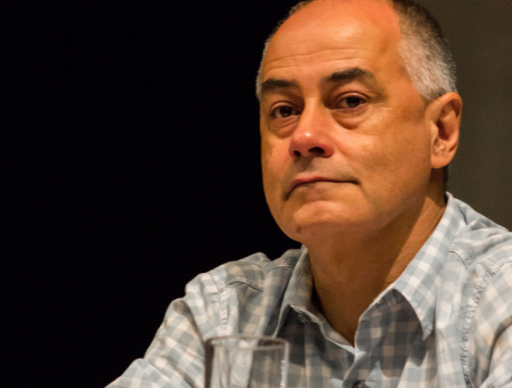
Ze Maria, a Brazilian trade-union leader and a leader of the Partido Socialista dos Trabalhadores Unificado (PSTU), spoke on the panel over video call about the criminal case pending against him for giving pro-Palestine speeches. He said that “I was arrested during the night and sentenced to two years in jail. All for speeches where I spoke out against the genocidal Zionist regime! I want to be clear about two major things in this case. First: I defend my characterization of the Palestinian resistance. We consider all actions of the Palestinian people in this struggle as part of the right to rebellion against tyranny. We cannot accept that these people will be called terrorists because of the pressure of the Zionist movement.
“Second: I defend my call for the end of the state of Israel. Trying to equate this position with an antisemitic position is wrong. The people who have inhabited the region, both Jews and Palestinians, should have equal rights; this cannot be the case under a state governed by Zionism, the racist colonialist ideology which has created the state of Israel.”
Ze continued by debunking the argument that the speeches he had made were racist. “The basis of my charge is that by calling for the end of the state of Israel, by defending the legal right of Palestinians to resist colonialism, I was being racist, I was being antisemitic. Let’s be clear, there is no equation of this with antisemitism I call for an end to the state of Israel because it’s the only way to bring an end to the genocide. We want a democratic non-racist Palestine where everyone can live with equal rights, both Jews and Palestinians.
“It is wrong to equate the end of Israel with the end of the Jewish people. Just as when we called for the end of apartheid in South Africa, we were not calling for the end of the whites, just that everyone had to live together in peace.”
Ze pointed to fact that his charges stemmed from a recent offensive by Zionists against Palestine activism, not any history Brazilian sympathy for Israel: “For decades, officially, the Brazilian state denounced Zionism as a racist ideology. Up until very recently there was no recourse under Brazilian law for charges like the ones against me. This is part of a larger offensive of the Zionist moment to defend the barbarism of the state of Israel in this region and to silence those who speak out against their atrocities”
“This is about a democratic movement that defeats this offensive by Zionism. I have been issued and sentenced, and there is soon going to be a ruling on another case against me. But I am not the only one, there are dozens of activists who have been sued for the same reason. With the complicity of the governments of the world for the treatment of the flotilla.
“People in Brazil have attempted to approve a law that would criminalize all criticism of Israel, along the lines of the IHRA definition that has been used in the US and UK. They are trying to give a new legal basis to silence voices in support of Palestine. It is important because Israel is more and more violent and more and more desperate because Israel has never been this politically isolated. After 80 years of genocide, now, the whole world can see what they are doing on social media. There is no why for them to hide their crimes. That is why they are proceeding with this desperate attempt to silence the voices that criticize the state of Israel. Israel is getting more and more hated.”
He also pointed to broader structural trends in the world political-economic system leading to an increase in authoritarian behavior by governments world-wide: “Given the decline of the capitalist system there is an ever-growing tendency to strengthen the authoritarian mechanism of the state to silence the opposition. You can see this in the US very clearly with the behavior of Trump. But this was not just in the US, we have also seen it in, Chile, Argentina, indeed across Latin America and even in Europe. It is part of the decline of capitalism; it is getting worse and worse so it needs to impose more and more its politics to the people of the world.”
Finally, Ze called on activists all over the world to build a movement that doesn’t just fight for Palestine, but also in defense of civil and democratic rights in their own countries: “Comrades, there is a need for a large campaign to fight this offensive of Zionism, which seeks to silence and criticize the people who fight for Palestine. To take the democratic struggle to fight against the demonization of the struggle of those who fight for Palestine. This is not abandoning the struggle of Palestine but quite the opposite. In Brazil there is a general feeling of the population against the genocide but small demonstrations because of the lack of the tradition of internationalist struggle. The ruling Workers Party will rhetorically denounce the genocide but will not take concrete measures against it. Brazil has maintained kept its relationships with Israel even though the president has made speeches against the genocide. This helps keep the population that repudiates the genocide from the movement. We need to continue to spread the movement and expose what is happening with the genocide.”
The struggle continues
The panelists ended by pointing to the fight ahead and centering the struggle of the Palestinian people in making their own destiny. As Judy put it, “I believe that the people of Palestine will win, and I think educators need to keep up the struggle. We need to support aid to those who might be fired, but we must not let ourselves be intimidated by a small but loud pro-Israel group.”
Shelly agreed and pointed out that there was no going back to the public acceptance for Zionism of the pre-Oct. 7 days, saying, “The high degree of repression exists because of the silent agreement everyone had that Zionism was compatible with liberalism has been shattered and there is no coming back from that. I would like to take heart in that and take heart in the fact that we are winning.”
Ze agreed, adding, “The Democrats and Republicans in the U.S., the Workers Party in Brazil, the ruling parties of the world are terrified of the Palestinian solidarity movement. It shows the real power that we have as workers in supporting the Palestinian people in their struggle for liberation.”
Photo: Brazilian socialist and Palestine solidarity activist Ze Maria.
The post Activists speak on the repression against the Palestine solidarity movement first appeared on Workers’ Voice/La Voz de los Trabajadores.
From Workers’ Voice/La Voz de los Trabajadores via This RSS Feed.