

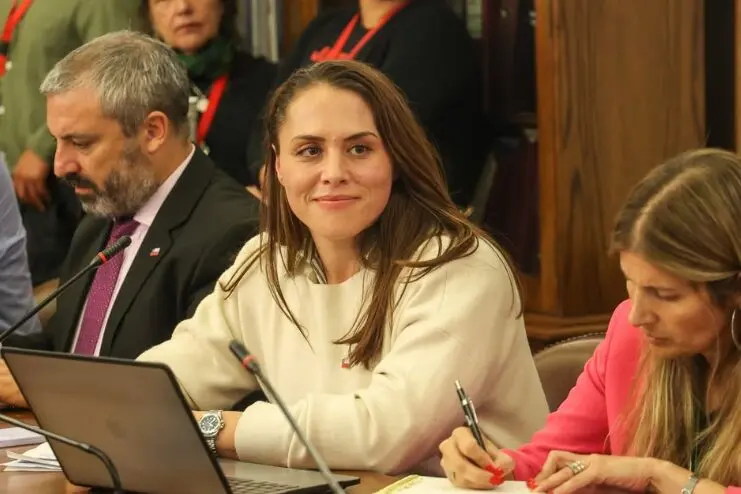
Chile gender parity declines as women lead just 8 of 24 ministries after recent changes, prompting criticism from lawmakers and feminist groups.
Related: Chilean Lawmakers Reject Five‑Year Suspension of Karin Anti‑Harassment Law
Chile Gender Parity Falls After Cabinet Reshuffle
Chile gender parity has come under renewed scrutiny after recent changes reduced women’s representation in the national cabinet to eight of the country’s 24 ministries.
The controversy intensified this week after Sports Minister Natalia Duco resigned and was replaced by government official Francisco Riveros.
The change followed earlier cabinet adjustments in which Trinidad Steinert was replaced by Martín Arrau in the Security Ministry, while Mara Sedini was replaced by Claudio Alvarado in the General Secretariat of Government.
The successive changes have shifted the cabinet’s composition to 63.6 percent men and 36.4 percent women.
Political and legislative sectors have criticized the decline, arguing that the replacement of female ministers by men weakens progress achieved in recent decades.
The issue has also been raised by feminist organizations and women’s rights advocates, who say gender balance in government should not depend solely on the personal decisions of presidents or individual cabinet reshuffles.
The criticism comes amid a broader debate over women’s political representation in Chile. The country has made significant progress in placing women in high-level public positions, but that progress has not always been permanent.
The first gender-parity cabinet in Chilean history was established in 2006, during the first government of former President Michelle Bachelet.
Bachelet appointed 10 women and 10 men to her original cabinet, fulfilling a campaign promise to create a government with equal representation.
Her administration also expanded the principle of parity to undersecretariats, regional authorities and other senior public positions.[heraldnet][nacla]
In 2022, President Gabriel Boric formed Chile’s first cabinet with a majority of women, appointing 14 women and 10 men. The team included women in traditionally powerful positions such as the Interior Ministry and the Foreign Ministry.[blogs.lse.ac]
The latest decline has therefore been interpreted as a reversal of institutional gains rather than a simple administrative adjustment.
#Chile: el Tribunal Constitucional frenó la megarreforma económico-tributaria del ultraderechista Kast.
Declaró inconstitucionales normas que debilitaban la protección ambiental y anuló indemnizaciones por RCA anuladas judicialmente.
— teleSUR TV (@teleSURtv) August 14, 2026
Chile Gender Parity Debate Focuses on Power
Chile’s Ministry of Women and Gender Equity | Economic Commission for Latin America and the Caribbean—Gender Equality
The debate over Chile gender parity has focused on whether women are being removed disproportionately from positions with the greatest political influence.
Representative Paula Olmos of the People’s Party criticized what she described as the systematic replacement of female ministers with men.
Olmos said the loss of women in decision-making positions marginalized them from areas where national policies are designed and implemented.
She argued that institutional parity and gender equality cannot be reduced to rhetorical commitments without concrete measures in public administration.
The lawmaker’s comments reflect concerns that women may remain present in the cabinet but become concentrated in less influential portfolios.
In many governments, the most politically powerful ministries include the Interior, Finance, Foreign Affairs, Defense, Public Security and the General Secretariat of Government.
If women’s representation declines primarily in those portfolios, the numerical percentage may not fully capture the loss of influence.
The recent changes have placed men in the Security Ministry and the General Secretariat of Government. Those ministries play a central role in coordinating the administration’s political agenda and public response.
The replacement of Natalia Duco in the Sports Ministry also became a symbol of the debate because she was one of the women ministers who remained visible in the government.
Duco is a former elite athlete and national shot-put champion. Her appointment had been presented as an example of professional diversity within the cabinet.
Her resignation and replacement have been interpreted by critics as another step in the reduction of female participation.
The government has not issued an official response to the criticism. It has also not announced whether future appointments will seek to restore a gender balance closer to 50 percent.
Organizations supporting gender equality have called for the cabinet to be restructured according to the advances achieved by women in recent decades.
They argue that a representative government should reflect the composition of the population and include women in all areas of decision-making.
Supporters of parity say women’s participation improves the range of perspectives considered when governments design public policies.
They also point to the importance of women’s leadership in issues such as health care, education, social protection, labor rights, violence prevention and care policies.
Opponents of mandatory parity argue that appointments should be based primarily on professional qualifications, political agreements and the president’s right to select ministers.
The debate is not limited to Chile. Governments throughout Latin America have adopted different forms of gender quotas and parity rules for legislatures, political parties and executive appointments.
Chile has often been recognized for making early progress in the formation of parity cabinets, especially during Bachelet’s administrations.
However, scholars have also noted that parity has not always been legally binding. Without permanent institutional mechanisms, the proportion of women can change when presidents reorganize their governments.
— teleSUR TV (@teleSURtv) August 9, 2026
Cabinet Changes Raise Representation Concerns
Chilean Chamber of Deputies | UN Women—Leadership and political participation
The current Chile gender parity controversy is linked to the broader political consequences of cabinet restructuring under President José Antonio Kast.
Earlier changes had already reduced the number of women in the administration. In May, reports indicated that the departure of Trinidad Steinert and Mara Sedini had lowered women’s share of the cabinet from approximately 45.8 percent to 40.9 percent.[theclinic]
The removal of Duco has now reduced the figure further, according to the article.
The pattern has led feminist groups to question whether women are being treated as more replaceable than men during political adjustments.
They have called on the government to apply equality criteria when filling vacancies and to ensure that women are not excluded from ministries linked to security, the economy or foreign policy.
The issue is also connected to political legitimacy. Governments often use cabinet composition to communicate their values and priorities.
A cabinet with balanced participation can signal inclusion, while a cabinet dominated by men may reinforce the perception that political authority remains concentrated in traditional male networks.
The debate is particularly significant in Chile because women have played a central role in the country’s recent political history.
Bachelet became Chile’s first woman president in 2006. She later served as executive director of UN Women, where she promoted women’s political participation and gender equality internationally.
Chile also elected women to major positions in the constitutional process and expanded public discussion about gender equality in state institutions.
The reduction in female ministers therefore comes at a time when the country has already experienced a visible transformation in women’s political representation.
The current cabinet has eight women among 24 ministers. That figure is above the level seen in several previous Chilean administrations but below the parity standard established in 2006 and the majority-women cabinet formed in 2022.
The comparison demonstrates that progress has not followed a linear path.
Women’s representation can increase under one government and decline under another, depending on the political priorities of the president, party negotiations and the legal framework regulating appointments.
Social organizations have urged the government to make parity a stable policy rather than a voluntary objective.
They argue that future appointments should be evaluated not only by the qualifications of individual candidates but also by the overall balance of the cabinet.
The government may face continued pressure from opposition parties, feminist organizations and women legislators.
The issue could also affect public perceptions of the administration, particularly among voters who view gender equality as a democratic value.
For now, officials have not announced any new changes or offered a timetable for restoring a more balanced cabinet.
Geopolitical Context
The debate over Chile gender parity has regional implications because Chile has long been seen as a reference point for democratic institutions and women’s political participation in Latin America.
The country’s decisions can influence debates in neighboring states about executive appointments, political quotas and the role of women in public leadership.
A decline in women’s cabinet representation could be interpreted as part of a wider regional movement in which conservative governments place less emphasis on parity and gender-focused public policies.
The issue may also affect Chile’s international image. Chile has participated in regional and global agreements promoting women’s political participation and gender equality.
International organizations may monitor whether the government maintains its previous commitments or moves toward a model based exclusively on presidential discretion.
For women’s organizations, the main concern is that symbolic progress could be reversed without a formal legal change.
A government does not need to repeal a parity rule if no binding rule exists; it can simply appoint fewer women during cabinet changes.
That is why advocates are demanding institutional guarantees rather than promises.
The current controversy will likely continue as long as the cabinet remains below parity. Future appointments will show whether the government intends to restore gender balance or accept the current composition.
The debate has moved beyond the number of women ministers and now concerns how Chile defines representation, democratic legitimacy and equality in public power.
From teleSUR English via This RSS Feed.