

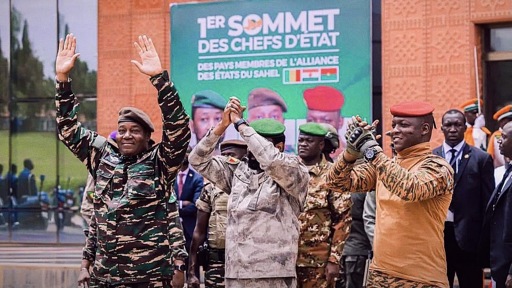
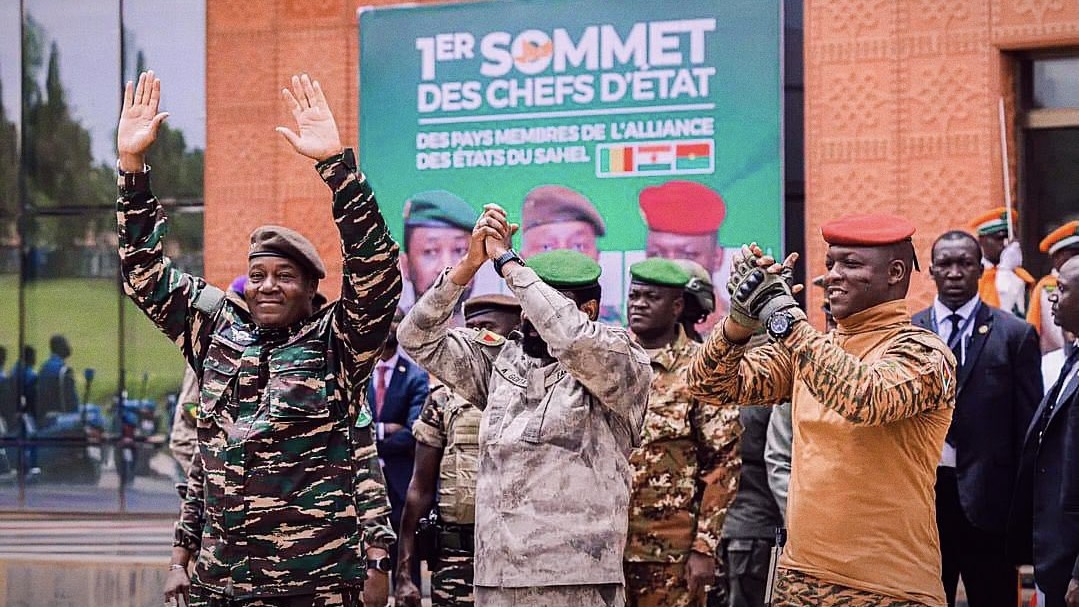
The Alliance of Sahel States (AES) has condemned Nigerian President Bola Tinubu for fueling “frustrations between peoples bound by history, geography, and fraternity.”
The bloc comprising Mali, Burkina Faso, and Niger summoned the Nigerian Chargé d’Affaires to a meeting in Burkina Faso’s capital, Ouagadougou, on August 6, to protest against Tinubu’s blaming the three Sahelian countries for Nigeria’s security woes.
Read more: Nigerian government losing ground to a resurgent Boko Haram and its IS-affiliated splinter
Multiple security crises plague Nigeria: Boko Haram ravaging the north, bandit attacks in the northwest, and communal violence in the central region driven by a contest for land between farmers and herders.
This violence is both exacerbating the worsening hunger and cost of living crisis triggered by Tinubu’s ruthless implementation of the IMF-prescribed neoliberal restructuring. The economic crisis is, in turn, fueling the violence.
Read more: World Bank acknowledges poverty increase in Nigeria, but doubles down on the reforms causing it
In this backdrop, addressing the traditional leaders on July 30, Bola Tinubu sought to deflect responsibility, saying, “Some of them (the terrorists) are not Nigerian. You see, the problem of insecurity in Mali, Burkina Faso, and Niger only exacerbates our difficulties.”
All three countries have emerged out of mass protests amid which the regimes propped up by their former colonizer France were ousted in popularly supported coups, leading to the formation of military governments that went on to expel French troops.
This toppling of French-backed governments began first in Mali in 2020, followed by Burkina Faso in 2022. France, whose troops were already expelled from the two countries by then, initially refused to back down and threatened war when its regime fell in Niger later in 2023, fronting the remaining countries in its neocolonial bloc, the Economic Community of West African States (ECOWAS), to invade Niger.
Tinubu, the chairperson of ECOWAS at the time, was keen on sending the Nigerian military – struggling to provide security within the country – to invade its neighbor to restore the ousted regime for France. However, the Nigerian parliament refused to authorize the military operation.
Read more: Nigeria’s Senate refuses to support ECOWAS plan for West-backed military intervention
On the other side, Mali and Burkina Faso came to Niger’s defense, and the three formed a military pact that has since evolved into a political and economic bloc, the AES.
Pursuing a drastically different economic policy to the one Tinubu is implementing in Nigeria, the AES countries have expanded the public sector and exerted greater control over their mineral wealth. Their economic advances in industry and agriculture have been widely acknowledged, including in the business press.
Read more: Burkina Faso expands budget as mining reforms boost state revenues
Despite registering high economic growth, the countries are fraught with insecurity, coming under frequent large-scale attacks by a coalition of Al-Qaeda-affiliated JNIM and the Tuareg separatist rebel group, the FLA. The AES maintains these groups are proxy forces used by France to derail their advancement toward sovereignty.
Read more: Mali fights yet another wave of attacks on multiple cities by terror groups
However, even before these large-scale attacks began across the three countries, Niger was already coming under attack from Boko Haram, originating in Nigeria.
Reminding the Nigerian Chargé d’Affaires of this at the meeting in Ouagadougou on August 6, Burkina Faso’s Foreign Minister Karamoko Jean Marie Traore complained that Tinubu’s remarks demonstrate “a contempt for the sacrifice made by the Nigerien army against Boko Haram for years.”
Nigeria’s diplomat reportedly acknowledged the AES role in combating terrorism – specifically the role of Niger in stopping attacks targeting Nigeria.
“We are paying the price, but the real enemies are elsewhere,” added Traore. “We would have preferred a more accurate presentation of the security situation [by Tinubu], rather than placing the blame for a complex situation on neighboring countries, at the risk of fueling misunderstandings and frustrations between peoples bound by history, geography, and fraternity.”
The Nigerian diplomat assured that he would take their note of protest to the capital, Abuja. Traore assured him that instead of condemning Nigeria for their insecurity, the AES countries chose to engage with the neighbor, insisting that they are in a “joint and shared fight.”
From BT News via This RSS Feed.