

By Klein Fausto Emperado
Iglesia Filipina Independiente/Aglipay Central Theological Seminary
Isaiah 56:1, 6-7
Psalm 67:2-3, 5, 6, 8
Romans 11:13-15, 29-32
Matthew 15:21-28
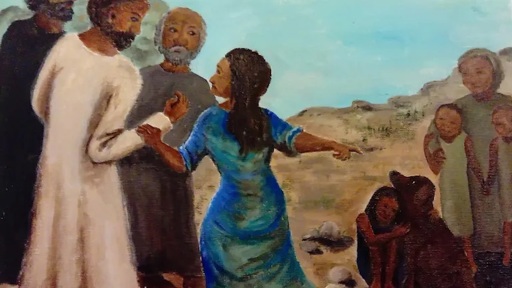
The Canaanite woman came to Jesus carrying the suffering of her daughter. She cried, persisted, and refused to be silenced. Yet the disciples wanted her sent away. Her voice was treated as a disturbance. Her struggle was seen as someone else’s problem.
How familiar this is today.
Women continue to face discrimination, violence, abuse, and the denial of their dignity. Patriarchy has become so deeply woven into our society and even our churches, that it is sometimes treated as normal. We silence women, question their leadership, and even deny their calling. Sometimes, women themselves become bearers of patriarchy and misogyny.
Yet the Canaanite woman would not leave.
Her persistence challenges a Church that is tempted to silence those who disturb our comfort. Her cry echoes in the voices of mothers, wives, and sisters of victims of the so-called drug war who continue to demand justice despite threats and harassment. It echoes in the courageous voice of an Aeta woman chieftain who stood before an inquiry on the proposed US-led Pax Silica, declaring that her people will not surrender their ancestral land, the land that sustains their life, culture, and future.
These are not merely voices of protest. They are voices of life.
The late Muriel Orevillo-Montenegro, a pioneer Asian theologian and author of “The Jesus of Asian Women” reminds us to encounter a Jesus understood through the lived struggles of the women of the Philippines and Asia, a Christ who accompanies people in their struggle against poverty, patriarchy, discrimination, and oppression, and who seeks life to flourish.
This is the Jesus we meet in the Canaanite woman’s struggle.
Isaiah declares that God’s house is for all peoples.
Psalm 67 proclaims God’s blessing among all nations.
Romans remind us that God’s mercy embraces all.
The Gospel reveals that God’s mercy cannot be imprisoned
by boundaries created by human beings.
So where does the Church stand?
We cannot proclaim God’s inclusive mercy while silencing those who cry for justice.
We are called to journey with women, listen to the marginalized, amplify their voices,
defend their dignity, and stand with communities resisting oppression.
The Church must not become another instrument of empire, patriarchy, or exclusion.
When women rise and speak for healing and justice , the Church must listen.
When the oppressed cry, the Church must stand.
When people struggle for life, the Church must struggle with them.
This is the way of Christ: to serve the people, to seek justice,
and to make God’s liberating mercy visible in the world.
Let us join our voices in this prayer:
Pray with Me for a World of Mercy
Pray with me
for a world where no one is turned away,
where every table has room for the poor ,
and every person knows the abundance of God’s blessing.
Pray with me
for the courage of the Canaanite woman,
who would not be silenced,
whose cry for mercy crossed every boundary
and opened the way to healing.
Pray with me
for those whose voices are drowned by power
for women seeking justice,
for Indigenous peoples defending their land,
for the poor and oppressed
whose dignity is denied.
Pray with me
for a Church that listens,
that welcomes,
that stands with those at the margins,
and refuses to send them away.
May our prayers become courage,
our courage become solidarity,
and our solidarity becomes action.
May God’s mercy reach every people,
until justice flows freely
and no one is left behind. Siya Nawa!
Balik-Tanawis a group blog of Promotion of Church People’s Response. The Lectionary Gospel reflection is an invitation for meditation, contemplation, and action. As we nurture our faith by committing ourselves to journey with the people, we also wish to nourish the perspective coming from the point of view of hope and struggle of the people. It is our constant longing that even as crisis intensifies, the faithful will continue to strengthen their commitment to love God and our neighbor by being one with the people in their dreams and aspirations. The Title of the Lectionary Reflection would be Balik –Tanaw , isang PAGNINILAY . It is about looking back (balik) or revisiting the narratives and stories from the Biblical text and seeing, reading, and reflecting on these with the current context (tanaw).
The post Balik-Tanaw | When women rise, God’s mercy breaks in the boundaries appeared first on Bulatlat.
From Bulatlat via This RSS Feed.