

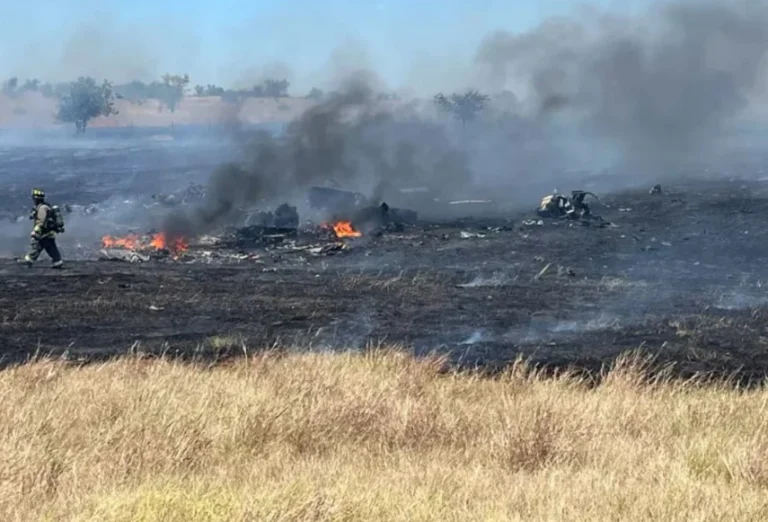
Apache helicopter grounding follows a fatal Texas crash that killed two soldiers near Fort Hood as the US Army investigates the accident’s cause.
Related: USS Abraham Lincoln to return home after 260-day deployment
Apache Helicopter Grounding Ordered After Texas Crash
The Apache helicopter grounding follows a fatal military aircraft accident near Fort Hood, Texas, that killed two US Army pilots during a maintenance test flight.
The Army announced the temporary suspension of all AH-64 Apache training flights on Friday, two days after the helicopter crashed in a rural area near Salado.
The measure will remain in place until investigators develop a clearer understanding of the accident’s root cause.
“The stand-down will remain in effect until we have a better understanding of the root cause of the accident,” the Army said in an official statement.
The crash occurred in a field near Fort Hood, approximately 30 miles from the military installation, according to local authorities and military officials.
The helicopter went down at about 1:40 p.m. on Wednesday, according to the Bell County Sheriff’s Office. The impact caused a fire that spread through nearby grassland.
Emergency crews responded to the crash site and worked to contain the blaze. The fire, known locally as the Dove Hollow Fire, burned approximately 155 acres before firefighters brought it under control.cbsaustin
No buildings were struck and no civilians were reported injured. The two people aboard the aircraft were the only fatalities.
The Army identified the pilots as Chief Warrant Officer 2 Deontre T. Huey, 34, and Warrant Officer Seth L. Olmsted, 25. Both soldiers were Texas natives.
Huey had served in the Army since 2014, while Olmsted joined the service in 2023. The two were assigned to Bravo Company, 1st Battalion, 227th Aviation Regiment, 1st Air Cavalry Brigade, 1st Cavalry Division.
The military expressed condolences to the soldiers’ families, colleagues and friends.
“The Army deeply regrets the loss of two soldiers in the recent AH-64 Apache helicopter accident near Fort Hood, Texas,” the institution said.
The temporary grounding applies to training flight operations, including exercises and maintenance-related flights. The Army has not announced a suspension of every operational use of the Apache fleet.
The decision is a standard precaution after a serious military aviation accident, particularly when investigators have not determined whether mechanical, maintenance, human or environmental factors contributed to the crash.
Apache Helicopter Grounding Supports Safety Investigation
US Army Combat Readiness Center | US Army Aviation
The Apache helicopter grounding gives investigators time to examine the aircraft, review maintenance records and evaluate flight procedures across the fleet.
The Army Combat Readiness Center is leading the safety investigation. Officials have not released a preliminary cause for the crash.
Investigators are expected to examine the wreckage for evidence of engine failure, problems with the flight-control system, structural damage or other technical issues.
They will also review the aircraft’s maintenance history and determine whether the helicopter had recently undergone repairs, inspections or component replacements.
Because the flight was described as a maintenance test flight, the investigation may focus closely on the work carried out before takeoff and the procedures used to verify the aircraft’s condition.
A maintenance test flight is performed to assess an aircraft after maintenance or to verify the performance of particular systems. Such flights may involve maneuvers or operating conditions that are not part of an ordinary transport mission.
The Army has not said what specific maintenance work was being evaluated on the aircraft involved in the crash.
Investigators will also examine pilot training, communications, weather conditions and the aircraft’s flight path. Witness accounts, emergency calls and data from onboard systems may provide additional information.
The aircraft crashed in an open field, which limited damage to surrounding structures but did not reduce the severity of the impact. The fire destroyed much of the helicopter, potentially complicating the recovery and analysis of evidence.
Military accident investigations can take weeks or months. Authorities generally release preliminary findings only after investigators have examined the wreckage and reviewed technical data.
The Army’s decision to suspend training flights across the Apache fleet indicates that officials want to rule out a problem that could affect other aircraft.
A fleet-wide stand-down allows commanders and safety officers to review procedures before crews return to the air. It can also include inspections of components that may have contributed to the accident.
The suspension affects training units at Fort Hood and other Army facilities. It could temporarily disrupt flight schedules, pilot qualifications, maintenance testing and readiness exercises.
Army units rely on regular training to maintain pilot proficiency and ensure that ground forces can operate with aerial support. A prolonged suspension could therefore affect operational planning and the timing of future exercises.
However, safety officials must balance readiness requirements with the need to prevent another accident.
The Army has not indicated how long the grounding will last. The suspension will be lifted when officials determine that crews can safely resume training or after investigators identify and correct the cause of the crash.
The military’s statement did not specify whether the order affects Apache combat missions currently underway. Reports indicate that the measure is focused on training flights rather than all operational missions.cbsnews
Texas Crash Raises Apache Fleet Concerns
US Department of Defense | Federal Aviation Administration
The Apache helicopter grounding has drawn attention to the safety record and operational demands of the AH-64 fleet.
The AH-64 Apache is the US Army’s principal attack helicopter. It is designed to provide close air support, armed reconnaissance and protection for ground forces.
The aircraft can operate in difficult conditions and is equipped with advanced sensors, weapons systems and communications technology. Its missions require highly trained pilots and maintenance personnel.
The Apache is also a complex aircraft. Its systems include a powerful engine, rotor assembly, electronic targeting equipment, flight-control components and weapons-related technology.
A malfunction in any critical system can have serious consequences, particularly during low-level operations or maintenance test flights.
The aircraft involved in the Texas crash was identified as an AH-64E Apache, the latest major version used by the Army. The E model includes upgraded avionics, improved networking and enhanced capabilities compared with older variants.
The investigation will determine whether the aircraft’s model, a specific component or the circumstances of the flight contributed to the accident.
The crash occurred less than two months after another fatal helicopter incident in Rio de Janeiro, but the two accidents involved different aircraft, countries and circumstances. There is no evidence that the events are connected.
Military aviation accidents often lead to temporary suspensions because authorities must establish whether a technical or procedural problem could affect other aircraft.
The Army has previously grounded aviation fleets after fatal crashes involving helicopters and other aircraft. Such actions can protect crews while investigators identify risks.
The suspension also affects local communities near Fort Hood. The base is one of the largest military installations in the United States and is surrounded by towns, roads, farms and residential areas.
Training flights are a familiar part of life in central Texas, but accidents can endanger civilians when aircraft operate near populated areas.
In this case, the helicopter crashed in a rural field and did not hit homes or other structures. The resulting fire nevertheless required a substantial response from local emergency services.
Bell County authorities said deputies, firefighters and other personnel secured the area while the military took control of the investigation.
The accident has also renewed attention to the safety responsibilities shared by military bases and local governments. Emergency services must coordinate quickly when aircraft crash outside installation boundaries.
Geopolitical Context
The Apache helicopter grounding affects more than a single Army unit because the AH-64 is an important component of US military power.
The aircraft is deployed at bases in the United States and abroad and has been used in operations across the Middle East and other regions. Any extended suspension could influence training schedules and the readiness of units preparing for overseas missions.
The United States is also modernizing its aviation fleet while maintaining older aircraft that remain central to military operations. Safety investigations can reveal whether modernization, maintenance funding or supply-chain problems are affecting readiness.
For countries that operate Apache helicopters through US defense agreements, the outcome of the investigation may be closely monitored. A technical finding could lead to additional inspections or changes in maintenance procedures outside the United States.
The accident also illustrates the risks faced by military personnel during routine training. Even flights conducted far from active combat zones can result in fatal consequences.
The immediate priority is to determine why the aircraft crashed and ensure that the families of the two soldiers receive support.
Until investigators establish the cause, the Army has chosen to keep Apache training flights suspended. The decision reflects the military’s need to protect crews while preserving the long-term readiness of its attack-helicopter fleet.
From teleSUR English via This RSS Feed.