

This article by Darylh Rodríguez originally appeared in the August 14, 2026 edition of Contralínea, an independent Mexican investigative journalism magazine.
Behind millions of posts that appear simultaneously on social media there may not be a crowd voicing opinions, but rather a structure designed to produce that impression. The Presidency’s Legal Counsel maintains that this is what happens with a digital amplification network that would have been used to produce narratives against President Claudia Sheinbaum Pardo and the so-called Fourth Transformation. Its head, Luisa María Alcalde Luján, asserted that this network is not organic, since it involves media outlets, commentators, political figures, attack accounts, and more than 560,000 bot and troll accounts. After this information was made public, communicators named in it and NGOs described the data as the government’s “fascist lists,” while the president and the legal counsel denied that these are “blacklists”: it is an analysis of the digital ecosystem of artificial trend amplification, they stated.
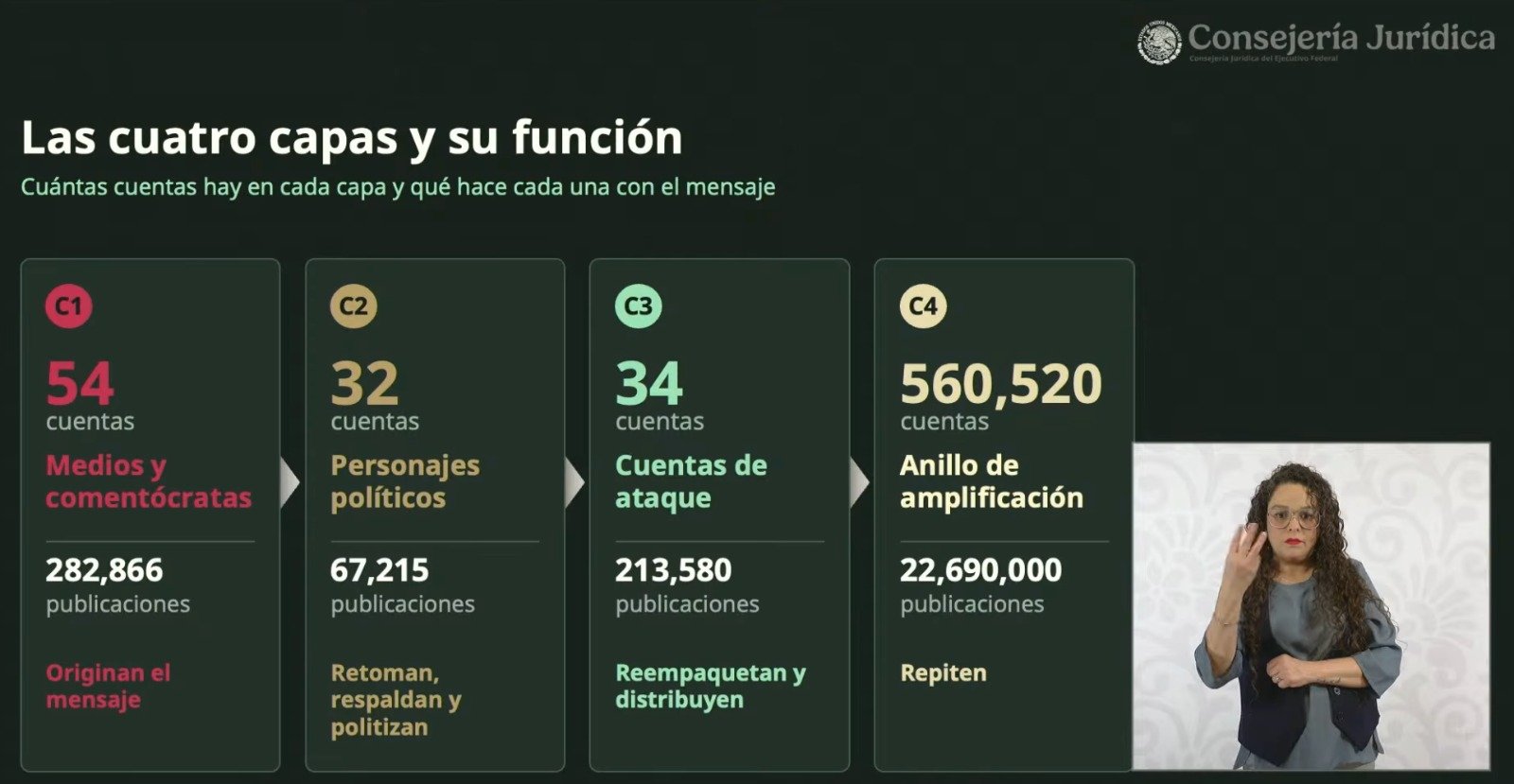
Photo: Presidencia
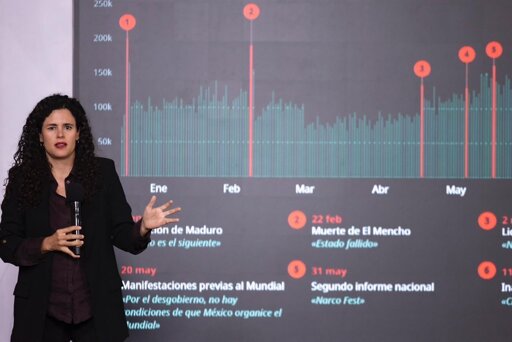
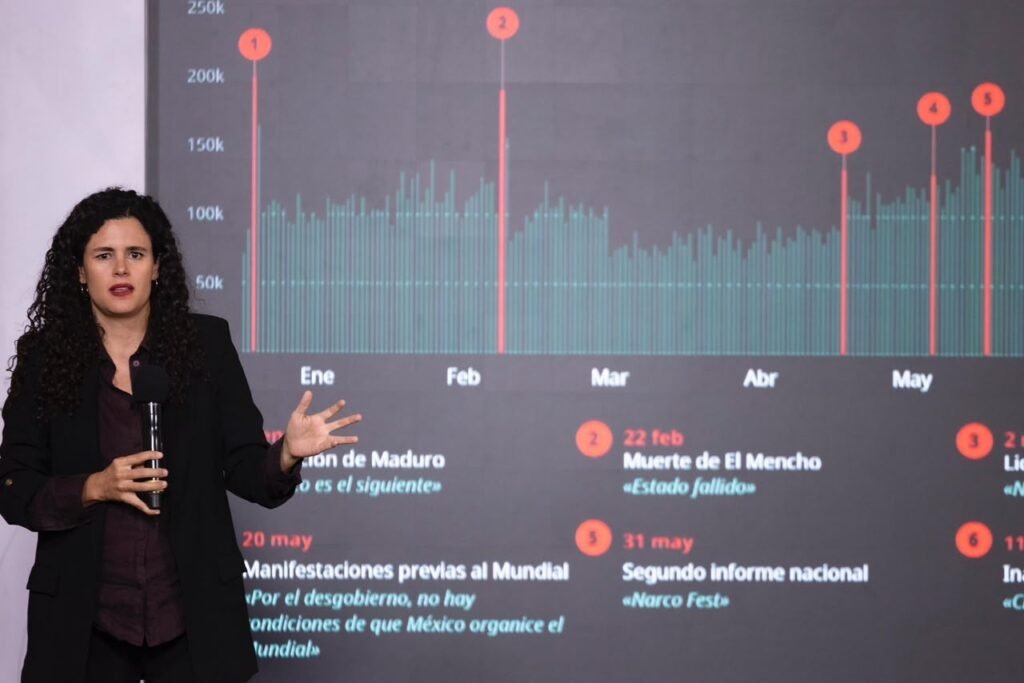
An alleged digital amplification network made up of opposition political figures, public figures, anonymous users, and a total of 560,520 accounts would be operating against President Claudia Sheinbaum Pardo and the movement of the so-called Fourth Transformation, with the purpose of spreading false narratives and thereby altering public perception, by coordinately replicating negative messages and systematic campaigns with certain hashtags and social trends. This, according to an analysis presented by the head of the Legal Counsel of the Presidency of the Republic, Luisa María Alcalde Luján.
The assessment points to a “digital amplification ecosystem,” made up of four layers in which different types of accounts and users participate with certain differentiated functions. Among them are media outlet accounts, commentators, profiles related to political figures, anonymous accounts or accounts identified as trolls, and, finally, a broad amplification ring composed of more than 560,000 accounts that together would have generated around 22.7 million posts during the seven months analyzed, from January 1 to August 8, 2026.
According to the information presented during the Right of Reply press conference on August 12 at the National Palace, the first layer would be made up of 54 accounts of media outlets and political commentators. A group that constitutes, according to Alcalde Luján, the point of origin of a large part of the messages that later circulate through the other levels. Among the names mentioned are Atypical TV, Bibiana Belsasso, Adela Micha, Ciro Gómez Leyva, Dolia Estévez, Javier Negre, ADN40, Azteca Noticias, El Universal, Joaquín López-Dóriga, La Derecha Diario, Carlos Loret de Mola, Aristegui Noticias, Denise Dresser, and Javier Alatorre, among others.
In this way, the first-stage accounts would have accumulated a total of 282,866 posts during the analyzed period. Their role, according to the federal interpretation, would consist of generating or legitimizing content through tailored news, columns, comments, supposed investigations, and the dissemination of opinions that would later be picked up by other users on social media. “Their importance is that they originate the message,” Luisa María Alcalde stated in the same press conference.
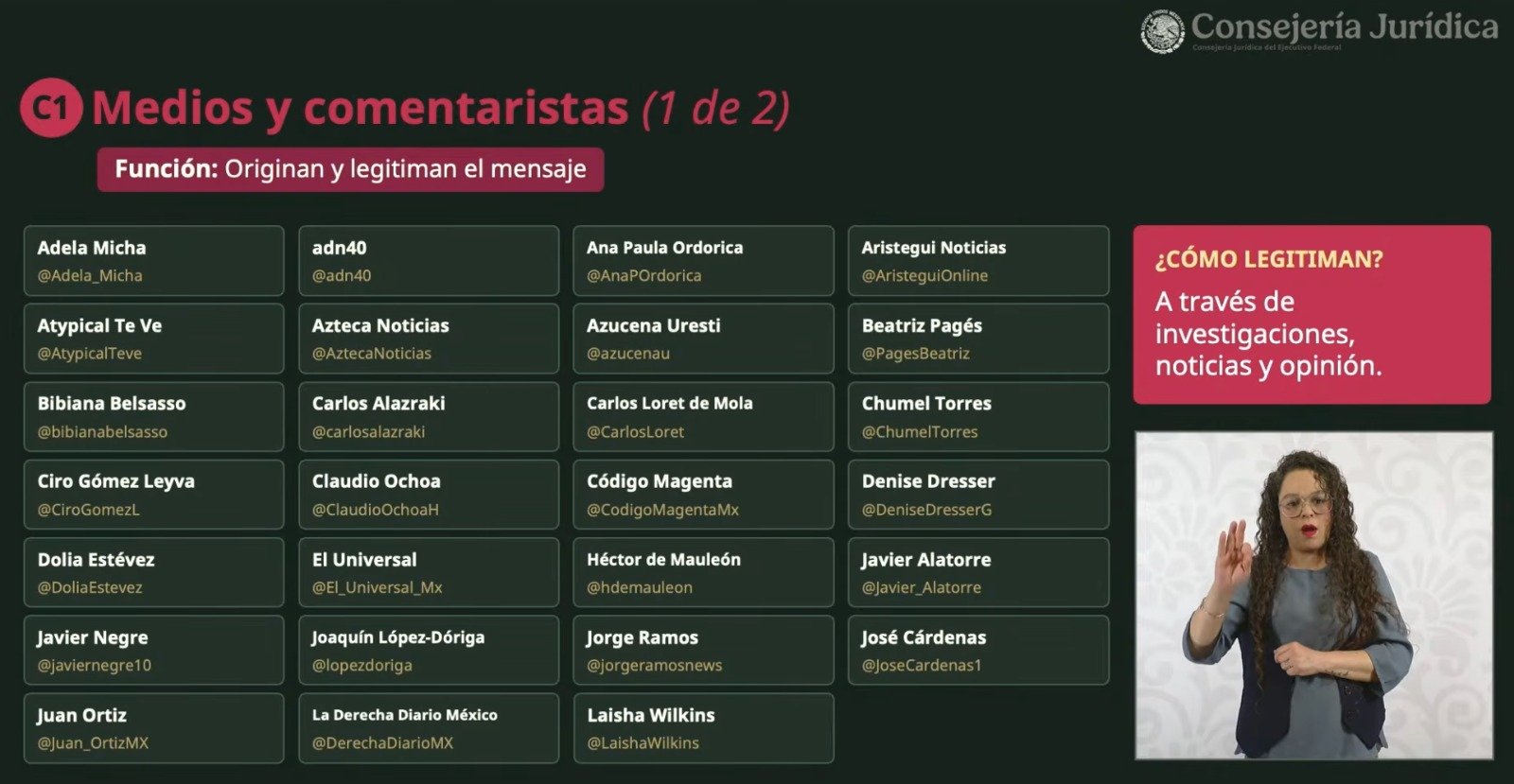
Photo: Presidencia
After this information was made public, communicators named as part of this digital disinformation structure and NGOs—such as the Miguel Agustín Pro Juárez Center—described the data as the government’s “fascist lists,” while President Sheinbaum Pardo and the legal counsel denied that these are “blacklists.” In a video shared on social media, attorney Luisa María Alcalde asserted that it is an analysis of the digital ecosystem of artificial trend amplification and of those who appear in it.
For her part, President Sheinbaum Pardo denied that what Alcalde presented is a registry comparable to fascist regimes. In her morning press conference on August 14, she indicated that a scientific analysis was carried out and that paid bot networks were identified.
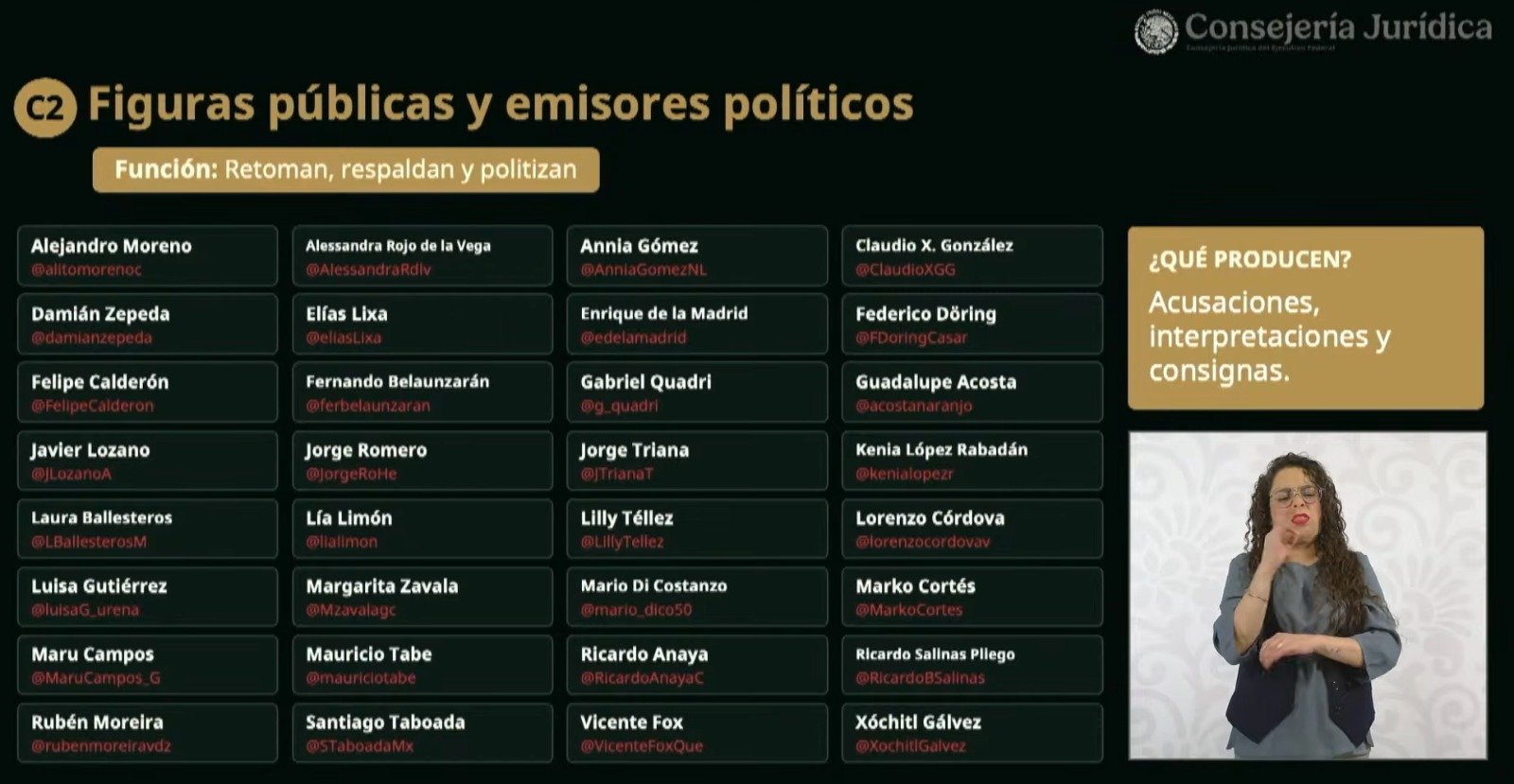
Photo: Presidencia
“They’re already saying it’s ‘Sheinbaum’s list’; I invite you to watch the Right of Reply press conference by Luisa María again […]. What Luisa says is: ‘a piece of news comes from one account and from there an entire mechanism is set off against a political position, against a project, against the president.’ She showed how social media works today; she never said: ‘this is the list of who knows what.’ No.” She added that under her government “the greatest freedom of expression in history” is exercised. And she asked: “Who is being censored? Who? No one.”
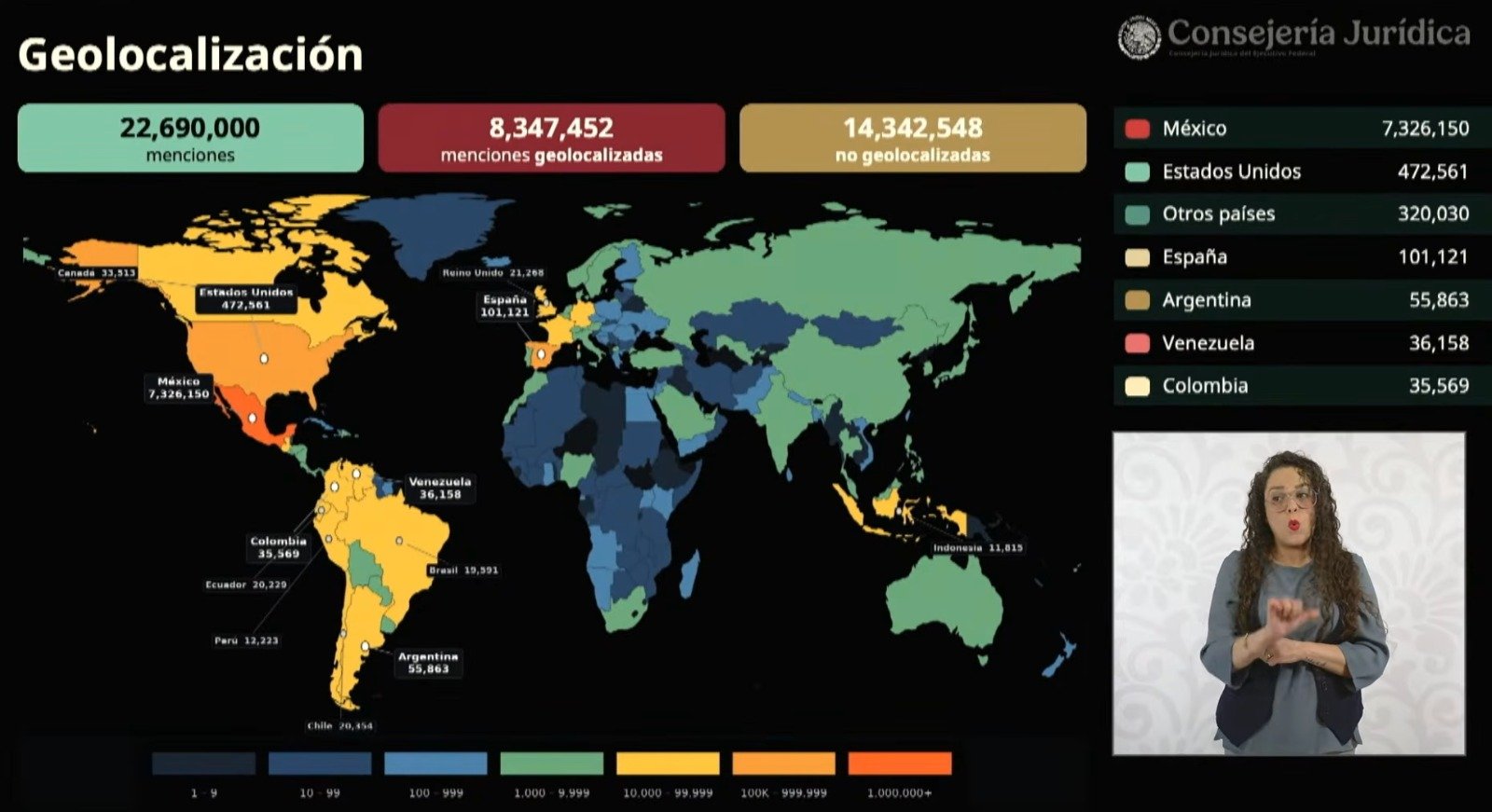
Photo: Presidencia
Who is being censored? Who? No one.
President Claudia Sheinbaum
Second Layer: Politicization
The second layer would be made up of 32 accounts related to political figures, to which more than 67,000 posts were attributed. At this level, Alcalde Luján explained, the messages are picked up, endorsed, and given a political slant before moving on to the following stages of circulation. “They mainly pick up, endorse, and politicize the information they gather from layer one.”
Among the politicians and public figures mentioned by the legal counsel are Alejandro Moreno, Felipe Calderón, Javier Lozano, Maru Campos, Rubén Moreira, Jorge Romero, Lilly Téllez, Margarita Zavala, Ricardo Anaya, Vicente Fox, Claudio X. González, Marko Cortés, Ricardo Salinas Pliego, Kenia López, Lorenzo Córdova, Xóchitl Gálvez, Damián Zepeda, Laura Ballestero, Luisa Gutiérrez, Lía Limón, Mauricio Tabe, Santiago Taboada, Annia Gómez, Enrique de la Madrid, Gabriel Quadri, Jorge Triana, Federico Döring, and Guadalupe Acosta Naranjo.
The third layer would be made up of 34 accounts identified as “attack” accounts or trolls, which would accumulate more than 200,000 posts. “They are in charge of repackaging and distributing the message,” Luisa María Alcalde stated. In other words, the function at this stage consists of taking up messages generated at the previous levels, reformulating them, and adding confrontational content, before distributing them among a larger number of users.
In this group, the Morena member showed as examples the accounts Melissa Bely, La Abuela García, José Díaz, Jorge García Orozco, and Don Metralleta; which, according to the data presented, register certain particularly intense activity patterns, with practically continuous posting during much of the day.
The case of Melissa Bely was used as one of the main examples. Luisa María Alcalde noted that this account would have a share equivalent to around 30 percent of the daily movement identified within this level of the network, and that a high proportion of its content would be directed against President Claudia Sheinbaum and the so-called Fourth Transformation.
We used Melissa Bely as an example because, as we saw on the digital map, this is the account that today concentrates what amounts to 30 percent of the daily movement of the entire ring of 560,000 accounts, the one with the most interaction with the bots. It starts at 6:00 a.m., 36 posts a day; that is, practically all of its posts—96 percent of its posts—are dedicated to attacking the Fourth Transformation, to attacking the president of Mexico, with aggressive language, using nicknames, phrases like “scandal” or “boom” to grab attention and to try to generate outrage.
Regarding the fourth layer, Alcalde explained that by far the largest number of accounts resides in it. This is the so-called “amplification ring,” which is made up of 560,520 accounts that would be accumulating around 22 million posts, with the aim of repeating and multiplying the messages that come from the previous levels.
It is precisely at this point that the scale of the structure takes on greater relevance, the official maintained. However, she clarified that these 560,000 accounts are profiles that do not correspond to people, but rather form part of an amplification pattern. With this, Alcalde explained that the hypothesis is based on the fact that within that universe there are behaviors compatible with automated accounts, although the existence of a high posting frequency does not by itself constitute definitive proof that an account is a bot.
Based on the above, the counsel said that the activity of these accounts can generate a perception effect; that is, a narrative that is initially placed by a media outlet, commentator, or political figure—aligned with the opposition—can be picked up by attack accounts and subsequently reproduced thousands or millions of times. In this way, any conversation can take on an apparently larger dimension through the coordinated, or also automated, repetition of certain content.
“So, the first thing to understand in order to break down this network is that we have four phases, four layers, and each one has a function and each one has specific accounts,” she stated at the Right of Reply press conference held on August 12.
Moreover, among the narratives identified by the Mexican government are accusations of an alleged “narco-government,” the so-called “fiscal huachicol” (fuel-tax fraud), claims about an alleged “authoritarian regime,” as well as content related to pressures or “foreign intervention.” Concepts, the official asserted, used recurrently, since they are also adapted to different events in the national political situation.
According to the information presented in the same press conference, the described mechanism consists of a narrative that can begin as some kind of information, opinion, or political claim; it is later picked up by other actors, transformed into attack content, and finally turned into mass posts. This results in an amplification circuit in which it becomes difficult to distinguish the origin of a message from the thousands of times it is subsequently reproduced.
Another of the elements addressed by the official are the so-called behavior patterns of these accounts, which post with a frequency incompatible with the usual behavior of a user, while others remain active throughout the day. Also identified were name changes, the repeated use of certain hashtags, the mass production of memes and videos, and a high concentration of messages against President Sheinbaum.
In light of this information, Contralínea asked Luisa María Alcalde directly about the possibility of following the money trail behind this structure, considering the magnitude of the identified universe, the volume of posts, as well as the activity sustained over seven months. This, in the context that maintaining a digital operation of this scale can involve different types of resources, both for account management, content production, and the hiring of digital services, as well as for automation tools, technological infrastructure, and advertising.
However, Alcalde responded that, for now, the government’s objective is to expose the phenomenon and allow the population to identify this type of mechanism, rather than to present an investigation into its financing. While she acknowledged that identifying the resources and those who might eventually be behind these structures would be a different path, she maintained that, at this stage, the aim is only to generate tools so that people do not confuse an artificially amplified trend with a widespread social conversation.
“Well, that in any case is up to the institutions, to the INE itself. The INE always audits the resources of the political parties; it is part of its powers and responsibilities: that the use of these resources go specifically toward what is permitted. Financing a scheme of this nature would not be permitted, much less with the intent to disinform. But, well, that is the exclusive authority of the Electoral Institute.”
And she added that the government’s intention is to expose the phenomenon and generate a space for joint reflection. “Because it is very important that we all know that when we talk about bots, it’s not that one says: ‘no, no, don’t worry, there are no people behind them.’ No. It is proven; we can show you how these accounts work, and that they have been increasing.”
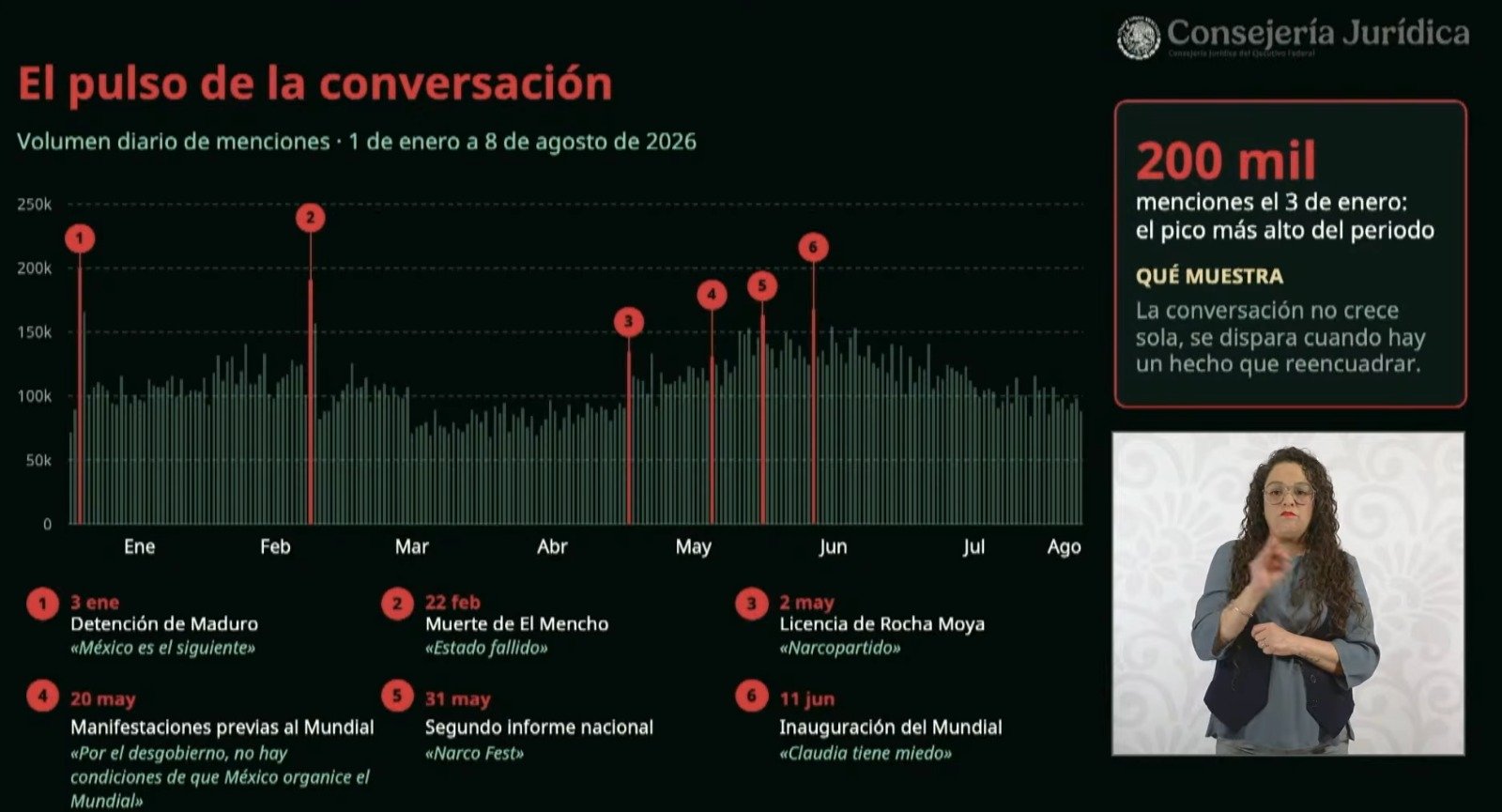
Photo: Presidencia
Audience Rights in the Face of Disinformation
On another matter, this weekly asked the legal counsel about audience rights. In the same press conference, Contralínea asked whether the federal government or the Legal Counsel itself had considered expanding obligations not only for print media, but also for digital media and accounts operating on social media, in order to clearly differentiate information, opinion, and advertising. With this, the question was raised of whether audiences could have mechanisms to file complaints when disinformation is spread, particularly in a context where journalistic content, political opinions, advertising, and artificially generated messages can circulate within the same platforms.
In response, Luisa María Alcalde noted that expanding the guidelines to other types of media has not been contemplated. “Let’s say, there isn’t even that intention for now.” The official explained that the government is currently focused on establishing the guidelines derived from a law passed in 2025, and denied that there is, for the moment, any intention to expand those obligations in the terms proposed.
The legal counsel maintained that the discussion about audience rights has generated various interpretations, and asserted that some of the “false narratives” that circulated around the guidelines had already been clarified, including through statements from the industry itself. In this way, the official drew a distinction between print and audiovisual media. In the case of newspapers, she noted, it is easier to identify the difference between advertising, informational content, and opinion, since traditionally there are differentiated spaces for each of them.
-
Sheinbaum and Lula Strengthen Cooperation Between Pemex and Petrobras
August 15, 2026August 15, 2026
In a video call, the two presidents advanced a June memorandum pairing the state oil firms on Gulf of Mexico exploration, refining, and fuel marketing.
-
Disinformation Network Connects with Media, Politicians, and 560,000 ‘Bot’ and ‘Troll’ Accounts
August 15, 2026August 15, 2026
Mexico’s Presidential Legal Counsel says a four-layer network of media outlets, commentators, opposition politicians, troll accounts, and more than 560,000 bots amplified false narratives against President Sheinbaum and the Fourth Transformation.
-
People’s Mañanera August 14
August 14, 2026August 14, 2026
President Sheinbaum’s daily press conference, with comments on returning migrants, sovereignty, media freedom, falling homicides, and the economy.
The post Disinformation Network Connects with Media, Politicians, and 560,000 ‘Bot’ and ‘Troll’ Accounts appeared first on Mexico Solidarity Media.
From Mexico Solidarity Media via This RSS Feed.