

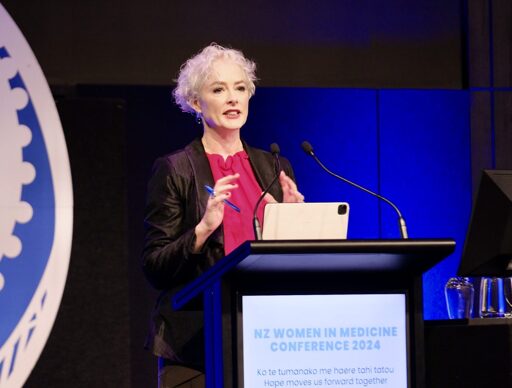

Aucckland GP Dr Orna McGinn is the chair of New Zealand Women in Medicine, which began as on online peer support group and ha grown to more than 5000 members. (Image supplied)
Doctors are criticising health minister Simeon Brown for labelling cultural sensitivity in healthcare an “ideological agenda” and for interfering with the independence of their regulatory body, the New Zealand Medical Council.
Here, GP Orna McGinn explains why this should concern all of us.
Something unusual happened at the Royal New Zealand College of General Practitioners’ annual conference in Tāmaki Makaurau two weeks ago.
As the Minister of Health, Simeon Brown, cleared his throat and began his keynote speech, telling the 800 doctors present his plans for their collective future, a group of those doctors silently left their seats, made their way to the front of the auditorium, and unfurled a banner.
They stood quietly as the audience’s attention shifted to the message on the banner: 1200 doctors. One voice. Cultural safety improves patient outcomes.
Doctors, as a rule, are respectful of authority. We’re not given to public displays of defiance, and until recently tended to concentrate our energies on tending to our patients. However, we live in interesting times, and we have had to adapt.
The group behind the peaceful protest, if that is the correct shorthand for a public show of displeasure, was the NZ Women in Medicine Charitable Trust, of which I am chair. We started as an online group focused on support and connection in the depths of the Covid-19 pandemic, when the world felt like it might be ending and many of us were in taxing, isolating frontline roles.
Our kaupapa has since evolved to include an increasing number of advocacy campaigns, as the health landscape we work in has undergone rapid and, in many ways, confusing change since 2021. This is not due solely to structural transformation, medical innovations, or the availability of new medicines. Rather, it is about culture, emphasis and direction.
Doctors now find themselves working in an Orwellian universe, where speaking publicly about health issues may result in censure, and cognitive dissonance is part of the job.
Trust is in short supply between doctors and their employers, and we have seen unprecedented industrial action as a result. The rates of moral injury and burnout have been well documented. But doctors staging a protest at a conference? How did we end up here?

Dr Ella Barclay and Dr Anna Chodya with the banner that was unfurled before health minister Simeon Brown. (Image supplied)
What happened at the Medical Council
In June, health minister Simeon Brown declined to reappoint Dr Rachelle Love and barrister Simon Watt to the Medical Council when their terms expired. Love is a highly respected Christchurch-based surgeon and the council’s first wahine Māori chair. Both she and Simon Watt, who has expertise in public law, health law, and climate change, had been eligible for another term.
As government appointments, their removal and subsequent replacement was legal. But it was entirely unprecedented and unwarranted. The consensus is that they were effective leaders who, importantly, listened to members on a range of issues.
By way of explanation, the minister said publicly — without irony — that the council had become “distracted by politics” and an “ideological agenda,” referring to its work on cultural competence, cultural safety, and hauora Māori (Māori health).
This work on cultural competence is far from new. The council’s role, like that of all medical councils worldwide, is to set and uphold standards, ensuring that doctors are safe and fit to practise. As explained on its website, cultural safety is one of these standards, requiring doctors to “reflect on how their own views and biases impact on their clinical interactions and the care they provide to patients”.
Between February and March this year, the council held an open consultation aimed at updating its 2019 standards on cultural safety. More than 8,000 submissions came from doctors and members of the public, and an updated statement was drafted.
On June 12, Rachelle Love, council chief executive Joan Simeon, and its principal communications adviser Janette Deed published an editorial in the New Zealand Medical Journal based on the consultation feedback. It was titled Listening to patients and doctors: How voice strengthens good medical practice. The article laid out the reason for the consultation: “patients’ expectations of their doctors are changing, and we need to understand that change.”
Patients’ submissions had provided a clear mandate, they wrote. When accessing health care, patients said they wanted to be listened to, treated with respect, and involved in decisions. Trust, clear communication, and cultural respect mattered to them.
Doctors, they wrote, wanted “standards and guidance that help them navigate complexity”. Specifically, “patients’ comments about cultural respect, Te Tiriti and whānau involvement reinforced that good medical practice in Aotearoa New Zealand must be understood in its local context. Cultural safety is not an abstract regulatory concept. Cultural safety is about how patients experience their care.”
Three days later, Rachelle Love and Simon Watt were gone. In late July, four new appointments were made to the Medical Council. Two of them, GP and lawyer Roderick Mulgan and anaesthetist Manoja Kalupahana, are members of the Free Speech Union (FSU).
Founded in 2018, the Free Speech Union claims to be “the country’s loudest voice for free expression”. The freedom of expression it espouses is relatively selective. It is currently campaigning heavily on sex and gender issues, and its website highlights as one of its successes the government’s decision to drop a recommendation to expand anti-discrimination laws to include transgender, intersex and non-binary people. The New Zealand FSU, like its counterpart in the UK, is closely aligned with conservative, so-called “anti-woke” politics.
The FSU took a particular interest in the council’s consultation on cultural safety and made a submission. While the organisation claims to support respectful, non-discriminatory care and recognises health inequities, its submission argued that the council had moved beyond cultural competence into “contested sociological and political narrative, drawn from critical social theory, postcolonial theory and indigenous rights frameworks”, and risked “effectively forcing [doctors] to publicly express beliefs they may not hold to keep their jobs”.
We seem to have entered a culture-war zone. Both Rodney Mulgan and Manoja Kalupahana had met with the health minister in May 2025 to discuss freedom of expression, conscience rights in healthcare, and how these may lead to disciplinary processes for practitioners. Two years earlier, Manoja Kalupahana had been successfully defended by the Free Speech Union after facing workplace scrutiny over anonymous online posts she had made.
This situation could not go unaddressed. Doctors posting online were outraged and distressed on two fronts: the undermining of our integrity as ethical practitioners, and the loss of yet another female health leader. Since 2024, there has been an unusually high turnover of senior health leadership, and a disproportionate number of those departing have been women.
By remaining silent, the implication would be that the medical profession in Aotearoa New Zealand agrees that addressing our patients’ cultural needs is “ideology”, and that the professional body setting standards for best practice can be subject to direct political interference, with outstanding medical leaders removed at will.
Within three weeks, NZ Women in Medicine had collected more than 1200 signatures for an open letter to the minister, reinforcing the importance of both cultural safety in medical practice and independent professional regulation. At the conference, we presented this to him directly. The encounter was calm, respectful, and gracious. The minister accepted the letter and agreed to meet and discuss the issues further.
We are yet to receive a formal response.

GPs Clare Harford, Christine Coulter-Heron, Marcia Walker, Jo McGregor and Orna McGinn at the GPs conference. Health minister Simeon Brown stands behind them. (Image supplied)
What safety looks like in the clinic
Twenty-five years ago, I was a GP registrar on the south coast of England. My memories of that year are migraine-bright for many reasons. I was expecting my first child, for a start. Driving home one evening, a newsflash announced that the Twin Towers in New York had been struck by two planes. I remember the shock of realising that this baby would be coming into a very different world.
I remember other things from that year too. One was a patient who came to see me, took one look at my swollen belly, burst into tears, and turned to leave the room. She had come in to discuss having an abortion, after finding herself pregnant with a child she could not support.
Approaching that young woman with compassion and understanding, so that she stayed in the room, and directing the consultation to her and her situation, not to me and mine, was possible only because of the grounding in careful, nonjudgmental, compassionate consulting we had received as apprentice GPs on our excellent training scheme. In 1990s England, this approach was the closest thing to cultural safety training.
My special interest has always been women’s health. People talk to me about sex, bleeding, fertility, pregnancy loss, menopause, trauma, family violence, and pain. They may have to undress and undergo intimate examinations. If I don’t understand the power I hold in that room, or how my gender, ethnicity, language, assumptions or professional status might affect the person opposite me, I am not practising safely.
Working in contraception clinics with large Māori and Pacific populations has taught me that there are as many nuances as there are patients. To one, free contraception that lasts up to five years and also stops heavy menstrual bleeding is a gift. To another, free contraception is a subversive way to control the fertility of populations more likely to have large families.
Using these forms of contraception to space pregnancies leads to better outcomes for māmā and pēpi — fewer pre-term births and less maternal anaemia — but trust, honesty, and understanding are required for this information-sharing.
Dismissing cultural safety and an understanding of how patients live — including the compounding impact of social and commercial determinants of health, such as diet, housing and transport — are part and parcel of a reductionist, target-driven approach to health.
In this reductionist approach, everyone is equal and entitled to exactly the same share of the health(y) pie. Binary measures replace the effort required to understand complexity. Patients are sick or well. They need a prescription or they don’t. They work or they don’t. They are poor or not poor, and if they’re poor, it’s their fault. Giving some patients more resources, including attention, time and understanding, based on their needs, is unfair ideology, not equity.
Fair and unfair are the binary terms du jour.
The statistics in the Ministry of Health’s own Tatau Kahukura: Māori Health Chart Book 2024 are not ideological. In 2017–19, life expectancy for Māori was more than seven years shorter than for non-Māori. This has improved over the last five years, but only marginally.
Among Māori under 75, amenable mortality — deaths that were potentially avoidable through timely and effective healthcare — was more than twice that of non-Māori. Total cancer mortality among Māori adults was around 1.75 times that of non-Māori. These cancers present later due to a combination of factors and consequently are harder and more expensive to treat, if treatment is even available or appropriate by the time the patient is seen.
Cultural safety, in and of itself, will not close the gap. A health-in-all-policies approach is needed, across housing, income, education, access, and transport. If implemented, it would not only be a triumph of equity — it would likely save hundreds of millions of dollars in health costs. Surely, this is enough of a case.
Meanwhile, mistrust continues to be a barrier to care. If a patient fears they will be stereotyped, dismissed or misunderstood, why would they come early? Why would they come at all?

GPs Jo McGregor , Ella Barclay, Anna Chodyra unfurl their banner as Health Minister Simeon Brown delivers his speech to the GP26: Conference for General Practice. (Image supplied)
With most of our doctors from overseas, cultural competence is critical
Aotearoa New Zealand is desperately dependent on doctors trained elsewhere. International medical graduates (IMGs) now make up 42 percent of the practising workforce, the highest proportion of any OECD country. But only around 40 percent remain here after two years, creating a rolling hamster wheel of attrition. In 2023-24, 71 percent of new registrations were doctors trained overseas. Psychiatry has a particular problem, with 63 percent of the current workforce trained abroad.
These doctors may come from up to 100 different countries — the UK, South Africa, Ukraine, Iraq, Jordan, Malaysia, Russia. The distribution of IMGs is uneven, with far higher numbers outside large urban centres. In Whanganui, for example, more than 80 percent of hospital specialists were trained outside Aotearoa.
Now imagine these newly arrived doctors going to work in an area with a high-needs population. Training in cultural understanding and our local context is not a nice-to-have. It has a direct impact on patient safety and health outcomes.
I arrived here in 2011, having been trained at a very traditional 300-year-old London medical school, well before the understanding of the impacts of inequity. As a goodbye, a public health-trained friend revealed that I was heading to “one of the most unequal countries in the world”.
I had no understanding of Māori health or the history that had shaped it. I had to learn, and working in the Counties Manukau catchment area provided a fairly steep learning curve.
Cultural safety teaching, including a confronting couple of days in a classroom with trainer Hone Hurihanganui, from consultancy Engaging Well, made me examine my assumptions, my privilege, and the habits I had absorbed from a very traditional and hierarchical system.
Far from making me a worse doctor, the training gave me more tools to understand my patients and a deeper enjoyment of my role. I also had to laugh: Hone spoke about how often his name was mispronounced, and the fact that sometimes — often in official spaces, like passport control — people didn’t even try because it was just too hard. This resonated because, as an Irish woman, this is something I’ve seen many times.
From Ireland to Aotearoa
My parents are Irish, and although I grew up in England, most of my vast whānau are in Ireland. My grandfather Jim Coyne, born in 1917, was a native Gaeilge (Irish) speaker. He and his parents would not speak the language in public when he was a child, as it was prohibited in legal proceedings, public administration and official documentation until 1922.
But the oppression had started many generations before. Irish was systematically suppressed from the 14th century, when the 1366 Statutes of Kilkenny forbade English colonists in Ireland from adopting Irish customs, names or language.
The English-language National School System, instituted in 1831, nearly killed Irish. Pupils were beaten for speaking the language they spoke at home, and a deep sense of shame was ingrained that carried through subsequent generations.
By the time my grandfather became a teacher, things were changing. Following Irish independence in 1922, the Irish language became a cornerstone of primary education. He became the headmaster of a small, two-classroom rural village school, and from there he quietly championed the revival of Gaeilge.

Orna’s parents Noel and Clare married in 1970 in Bellewstown, Ireland. Orna’s grandfather Jim Coyne is fourth from left in this pic. (Image supplied)
From the age of four or thereabouts, my summer holidays started in the last week of his term, and I’d attend school with the kids from the village and learn to “dún an doras” (shut the door) and “suí síos” (sit down) — often on his lap at the front of the class, as a treat.
My mother went to an Irish-speaking boarding school, but hers was a generation in which the language still carried complicated associations of poverty, politics, and shame. She did not teach it to us, growing up in South London, describing it as “no use, sure nobody speaks it”.
Her six younger siblings came of age in a different Ireland. Their children, my cousins, went to Irish-language summer camps and became fluent. They carry their heritage very differently. Openly and proudly.
The histories of Ireland and Aotearoa are not interchangeable, and I would never claim that they are. But growing up in the shadow of one history perhaps made me receptive to what cultural loss, shame, and recovery can mean in another.
And though the histories are different, I see the similarities in culture — particularly the lyricism of both languages, deeply intertwined with history and culture, the rich imagery, and the importance of whānau, of welcome, of whakapapa, whakawhanaungautanga, and of shared kai.
Whakataukī (proverbs) and seanfhocail (Irish proverbs) are similar in that they convey a particular form of wisdom which is deeply connected to the land where they originated and the people who gave voice to them. They can also both display a particularly pithy humour.
And the importance of people. After more than 20 years, the reason I still love general practice is simple: I love people. I am curious about them.
This I see as very Irish. Who are your people? Where are you from? How do you live? What matters to you? What has happened to you? What do I need to understand before the symptoms you describe make sense?
Tell me your story, not just your symptoms.
What we need to protect
This is why I find the current arguments against cultural sensitivity dispiriting. Cultural safety is being presented as though acknowledging another person’s history or worldview somehow diminishes our own, as though equity is a zero-sum game, where for someone to gain means someone else has to lose.
Cultural safety is actually an optimistic idea. It is generous. It assumes that we can learn about one another, that doctors can examine their assumptions and change, that patients can teach us, and that encountering another way of seeing the world will open our eyes and our minds.
This is why the independence of institutions such as the Medical Council matters. A regulator should absolutely be accountable, open to challenge, and responsive to feedback. But professional standards shouldn’t swing backwards and forwards according to the political preferences of whoever happens to hold ministerial office.
Health policy increasingly prizes speed and growth — more appointments, more telehealth, more screens, more transactions. Some of those things are useful, but good medicine is also slow work. It’s sitting down and listening, staying silent and resisting the urge to interrupt. It’s taking the time to learn names and pronounce them correctly. It’s being aware of relationships and knowing who should be in the room.
Political cycles are short, but culture, language, memory and relationships are long. Eight different health ministers have held the post during my time in Aotearoa, but I am still here, and so are my colleagues and the patients who have trusted us across thousands of encounters.
Legislation, policy documents and rhetoric may have influence, but we cannot let them undermine the fundamentals of trust. The recognition of our shared human experience makes us better doctors.
I think that’s worth protecting.
Nāu te rourou, nāku te rourou, ka ora ai te iwi.
With your food basket and my food basket, the people will thrive.
Ar scáth a chéile a mhaireann na daoine.
People live in one another’s shelter.

GP Dr Orna McGinn. (Image supplied)
Dr Orna McGinn is an Auckland-based specialist general practitioner with more than 20 years’ clinical experience in Aotearoa New Zealand and the UK. She is the chair and founder of the New Zealand Women in Medicine Charitable Trust.
The post Dr Orla McGinn: Cultural safety improves patient health appeared first on E-Tangata.
From E-Tangata via This RSS Feed.