

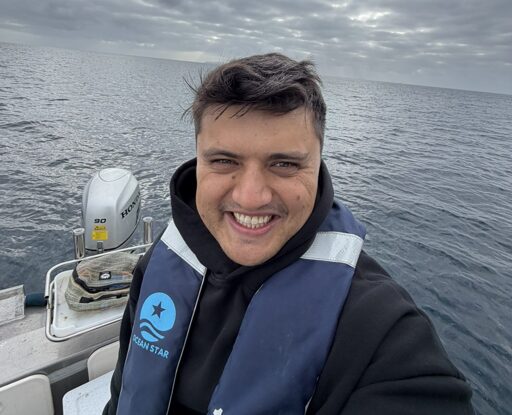

“When I make videos, the only thing I have in mind is rangatahi Māori watching those videos. I truly just want them to see that this life I have here is enough. To live on my whenua, to fish and dive, to love my wife and love my kids, to honour my parents, and to be a part of my community. That’s enough.” (Photo supplied)
There’s hardly anywhere in the world Louis Davis (Ngāpuhi, Ngāti Whātua) can go these days without someone recognising him. And no wonder. Last year, the 32-year-old social media star attracted 3.5 billion views for his videos about being a stay-at-home Māori dad living his best life in Te Tai Tokerau Northland.
Here’s Dale getting to know the country’s top TikTok content creator and newly published author.
Tēnā koe, Louis. It’s good to talk with you. I’ve been enjoying your book. I like your style. I always start with names, so can you tell us about yours?
I’m Louis Henry Davis the fourth. I have the same name as my father and my grandfather. It’s caused some hassles, actually. We’ve been on planes where our seats have been cancelled because there’s two of us with the same name, and similar problems at the bank.
It’s a common story for people my age and above. We were given a Pākehā name to hopefully give us a fairer crack at life, or that was the belief, that we’d be able to go to nice schools and have jobs and move through the world.
But with the next generation, we’re seeing a big revitalisation, with all of our tamariki carrying Māori names. Our next bubba arrives next month, and it’ll be the same for them.
So the tradition of the name ends with me. All my kids will have Māori names.
Tell us a little more about your old man. He seems to have had a nice touch. You know, good people beget good people. Well, that’s the thinking.
My grandfather wasn’t around. He wasn’t in the picture, so my dad grew up without a dad. And so it would have been an easy excuse if he had been a useless dad himself. But I had the most incredible dad, who was actively involved in my life. Most importantly, I watched him love my mother my whole life. I got to watch my hero love my favourite person every day.
And still today my dad is my hero.
My mum, Sharon, is a Hill from Haranui, Helensville, and the other side of her whānau are Cruickshanks from Scotland. My mum’s my biggest fan and encourager. I guess why I’m not fazed by millions of people looking at me every day is because my mum built me up so much when I was little. My mum calls me her scrumptious muffin. When you’ve got a mum like that, you don’t care what random people on the internet think.
You’ve got brothers and sisters, too?
I’ve got an older sis, Taylor, and I’ve got a younger brother who’s 13 years younger than me. He’s a bit of a surprise, Jakey boy. My sister works at a hospice here in Te Tai Tokerau, and my little brother’s an accountant down in Pōneke.

“My aspiration is to be like my mum and dad. To be interested and warm and forgiving and gracious, like how they were for me. And I think if I got to have that, my children are owed that as well.” Pictured, Louis with his mum, Sharon, and dad, Louis senior. (Source: Instagram)
You were raised in a village, and in the book you said you couldn’t wait to get out of the joint. But now you’ve found your way back there to raise your own girls. I’m not sure that you mentioned the name of the beach in the book. Was that intentional?
Yeah. The reason I haven’t published where I live is because I’ve decided to share my life with millions of people, and that’s my choice. But for my community, our fishing spots, our way of life, all the special things about our home, they haven’t signed up to share those things. So how I communicate in the media is that I live in Te Tai Tokerau.
So schooling, reo, kapa haka, taha Māori — talk about them for a moment, please.
I went to Whangārei Boys, which can be a pretty rough school. Being here in the north, it’s a mixed bag. I’ve got bros that are dead from prison, and then I’ve got bros that work at Google and Facebook. It’s a real melting pot school, but I had a great time there.
It has a culture of excellence. So, whether that be in sport or academics, whatever, it’s just about doing your best, and people come from all over the Northland to go to our school.
But it’s a hard school. Very homophobic, very difficult school for anyone who isn’t good at sport, good at academics. But I’m a proud alum.
I went to Waikato and did a Bachelor of Commerce, so marketing and PR. And I was sitting there as an 18-year-old kid, thinking I was going crazy, because social media existed but none of the academic literature had caught up. I was like, what are we doing here? I couldn’t believe we weren’t talking about social media in every single class. And that’s where I got started.
I started making videos as a university assignment. I had a crazy lecturer, Professor David McKie, who gave everyone in the class an A-plus on a 30 percent assignment, and he said: “You’ve got the grades, you don’t have to worry about it. Just take something you love, something that you would do for free, and go convince someone to pay you for it.” And I just started making videos about my life.
I paid my way through uni from making videos online, and I left uni without any debt. Even so, I didn’t really think it was going to be possible to make a career of it.
But regarding the other part of your question, I was really lucky to grow up on my whenua. I grew up two minutes from my marae. Because my parents didn’t have their reo, I didn’t grow up in a Māori-speaking household. My parents have since learned the language, and I learned it at university.
And it’s a funny thing, because the arrival of my kids has been this amazing thing for all the whakamā that I carry and that my parents carry, because it’s such a pure thing and such an unscary thing to use reo with a child. So these last couple of years with the little ones have been a beautiful start of that journey for us.
Our goal for our kids is that they move through the world with that taonga that we didn’t have when we were younger — so it’s a journey for us not as individuals but as a family unit.
One of the special things that has happened to me is being able to look after my parents and for us to all be together. We live on a big five-acre block. We just started developing it, building houses on it. The end goal is to have all the infrastructure here so my kids can be here, because, selfishly, I just want my mokopuna around! So, if I can bribe my children with houses, hopefully they’ll remain here, because we have everything we need here to sustain us.
We obviously have the moana, but we also have big blocks of land where we run cows and sheep, and we can produce all our own fruit and many of our own veggies. The food sovereignty aspect of being here in the north is really special.
So we’re building something special, and this is what I basically use all the resources I’ve accumulated from my career for, to make this place as incredible as possible.

Louis Davis was named New Zealand’s top TikTok creator in December 2025. He has 2.2 million followers on TikTok, 1 million on Instagram, and 815k on Facebook. His videos about fatherhood and whānau life regularly attract millions of views, and his most popular video has been viewed nearly 100 million times. (Photo supplied)
I love that you’re developing a papakāinga. Perhaps like you, your kids will want to go and check out the world. But I’m pleased that you’re planning a place that they can always return to and feel safe.
I must admit that I’m an old guy who doesn’t do social media. So I guess I don’t know what I’m missing, but I do know that messages spread fast and people are enjoying interactions from afar. And that gives opportunities that never existed in previous generations. It seems to me that a lot of people are now trying to be funny all the time, because this is the way to attract attention, but I sense that’s not you — you’re just trying to be real. Were you tempted to try to be the funny guy?
I take very seriously the way te iwi Māori is seen by the world. If you only see one thing about our people, if you’re watching us in Ireland or Jamaica or the States, wherever, I want to leave you with an impression that we are people of goodness. We look after our partners. We look after our kids. We look after the moana and the taiao that sustain us.
I never use cheap stereotypes about our people to portray us as drunk or violent or hori for a cheap laugh. I take that very, very seriously. And if that makes me boring or plain vanilla, because I don’t do anything funny or outrageous, then I’m okay with that.
When I make videos, the only thing I have in mind is rangatahi Māori watching those videos. I don’t actually care about anyone else watching the videos. It’s just them I have in mind.
And when they see me — and last year I did 3.5 billion views — I truly just want them to see that this life that I have here is enough. To live on my whenua, to fish and dive, to love my wife and love my kids, to honour my parents, and to be a part of my community. That’s enough.
I don’t need other things, so that’s why you don’t see, like, a skit where I do a Billy T James accent.

“If there is one hater comment that I see about me online, it’s that I’m boring. But I’ll take that every day of the week. I’d rather have this quote-unquote boring life than try to tell other stories about us.”
Good on you. I was touched when you referenced Once Were Warriors in the book, because I’m old enough to have been around when it was released. And I, too, harboured a fear that for people who had never met a Māori, this is what they would think of us. And while I don’t begrudge people their right to make provocative movies, I was concerned that if you’re watching this in Sweden, this is the impression that you would have of Māori men.
I’m interested that you have deliberately gone about trying to counteract that negative stereotype, which many people across the world still believe. We’re always ripping into the haka and we’re always looking like we’re up for a stoush. But it does cut out the gardener, the nurturer, the tender side that is a reality for many of our whānau, and you’ve been quite deliberate in trying to convey a different narrative.
I have it pretty easy online, like I don’t really get a lot of angry comments. But if there is one hater comment that I see about me online, it’s that I’m boring. But I’ll take that every day of the week. I’d rather have this quote-unquote boring life than try to tell other stories about us.
This lady, Ash, she stole your heart very early on, āe?
We’ve been together since we were teenagers. Like all teenagers, we were together, then not together, and I’m always really careful that I don’t describe us as this perfect end-of-the-movie relationship, that it’s forever and ever, all good.
I was asked this question about us by the press this week, and the question was setting us up like we’re this gold standard. But I don’t think that the forever is guaranteed. I think love is an active choice. Every day we make a choice to woo our partner and try and fix things, and some days we’re terrible at being a great partner, and some days we’re awesome at it, but most of the time we’re somewhere in the middle.
The most famous stories are always about the grand gestures of love because the audience loves to see those things. But the real story is one where I choose to be with my person every day, every season, and I’m making that choice actively. And every time you make it through another week, another year, you put it on this big pile of memories that you’ve accumulated.
It’s a special thing to have got to build all this with my wife. We’ve got to see so much of the world and experience so many incredible things together.
I know beyond a shadow of a doubt that all of this is only possible because I married someone who enabled my dreams. Someone who believed in me and made sacrifices, because a lot of people aren’t actually with someone like that. It’s actually a really hard thing to do as a partner. It requires a lot of selflessness. So I’m very grateful for my wife, and I’m glad that she gets to enjoy these times when things are a bit cruisier.

Louis and Ashleigh have been together since they were teenagers, and have three children, all girls (Anakiwa, Kānoa, and Kiahi), with their fourth child due in September. Here they are in Fiji. (Photo supplied)
And please note that she likes KFC. Good on you, Louis. I’m still with my high school sweetheart 50 years deep.
That’s the one!
And she’s just beautiful. Although we did have a disagreement last night, but I kissed her on the way to work this morning, so all is well. I wondered, when reading your book, are you a man of faith? Are you guys a church family, or no?
My mother is a daughter of pastors, more specifically missionaries. She was born in Vava‘u, in Tonga, along with all her siblings, and my grandparents were missionaries throughout the Pacific.
My father comes from the exact opposite of that situation. The short answer is that I subscribe to a lot of the beliefs of our tūpuna. My connection is with the taiao, and I think I see divinity in those things. I experience atua, divinity, in the moana, in the ngahere, but I don’t subscribe to the belief that salvation was brought across the seas to our people.
One thing you say in the book is that your dad taught you about the ocean, to respect its power and find peace in its vastness. I thought that was a lovely use of words.
My dad didn’t have a dad around, so no one taught him how to bait a hook, how to read the tides and the winds, how to fish off a reef, how to fish deep, how to fish off the rocks. All of those things he had to learn along the way. He had to learn for himself or go with a friend’s dad or an uncle or make it up himself.
And as his son, I got to experience all of that with him. I got to go out on the moana. I learned to fish and dive and to hold my breath and relax, and to fish for kingfish and snapper or just to get something because it’s a tangi.
I had all of those lessons from a young age, and I’ve been very mindful that he was teaching me without having been taught. So I always gave what he was saying way more weight. When he told an arrogant young teenager learning to spearfish that the moana needs to be appropriately feared, I listened to him because I knew the context from which he had arrived to teach me that lesson about the ocean.
And then I have a thing called ADHD, which means many things to me, one of which is that I have a brain that’s like a Ferrari, that has so much power and is always on and running. I can’t slow my brain — it’s one of the things that allows me to do this at the level I do. The ocean is the only thing that can slow my brain, because you only have this one breath right here, right now. Just one breath to just be, to see, to look, to grab 20 kinas, to bring a kingy in and shoot it.
You only have one breath, and that simple concept has done more for me than any Ritalin or therapist or psychiatrist has ever done in my life, just that thing of being in the ocean with this one breath.

“I take very seriously the way te iwi Māori is seen by the world. If you only see one thing about our people, I want to leave you with an impression that we are people of goodness. We look after our partners. We look after our kids. We look after the moana and the taiao that sustain us.”
How has knowing you have ADHD changed the way you see yourself?
It hasn’t really changed how I see myself. I’ve always known I was different. What the diagnosis does is give you access to medication, which for some people is life-changing. For me, it allows me to clean the house without getting distracted, but it turns off the part of my brain that can generate ideas, can write scripts, the creative part of my brain, which has been my superpower in this lifetime. It dulls it.
So I never had an interest in the medication. I never had an interest in even knowing that I had ADHD, because I always knew I was different, and that was okay. It goes back to that thing I was telling you about — that my mother built me up so strong as a child, to believe that my ideas were wonderful.
My mother was my biggest encourager, and my dad taught me that if you stuff things up, you can always fix them, that there’s always a path back after you get something wrong. If you have those two things — the belief that your ideas matter, and that if you get it wrong, it’s okay, you can fix it — man, you can face the world with so much courage.
And so, to tie it back to your original question, it didn’t really matter to me getting a formal diagnosis. But the reason I talk about it more is because I realise a diagnosis of ADHD gives a lot of hope to parents who think there’s something broken in their child.
I’m an example of an unconventional path that can be walked by an unconventional mind. I knew from a young age that I didn’t fit the conventional school environment. I didn’t fit learning in that way. It’s not because I didn’t like learning. It wasn’t because I wasn’t good at learning. I just thought everything we were learning inside the classroom was useless.
What I came to realise as an older person is that it wasn’t true. We were learning many things that were useful and important, and we were also learning how to be part of a group, connecting, being tolerant and mindful and kind, and working together and listening. But you don’t know that as a teenager. You just think this algebra is a waste of time.
But, yeah, the reason I talk about it a lot now is because I’ve realised that it’s been a really hopeful thought for parents of kids like me.
Something you advocate for is getting down on the floor and being at eye level with your tamariki. As a grandparent, I try and do this, too. I might not have done it as a parent, but now I recognise that time is short and personalities are developed early, and the more we can literally connect with young people and young minds, the more advantageous it’s gonna be not only for future relationships between them and us, but also their own development. It’s a fairly simple sort of tool, but as a way to resolve tantrums or hara or even conflict, this eye contact seems really important. How did you come to this?
The origins are my parents. My mother was on her hands and knees as a parent, and as a grandparent she’s on her knees being a dinosaur, crawling around doing all kinds of games. She was always trying to immerse herself in my world, know all the songs that I loved, all the different Pokémon and all the shows that I liked watching. If it was interesting to me, it was interesting to her, and she’s like that with my kids, too.
And my dad never weaponised shame or withheld his attention as punishment. My dad was very soft and very forgiving. I’ve definitely been told off, I’ve definitely been corrected, but my dad is very warm, very kind — and the way my parents would let me know I had done something wrong always made me want to live up to their standards and never increase the shame.
You know, everyone yells at their kids, everyone loses it sometimes. It happens, but my aspiration is to be like my mum and dad. To be interested and warm and forgiving and gracious, like how they were for me. And I think if I got to have that, my children are owed that as well.

The Modern Dad by Louis Davis, published by Allen and Unwin Aotearoa New Zealand, is out now.
You’ve become an author now. How did you find the process?
It started three years ago as a big cocktail of messy written paragraphs and voice notes on my phone and laptop, and then the publisher, Allen & Unwin, helped me put it all together.
The most powerful part was when I narrated the audiobook, because I was saying it in my own words, out loud. It was quite an emotional experience. I cried a lot reading the audiobook, which I never really felt while writing or reading it.
And it was scary, too. There’s some stuff in the back half of the book that I’ve never managed to talk about online, because it’s never felt like something I’ve overcome. It’s not something I’ve beaten, or there’s a lesson on the other side. So for people to read that in the book is a real scary thing for me. But it’s out there in the world, I’m glad we did it, and I’m grateful to anyone who takes the time to read it.
I know there are a lot of people who find something special about the way you roll as a dad, and your willingness to share. What are some of the far-flung countries that have made contact with you and support your perspectives and efforts?
The videos get watched all around the world. It’s a pretty crazy thing. The last five countries I’ve been to, they’ve stopped me at the arrivals counter, where you get your passport stamped, to say: “Oh, hey, I watch your videos!” That’s such a head trip for a Māori kid from the bottom of the world.
To get stopped in the streets of Istanbul or Rio de Janeiro or London is a crazy thing. It’s crazy how far it goes and how far it travels, because these are all things that are normal to us. You know, fishing and diving and having home kill and staying at your grandparents’ house and bare feet and all these things about our way of life down here. That means something to other people who don’t have these special things that we have.
I was recognised inside the Great Pyramid of Giza, in Egypt. I was inside the tomb in the Great Pyramid, and there were only two other people there, and one of them says: “Hey, are you Louis Davis? I watch your videos.”

Louis, Ashleigh and baby Kiahi. (Photo supplied)
Where’s it all heading, mate? What are your goals? You’re just gonna be Louis from up in Te Tai Tokerau?
Everything that I’ve ever wanted to happen has happened. My goals are that I wanna have lots of mokopuna. I want to serve my community as much as possible. One day, I’d love to build a theatre here in my hometown of Whangārei. I’d love for young creatives to be able to put on incredible shows at no cost. I want to finish going to every country on the planet.
My goals are for my whānau. I’d love to formally retire my parents. I’d love to figure out how to bring my cousins home from around the world, from Australia, from London. They have the golden handcuffs. I’d love to figure out how to resource them to come home, so they can enjoy what my kids have got to enjoy.
(This interview has been edited for length and clarity.)
See also this extract [link] from Louis’ book The Modern Dad*, published by Allen & Unwin.*
The post Louis Davis: Whānau, fishing, and fatherhood appeared first on E-Tangata.
From E-Tangata via This RSS Feed.