

By Sacha Llorenti – Aug 13, 2026
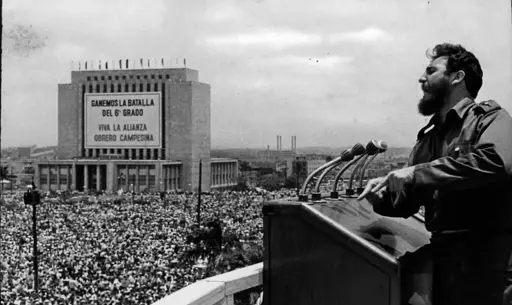
On Sunday, April 16, 1961, at the funeral for the victims of the bombings at various locations across Cuba, which was part of the mercenary invasion financed and supported by the US government, Fidel Castro told the armed people who filled 23rd Avenue in Havana’s Vedado: “This is what they cannot forgive us for, that we are right there in their faces and that we have executed a socialist revolution right under the noses of the United States!”
With those words, he proclaimed the socialist nature of the Cuban Revolution and embarked on a bold action that not only confronted the most powerful empire on the planet but also marked a turning point in the struggles for emancipation in the so-called Third World.
The audacity of a political leader is nothing more than the sum of decision, courage, and determination to challenge the established order and act to change the course of historical events. When talking about that type of leadership, it is difficult to avoid an epic tone. How else can the feats of Spartacus, when he organized an army of slaves to confront Rome, or Bolívar’s decision to cross the Andes to expel the last soldier of the Spanish Empire from America, be recounted?
Fidel’s political life and the fate of the Cuban Revolution were marked by the constant challenge of overcoming what seems insurmountable and facing adversities at the cost of sacrificing everything except principles. Both the assault on the Moncada Barracks in 1953 and the landing of the Granma yacht to begin the guerrilla struggle in the Sierra Maestra with a handful of men in 1956 are clear evidence. What seemed like an irrational gamble turned into a necessary action.
No invasion will be without a response
The proclamation of the socialist nature of the Cuban Revolution was made amid the invasion that Cuba defeated hours later at Playa Girón. Thus, the response to that invasion attempt was not retreat, but armed defense and political radicalization.
Fidel illustrated his approach to confronting imperialist aggression with an anecdote: he recounted that while fishing, a barracuda had shown its teeth aggressively. He initially retreated, but then decided to confront the animal, and it fled. Thus, he concluded: “If Cuba, facing imperialism—that beast, barracuda, shark, vulture, or all the vermin together, showed fear or hesitation in front of the imperialists, they would have already devoured us.”
That same trait was expressed when, just a few months after the triumph of the Revolution, the United States deployed a strategy to isolate the island from all international forums, achieving its expulsion from the OAS in January 1962.
Fidel’s response was rapprochement with the socialist bloc, Africa, and Asia, with the world’s revolutionary, anti-colonial, and independence movements, building a global policy of internationalism. Part of that effort was both the call for the first Tricontinental Conference and the creation of the Latin American Organization of Solidarity. The OAS itself described these efforts as its main threat.
He also built a top-tier diplomacy with a presence on all continents and a leadership role in the Non-Aligned Movement and the Group of 77. One of the most visible achievements of this revolutionary diplomacy is the annual victory in the vote on the resolution against the US blockade at the UN. There, the United States is the isolated one.
Likewise, during the early years of the 21st century, while the US government tried to advance its neoliberal expansion policy through the Free Trade Agreement of the Americas (FTAA), Fidel and Hugo Chávez promoted the creation of the Bolivarian Alternative for the Peoples of Our America (ALBA).
This initiative not only proposed a way to integrate Latin American and Caribbean countries, but also represents a genuine and distinct way to unite peoples with concepts and practices that go beyond commercial exchange or profit, with efforts focused on improving the living conditions of the majority. Thus, the enormous achievements in health, education, and energy stand out.
Angola is not alone: pragmatic idealism
What motivates a small island country, in the middle of the Caribbean, with just over nine million inhabitants, to send an army across the Atlantic Ocean? Cuba did. Between 1975 and 1991, over 300,000 soldiers voluntarily participated in the war that achieved the preservation of Angola’s independence, Namibia’s independence, and the fall of the apartheid regime in South Africa.
Cuba did not acquire any oil or mining concessions in Africa. It brought back the remains of the 2077 Cubans who fell in combat and the honor of having written one of the most beautiful pages of internationalist solidarity.
The question posed cannot be answered by material benefit, nor by the desire for conquest, nor by profit. It can only be answered by principles, by values, by the sense of humanity, and by the need to share the fate of our sister nations. The facts confirm the words that Fidel said in 1975: “Internationalism is one of our most sacred banners, and we develop our internationalist consciousness in the practice of internationalism, and modestly joining, to the best of our abilities, in the task of collaborating and fighting for other peoples as well. This internationalist spirit is the essence of our revolutionary ideals.”
Resistance, synonym of victory
Fidel considered himself a soldier of ideas. From the early days of the Revolution, he made words one of the most effective weapons. He defended the truths of Cuba, embarked on a battle of ideas, and managed to build a relationship with his people, turning Cuba into an impregnable fortress whose foundations are revolutionary consciousness, a sense of homeland, the struggle for its independence and sovereignty, and the defense of the nation.
Under Fidel’s leadership, and to this day, Cuba has achieved the historic feat of resisting the longest economic, commercial, financial, and energy blockade in the history of humanity. It faced invasions, terrorist attacks, chemical and biological attacks against its agriculture and livestock, the collapse of the Soviet Union and its trading partners, the change in policy in its ally Venezuela, and today, the unprecedented and cruel decision by the US to prohibit the sale of oil to the island.
Amid the imposed shortages and suffering, Cuban resilience is not devoid of impressive achievements. It was Fidel’s long-term vision that bore fruit, turning Cuba into a powerhouse in human development, sports, arts, sciences, and civil defense. Among many accomplishments, Cuba became the only country in the Global South to have its own vaccines to combat the COVID pandemic.
Unbreakable Cuba: Why Washington Still Fears a Defiant Island
The voice of example
José Martí, the apostle of Cuba’s independence, said that the loudest voice is that of example. Fidel led the assault on the Moncada barracks; he was imprisoned; he organized the resistance to Batista’s dictatorship from exile; he directed the Granma expedition; he commanded the guerrilla struggle in the Sierra Maestra; he was on the front lines of combat from a tank during the mercenary invasion; he was in the disaster zone during the impact of the deadliest hurricanes that struck the island; he was in the war against colonialism and apartheid; he led the fight against external debt; he was one of the first to warn about the effects of the climate crisis; and he was on the front lines in the long and difficult task of the unity of Latin America and the Caribbean.
Approaching Fidel’s life is to approach that of an extraordinary politician. It is not possible to find a divorce between what he said and what he did. There was coherence between his interests and principles, and he never asked others to take risks he had not already faced. Austerity, modesty, discipline, and work ethic are some of the essential characteristics of his leadership style.
Destiny willed that, in the year of the centenary of Fidel’s birth, imperialist aggression intensified to unimaginable degrees of cruelty. From the first months of 2026, the United States imposed a ban on third countries selling oil to Cuba. No country could withstand that kind of medieval siege. However, Cuba does. This happens largely because of Fidel’s legacy, because the work of the Revolution is nothing more than overcoming what seems insurmountable.
The lineage of leaders to which Fidel belongs is now embodied in his people who face adversity with integrity, dignity, and audacity. In days of siege, Fidel’s words are echoed in the speeches of leaders and in the words of Cuban workers.
It seems that his own prophecy came true when, in 2003, facing similar threats as now, he said: “Let our enemies not get their hopes up. I may die tomorrow, and my influence will grow. Once I said that the day I truly die, no one would believe it. I could walk like El Cid, who, even in death, was carried on horseback winning battles.”
Translation: Orinoco Tribune
OT/SC/SF
From Orinoco Tribune via This RSS Feed.