

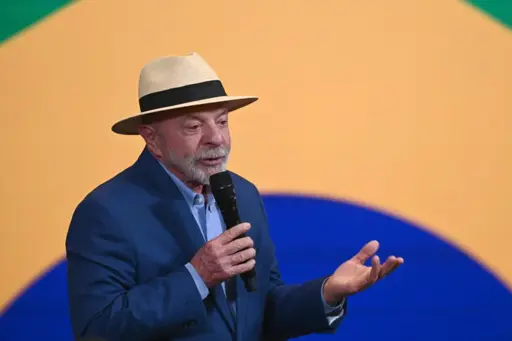
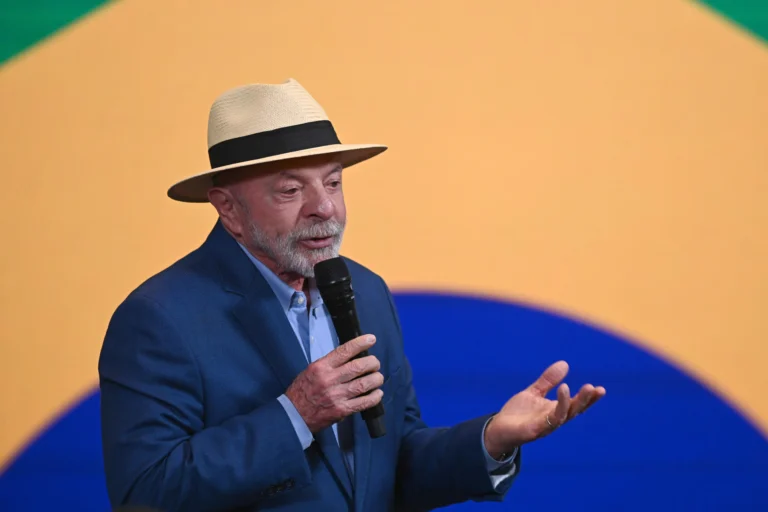
Brazil election poll shows Lula leading with 38% against Flávio Bolsonaro’s 31%, while a runoff now appears closer ahead of the October vote.
Related: Lula Seeks to Contact Trump Directly to Prevent Interference in Brazilian Elections
Brazil Election Poll Keeps Lula Ahead as Right Gains Ground
The latest Brazil election poll keeps President Luiz Inácio Lula da Silva in first place ahead of the October presidential vote, although the contest against Senator Flávio Bolsonaro has become increasingly competitive.
A Genial/Quaest survey published Friday gives Lula 38 percent of voting intentions in a first-round scenario. Flávio Bolsonaro, the Liberal Party candidate and son of former president Jair Bolsonaro, follows with 31 percent.
Renan Santos, of the Missão party, and Goiás Governor Ronaldo Caiado are tied in third place with four percent each. Former São Paulo governor Romeu Zema and candidate Augusto Cury each receive two percent.
Samara Martins registers one percent, while Edmilson Costa, Clariana Barão, Hertz Dias, Leonardo Avalanche, Rui Costa Pimenta and Wilson Grassi did not receive measurable support in the survey.
The poll also shows a large group of voters who have not fully settled their choice. Approximately 30 percent said they could still change their vote, while another 10 percent indicated that they would cast a blank or spoiled ballot.
The size of the undecided and potentially movable electorate means that the current figures do not establish a definitive outcome. Brazil’s official campaign period begins on August 16, leaving candidates with several weeks to consolidate their support and attract voters who remain uncertain.
The first round of the presidential election is scheduled for October 4, with a second round set for October 25 if no candidate receives more than half of the valid votes. g1.globo
The survey was conducted between August 10 and 13 among 2,004 voters. The margin of error is two percentage points, meaning that the difference between some candidates may fall within the poll’s statistical range. aljazeera
Brazil Election Poll Shows Narrower Runoff Margin
Brazil’s Superior Electoral Court | Quaest research institute
The Brazil election poll presents four potential second-round matchups, and Lula leads in all of them. However, the margin against Flávio Bolsonaro is narrow enough to be considered a statistical tie.
In a direct contest with Flávio Bolsonaro, Lula receives 43 percent, compared with 40 percent for the conservative candidate. Another 13 percent of respondents said they would cast a blank or spoiled ballot.
Because the survey’s margin of error is two percentage points, the three-point difference between the candidates does not necessarily indicate a clear advantage for Lula.
The result marks a significant narrowing compared with an earlier Genial/Quaest poll published on August 5. That survey gave Lula 44 percent against 39 percent for Flávio Bolsonaro, a five-point margin. valorinternational.globo
The latest figures suggest that the former president’s son is gaining ground as the campaign moves toward its formal start. Nevertheless, the poll does not show Flávio Bolsonaro overtaking Lula in either the first-round scenario or the simulated runoff.
Lula also maintains an advantage over Ronaldo Caiado. In that scenario, the president receives 44 percent, while the former Goiás governor records 37 percent. Fourteen percent of respondents choose a blank or spoiled ballot.
Against Renan Santos, Lula leads 44 percent to 36 percent, with 16 percent of voters either undecided or indicating another voting option, according to the survey’s reported distribution.
The widest margin appears in the simulation involving Romeu Zema. Lula receives 45 percent, while the former Minas Gerais governor obtains 34 percent.
The different second-round scenarios show that Lula’s position remains stronger against candidates with less nationwide recognition. Flávio Bolsonaro, however, benefits from the political identity associated with his father and from the support of Brazil’s conservative and right-wing electorate.
The results also point to the importance of the first-round campaign. Candidates outside the two leading positions must decide whether to continue their own campaigns, form alliances or negotiate support for a potential runoff.
Caiado and Zema represent influential state-level political networks. Renan Santos, meanwhile, is associated with a newer conservative movement seeking to expand its presence in national politics.
The poll’s results do not measure only personal popularity. They also reflect party structures, ideological identification, voter rejection and the political environment surrounding the Lula government.
The 10 percent who say they will cast a blank or spoiled ballot may represent voters who reject all available candidates or who have not yet decided whether to participate meaningfully in the election.
Brazil’s compulsory voting system means that voters who do not wish to support any candidate can still attend the polls and register a blank or spoiled vote.
Lula and Flávio Bolsonaro Face Polarized Race
Brazilian electoral calendar | Reuters coverage of Brazil’s 2026 election
The Brazil election poll confirms that Lula and Flávio Bolsonaro are currently the central figures in the presidential contest.
Lula is seeking another term as president and is campaigning on his record of economic recovery, social programs and Brazil’s international role. His administration has emphasized employment, public investment, poverty reduction and the expansion of diplomatic ties with countries in the Global South.
Flávio Bolsonaro is presenting himself as the main conservative alternative. His campaign draws on the political movement created by his father, former President Jair Bolsonaro, and emphasizes public security, reduced government intervention and opposition to the Workers’ Party.
The election is therefore likely to be shaped by issues beyond individual policy proposals. The contest reflects a broader dispute between progressive and conservative political projects in Brazil.
Economic conditions will be a central factor. Voters are expected to assess inflation, employment, food prices, public debt and household purchasing power.
Public security will also remain a major issue, particularly in urban areas where residents face organized crime, police violence and insecurity.
The candidates will also debate the role of the federal government in health care, education, infrastructure and environmental protection. Brazil’s size and regional inequalities make these issues especially complex.
The Amazon will be another important subject. Brazil faces international pressure to reduce deforestation while protecting economic activity and the rights of Indigenous and traditional communities.
Foreign policy may also influence the campaign. Brazil has sought a more autonomous international position under Lula, supporting multilateral diplomacy and cooperation among emerging economies.
A conservative government led by Flávio Bolsonaro could seek closer alignment with the United States and place greater emphasis on security cooperation and market-oriented policies.
The political debate is taking place amid tensions between Brazil and Washington. President Donald Trump’s administration has applied tariffs and other economic measures affecting Brazilian exports, prompting the government in Brasília to prepare reciprocal actions.
That dispute could become part of the campaign narrative, with Lula portraying his administration as a defender of national sovereignty and Flávio Bolsonaro arguing for stronger relations with the United States.
Poll numbers may also influence the behavior of political parties and donors. A narrow runoff could encourage alliances among conservative groups seeking to prevent Lula from winning another term.
At the same time, Lula’s lead in the first-round scenario could motivate progressive parties to consolidate their support behind his candidacy and avoid divisions that might force a more uncertain runoff.
The survey indicates that approximately three in ten voters remain open to changing their choice. This makes campaign debates, televised advertisements, regional alliances and social media messaging particularly important.
Brazil’s electoral law imposes rules on political advertising and media coverage, while the Superior Electoral Court monitors the process and establishes deadlines for candidates and parties.
The campaign will officially intensify on August 16. From that point onward, candidates will have greater access to television and radio advertising and will be able to expand their public events.
Geopolitical Context
The Brazil election poll has implications across Latin America because Brazil is the region’s largest country and economy.
The outcome could affect South American integration, trade policy, environmental cooperation and relations with China, the United States and neighboring governments.
Lula has promoted stronger ties among emerging economies and supported regional dialogue on issues such as energy, food security and climate change. A conservative administration could alter those priorities and place greater emphasis on bilateral relations with Washington.
The election will also influence debates over the Amazon. Brazil’s environmental policies affect global climate negotiations and the future of one of the world’s most important ecosystems.
A close election could intensify political polarization and encourage alliances among parties that oppose Lula. It could also deepen tensions over Brazil’s democratic institutions, particularly after the political crisis and attacks on government buildings that followed the 2022 election.
The current poll does not predict the final result. It captures voter preferences at a specific moment, before the official campaign has fully begun and before all candidates have consolidated their alliances.
The narrow runoff margin against Flávio Bolsonaro indicates that Lula remains the favorite but cannot assume victory. With a large share of voters still open to changing their choice, the coming weeks could significantly reshape the race.
From teleSUR English via This RSS Feed.