

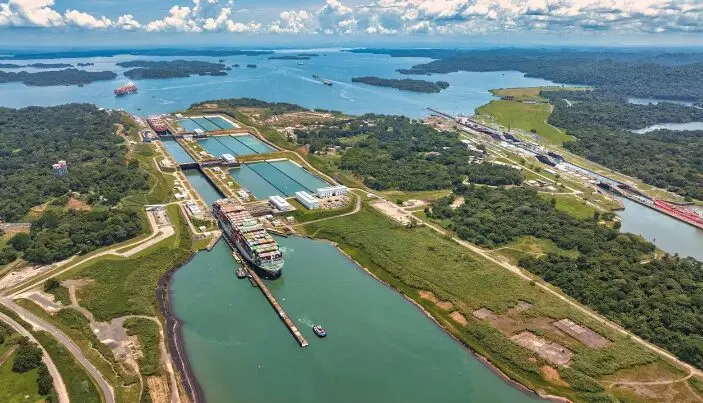
The Panama Canal has been operating since this Saturday with a draft of 48.5 feet or 14.78 meters in the Neopanamax locks, the expansion in service since June 2016, as part of preventive measures against the drought derived from a strong El Niño phenomenon this year that may extend until 2027.
[Panamanians Protest After the Relocation of Eight Cemeteries: Panama Canal Applies New Draught Reduction To Face the Drought](https://www.telesurenglish.net/panama-canal-applies-new-draught-reduction-to-face-the-drought/)
This is the third draft adjustment of a schedule that, so far, establishes five, the first since last July 3 when it dropped to 49.5 feet or 15.09 meters, followed by the one applied on July 24 (49 feet or 14.94 meters), the one this Saturday, and those of August 26 (48 feet or 14.63 meters) and September 3 (47.5 feet or 14.48 meters).
The draft is the submerged part of the ship and the Panama Canal, the only freshwater canal in the world and which connects the Atlantic and Pacific oceans, offers a maximum of 50 feet (15.24 meters).
The direct consequence of reducing the draft is that the vessel must cross with less cargo, which can lead to logistical changes for customers and impact the Canal’s accounts, which charges in relation to the mobilized tonnage.
The Canal expects that it will have to gradually reduce the draft until it reaches 44 feet or 13.41 meters, the minimum operating draft of the Neopanamax, which it believes will be enough to overcome the water crisis without applying restrictions on vessel transit as occurred in 2023, according to the deputy administrator and designated administrator of the route, Ilya Espino de Marotta.
El Canal de Panamá redujo su calado a 48,5 pies ante la sequía por El Niño. La vía prevé llegar a 44 pies en 2027 sin restringir los tránsitos diarios. #teleSUR #Panamá #CanalDePanamá #15Ago pic.twitter.com/Ri4n5edEsZ
— teleSUR TV (@teleSURtv) August 15, 2026
“We are anticipating that by the summer of 2027, meaning April-May, we will reach a draft of 44 feet, based on the level of transit we are seeing and the rain forecasts. We are not foreseeing a reduction in transit,” said Espino de Marotta at a press conference last July 7.
In the statement that announced the August and September adjustments, the administration of the route, through which between 3% and 5% of world trade passes, maintained that the announced draft adjustments do not imply changes in the number of daily transits, which average between 36 and 37.
The draft adjustments respond to the projected levels of Lake Gatun, built in 1913 and the Canal’s main water supplier, which also benefits from another artificial lake, Alhajuela (1935), the administration of the route affirmed.
The schedule for applying the adjustments obeys “a planning based on lessons learned during the 2023-2024 period,” when a strong drought forced not only to reduce this level to 44 feet but also to restrict daily vessel transits, which reached twenty-two.
In the first nine months of the Canal’s current fiscal year (October 2025 – June 2026), transits grew by 5.2% and revenues by 17%, driven by the container ship and Liquefied Petroleum Gas (LPG) segments, according to official data.
From teleSUR English via This RSS Feed.