



When democratic socialists took Barack Obama’s advice (Time, 1/11/17), corporate media told them to untie their shoes.
As he was leaving office in 2017, President Barack Obama urged Americans concerned about where their country was headed to act. “If something needs fixing, then lace up your shoes and do some organizing,” he said (Time, 1/11/17). “If you’re disappointed by your elected officials, grab a clip board, get some signatures, and run for office yourself.”
Ten months earlier, then-presidential candidate Hillary Clinton had made a similar comment (The Hill, 3/1/16). At a campaign stop in Minnesota, a young woman pressed Clinton about her past remarks on “superpredators.” After a brief exchange, Clinton said, “You know what, dear? You have a different opinion… Why don’t you go run for something?”
A decade later, it’s clear that a new generation of leaders has taken that advice. But instead of being praised for contributing to civic life by participating in democracy, they and the organizations that support them have been pilloried as threats to both the Democratic Party and democracy itself.
DSA as ‘parasite’

James Kirchick (Atlantic, 7/21/26) explicitly called for a return to the McCarthy Era, enacting his vision of Democrats “prohibiting DSA members from joining their party and throwing out the DSA members already honeycombed within it.”
The Atlantic, which published a 2024 essay (5/17/24) asserting, in the context of Gaza, that “it is possible to kill children legally,” ran an article (7/21/26) on the Democratic Socialists of America headlined “The DSA Is a Parasite.” (I belong to the organization’s New York City chapter.) Writer James Kirchick averred that “ideologues on the left are attempting a hostile takeover of the [Democratic] party.” He suggested that the organization’s rise was enabled by a
yearslong effort by socialists and progressive activists to steer one of America’s two major political parties toward identity politics, isolationism and hostility to capitalism.
Kirchick’s disdain for those who join standard efforts to influence political parties is anti-democratic, ahistorical and willfully obtuse. He also conflates and misrepresents the goals of progressive and socialist activists. “Hostility to capitalism” is accurate enough if one is describing socialists—not necessarily progressives—but “identity politics” and “isolationism” are not.
DSA opposes military bases and economic warfare, but it explicitly champions immigration and international law, and working toward “a world without war or poverty”—that’s not “isolationism.” The group also calls for “a world where no one suffers for their race, gender or religion”—an enormously popular view that Kirchick dismisses, insultingly and inaccurately, as “identity politics.”
Kirchick and his ilk, of course, wouldn’t be able to caricature socialists’ views so easily if they were held to basic editorial standards, and if socialist perspectives weren’t almost entirely excluded from corporate media.
Hijacked by a ‘radical fringe’

Jim VandeHei and Mike Allen (Axios, 7/28/26) write that “it’s safe to assume the New York Times, the Atlantic and MS NOW will resist socialism.” Yes, that’s a very safe assumption!
A recent spate of articles have, like Kirchick’s, sought to repackage normal political practices as novel, violent and/or disease-like threats unrelated to the will of voters. An Axios column (7/28/26) by the site’s co-founders Jim VandeHei and Mike Allen began: “Republicans didn’t decide to become President Trump’s party. They surrendered to him, one stage at a time, over a decade, in plain sight.” It then posed the (paraphrased) question: Will the Democratic Party similarly surrender to the creeping threat of socialism?
While acknowledging that socialism is popular with the Democratic base, the Axios story portrays it as a disease whose “transmission is slower” than Trumpism. It’s not clear why Axios treats socialism as a pathology; in what way is it harmful to, or impairing the normal functioning of, America or American democracy?
The Hill (7/24/26) also noted “fears” that “the [Democratic] party is being taken over” by democratic socialists.
The Wall Street Journal warned darkly that
DSA’s advances are stirring consternation—and sometimes panic—among mainstream Democrats dreading their own Tea Party moment, in which a radical fringe hijacks the party and taints their brand just as they are trying to appeal to swing voters to win control of Congress.
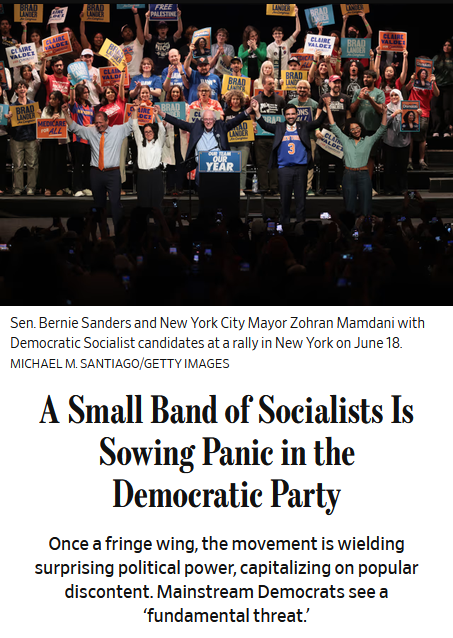
The Wall Street Journal (7/28/26) cites Rep. Tom Suozzi (D-NY) as warning that “many Democrats underestimate the threat posed by a group that has figured out how to organize and capture attention as successfully as MAGA does.”
Odd if true, given that recent socialist wins have coincided with an uptick in favorable views of the Democratic Party, which suggests that DSA’s success may in fact be burnishing the party’s brand.
DSA’s leaders, the Journal continued, “scarcely hide their disdain for a Democratic Party they view less as a partner than a hostile takeover target.” It’s true that DSA does not view most senior Democratic Party leaders as its partners; the organization is succeeding by appealing directly to the party’s supporters. (In the words of DSA member and New York City Mayor Zohran Mamdani, “What’s a party if not its voters?”) If those who regularly vote or are inclined to vote in Democratic Party primaries ultimately succeed in changing the party’s platform to better represent their views, that’s not a hostile takeover—that’s democracy.
The “takeover” language is telling: The corporate press sees any assertion of agency on the part of everyday people as a threat to establishment interests. The Free Press (7/21/26) sounded the alarm in an article headlined “What the Movement Taking Over the Democratic Party Wants.” And Fox News (7/27/26) went further with a story headlined “[US Rep. Steve] Scalise Warns ‘Bolshevik Revolution’ Taking Over Dem Party After Socialist Primary Wins.”
DSA does, like the Bolsheviks of more than a century ago, defend people’s rights to peace, land (housing, in a contemporary US context) and bread. But unlike the Bolsheviks, the organization is not armed or violent, and is committed to democratic change (hence the name).
**‘Getting away with’****—**what?

The New York Times (6/20/26) says “mainstream Democrats” see “DSA-backed candidates as outsiders looking to usurp political power from longtime residents.”
Seeking to change a political organization by appealing to its supporters and competing in its primaries is what politicians of all stripes do; it is how democracy works. Yet the New York Times (6/20/26) has characterized quotidian political participation as “an uprising from the left,” which poses a larger “threat”—it’s not clear to whom, other than House Minority Leader Hakeem Jeffries, who may eventually be primaried from the left. To the Times, DSA is not competing in congressional primaries but “targeting high-profile House races.”
And though the Times (8/10/26) acknowledges that “democratic socialists and their allies have scored a series of victories over traditional Democrats with superior messaging and organizing tactics,” it also reports that these tactics have “terrified” the party establishment, causing them to “burn through gobs of cash,” and leaving them to wonder: “How do progressives keep getting away with this?” Most see winning a primary election thanks to better messaging and organizing as entirely above board; the Times tells readers it’s a scary heist.
Martial analogies are common in political writing, but the corporate press covers intra-Democratic Party tensions as if progressives and democratic socialists were the only combatants. As a recent AP article (7/27/26) noted:
Establishment Democrats, including former Democratic National Committee chair Jaime Harrison, have forcefully pushed back against DSA candidates who run in the party’s primaries while criticizing the way the party is going.
But if you’re seeking to change a party’s direction, forming organizations to influence it, running in its primaries, and organizing caucuses within it are the most obvious and common ways of doing so. Centrist Democrats—including Bill Clinton, who went on to win two of his party’s presidential primaries—did this when they founded the Democratic Leadership Council in 1985 and the Progressive Policy Institute in 1989. Clinton and his allies were fighting in what some at the time called a “battle for the party’s soul” (Time, 7/10/95)—a struggle that continues to this day.
Working together to alter the priorities and structure of theoretically representative institutions like Congress and the Democratic Party is a necessary and crucial form of democratic participation. It is precisely what leaders like Obama and the Clintons have repeatedly enjoined Americans to do. And when done by individuals and organizations that are honest and forthright about their intentions—e.g., those with clear public platforms—there is nothing sneaky, underhanded or sinister about it.
Research assistance: Emily Marie Spencer
From FAIR via This RSS Feed.