

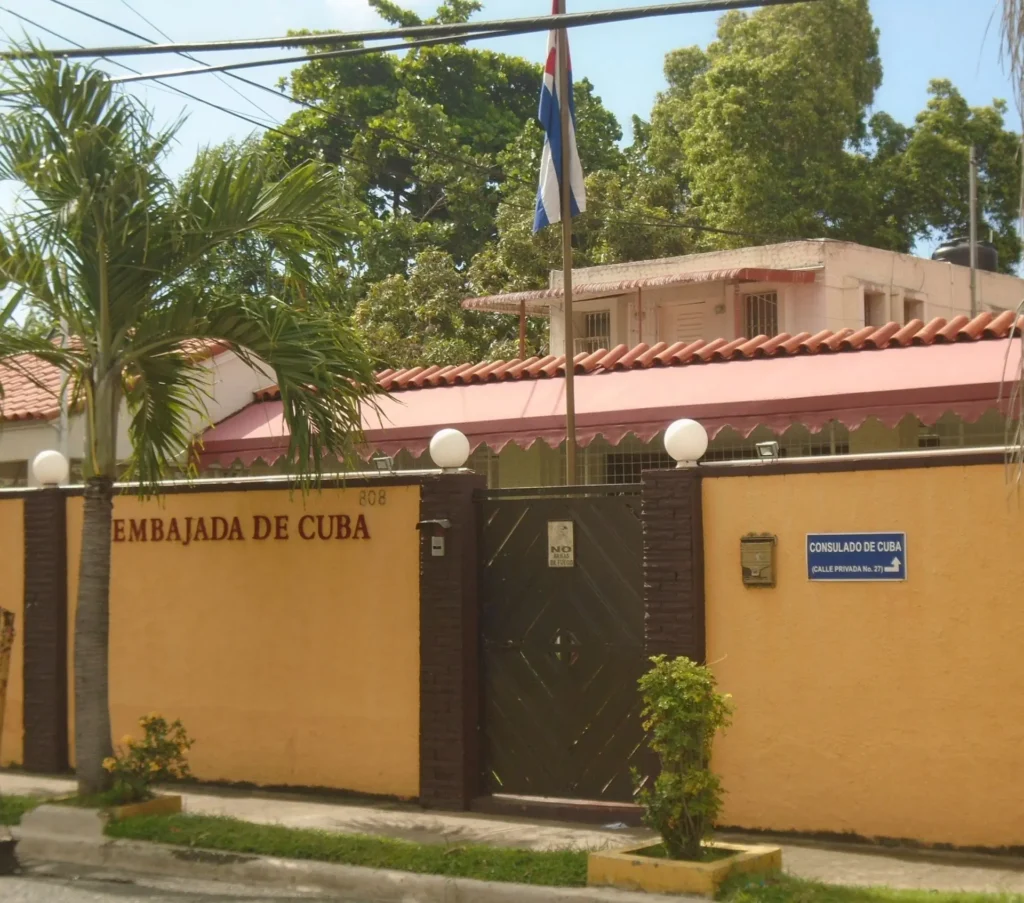
On Thursday, the Dominican Republic’s Foreign Ministry announced the expulsion of nine Cuban diplomats and their families, who will have seven days to leave the country. The Ministry of Foreign Affairs (Mirex) issued a brief statement that did not detail the reasons for the decision.
RELATED:
Dominican Republic and Mexico Sign Three‑Year Energy Research and Innovation Agreement
According to the official statement, the measure falls within the powers granted to the receiving state by international law and the relevant provisions of the Vienna Convention on Diplomatic Relations, to which the Dominican Republic is a State Party.
The Dominican government stated that it is adhering to current regulations and will continue to handle this matter with due discretion and through established diplomatic channels, in the interest of preserving relations between the two countries. It also clarified: “As these are diplomatic communications, we inform you that no further details will be offered on this matter.”
Bilateral relations between Cuba and the Dominican Republic were formally re-established in April 1996, under the government of Leonel Fernández, after decades of rupture during the dictatorship of Rafael Leónidas Trujillo (1930-1961). In August 1998, Fidel Castro made a historic official visit to the Dominican Republic.
Cuban Response Matching the Infamy
The Cuban Ministry of Foreign Affairs (Minrex) strongly rejected the expulsion of Cuban diplomats from the Dominican Republic, considering the measure a response to pressure from the Trump administration.
In an official statement, the Cuban Foreign Ministry emphasized that the diplomats have always acted in strict adherence to the 1961 Vienna Convention on Diplomatic Relations and with absolute respect for the laws of that sister nation.
The Dominican Ministry of Foreign Affairs (Minrex) stated that President Luis Abinader’s decision seeks to damage diplomatic relations with countries in the region as part of the isolation policy promoted by Washington.
Comunicado del Ministerio de Relaciones Exteriores de Cuba
Cuba rechaza acto de subordinación del gobierno de República Dominicana a la política agresiva de los Estados Unidos.
: https://t.co/LR9TeRuoeZ pic.twitter.com/P0SvKCJEMb
— Cancillería de Cuba (@CubaMINREX) August 13, 2026

The text reads, “Statement from the Cuban Ministry of Foreign Affairs. Cuba rejects the Dominican Republic government’s act of subordination to the aggressive policies of the United States.”
Havana recalled that this is not the first time the Dominican government has aligned itself with the hostile policy and aggressive escalation of the United States against our country, citing as precedents Cuba’s exclusion from the 10th Summit of the Americas and the Dominican Republic’s change of vote on the resolution against the US embargo in the UN General Assembly.
For his part, the Cuban ambassador to Santo Domingo, Ángel Arzuaga Reyes, participated in a solemn ceremony at the Autonomous University of Santo Domingo (UASD) commemorating the centennial of Fidel Castro. “We will always be together, we will be with him, as always, as Martí taught, as Fidel taught,” the diplomat stated.
Arzuaga Reyes denounced the economic blockade, the energy embargo, the media campaigns, and the military threat imposed by the U.S. against the island, and affirmed that the Revolution is here to stay, despite the aggressions, wherever they may come from. He asserted that the more difficult the circumstances, the greater the unity and fighting spirit of the Cuban people.
Political leaders speak out
The president of Alianza País, Guillermo Moreno, told local media that one doesn’t need to be a NASA scientist to know that this is due to pressure from the U.S. government. Moreno pointed out that it is no coincidence that the decision was announced on the centennial of Commander-in-Chief Fidel Castro Ruz (1926-2016) and described the blockade against Cuba as a measure “with genocidal characteristics.”
Meanwhile, former Deputy Foreign Minister Minou Tavárez Mirabal expressed concern about a foreign policy she described as subservient and questioned the attempt to strike at a country at such a difficult time, a sister nation that has been so supportive not only of the Dominican Republic, but of the entire world.
María Teresa Cabrera, president of the Frente Amplio, stated that the decision is shameful and that the Dominican government maintains a diplomatic relationship on its knees before the United States. The organization maintained that invoking the Vienna Convention cannot be used as an argument to keep such a momentous political decision secret and demanded that the historical relations between the two nations be preserved.
For his part, Manolo Pichardo, former president of the Central American Parliament and international secretary of the People’s Force party, recalled the historical ties between the Dominican Republic and Cuba, symbolized by the extradition of figures like Máximo Gómez, and called for any situation to be addressed through all available diplomatic channels to prevent escalation.
Ver esta publicación en Instagram
Una publicación compartida por teleSUR English (@telesurenglish)
From teleSUR English via This RSS Feed.