

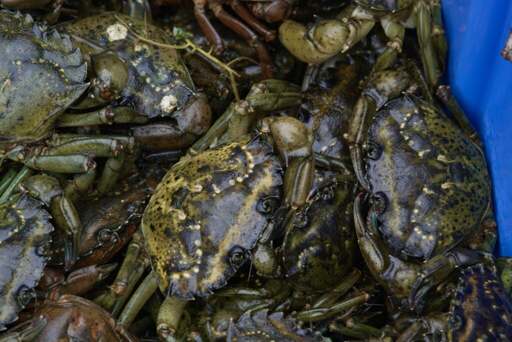

European green crabs caught by Heiltsuk guardians in Q’vúqvai (Gale Creek) on July 26. Photo by Sonal Gupta/Canada’s National Observer
This story was originally published in Canada’s National Observer and appears here with permission and minor style edits.
One of Turza Humchitt’s earliest memories is of her grandmother’s table — where family sat on benches on either side and shared from a large pot that might hold soup, clams, cockles or Dungeness crab.
Fresh clams were steamed with rice, fried in the half-shell or eaten with broth sipped straight from the shell.
For Humchitt, a fellow member of Híɫzaqv (Heiltsuk) Nation, they still taste like childhood.
“It reminds me of what’s always been there,” said Humchitt, who lives in Wágḷísḷa (Bella Bella), on “B.C.’s” central coast.
Now, that food is harder to find close to home.
Humchitt said her husband has had to travel farther in recent years to harvest clams — thanks to an invasion hastened by a disaster.

Diana Chan, natural resource manager with the Heiltsuk Integrated Resource Management Department, holds clam shells at Q’vúqvai (Gale Creek). Photo by Sonal Gupta
A decade after the tugboat Nathan E. Stewart ran aground and spilled diesel into the nation’s clam harvesting areas, Híɫzaqv guardians — trained Indigenous stewards who monitor the nation’s lands and waters — say the damage is still spreading.
In Q’vúqvai (Gale Creek) near Wágḷísḷa, guardians have found European green crab populations have increased dramatically since the October 2016 spill.
European green crabs are native to Europe and North Africa, but have spread widely in “North America.”
Unlike native Dungeness crabs and the larger blue crabs commonly eaten on the “US” East Coast, green crabs are small and carry little meat.
They are edible, but often more practical for stocks, sauces, fertilizer or other products than as a crab people crack and eat at the table, said Carolyn Tepolt, an associate scientist at Woods Hole Oceanographic Institution.
Tepolt said green crabs are unusually well-suited to spread and survive in new places because they tolerate a wide range of conditions, eat many different foods, and may be able to withstand some polluted environments.
“If you were going to design a great invasive species,” Tepolt said, “it would probably have a lot of the qualities the green crabs have.”

READ MORE: Colonialism ‘an invasive species’: Indigenous communities replenish threatened Indigenous food systems
Crews are removing the invasive crabs as they eat young clams and show up in more parts of Híɫzaqv territory — threatening clam beds that have sustained Híɫzaqv food, culture and livelihoods.
Diana Chan, natural resource manager with the Heiltsuk Integrated Resource Management Department, said the possibility that an oil spill could be followed years later by a green crab surge was not something the nation had initially been watching for.
When a spill happens, the response often focuses on containing and cleaning up the oil, Chan said.
“The long-term monitoring has really been lacking,” she said.
“Híɫzaqv was left to just do all of it on our own.”

Richard Reid, a veteran Guardian Watchmen supervisor and steward for the Heiltsuk Nation, carries a tote used to hold European green crabs after they are trapped in Q’vúqvai (Gale Creek). Photo by Sonal Gupta
A surge in green crabs
Green crabs were present around Q’vúqvai before the spill, but in much smaller numbers.
Guardians usually caught 10 to 20 crabs per trap, and commercial clam harvesters killed crabs they found on the beaches.
A July 2026 report prepared by Chan and Milène Wiebe — a PhD candidate at University of Alberta — and reviewed by Canada’s National Observer determined the spill was “likely a significant contributing cause” of the crab explosion that followed.
Green crabs are highly resilient to pollution and environmental disturbance and may survive those impacts better than many native species, it says.

READ MORE: Híɫzaqv takes legal action against ‘Canada’ after DFO shut down nation’s herring fishery
The spill also closed the commercial clam fishery, meaning the usual 40 to 50 harvesters were no longer on Q’vúqvai beaches for weeks each winter, killing crabs as they worked and detecting changes early.
By 2019, three years after the spill, some traps were regularly catching more than 50 crabs.
In one three-month stretch in 2024, Híɫzaqv crews removed more than 32,500 green crabs from about 20 Q’vúqvai clam beaches.
To protect clam beds, Híɫzaqv crews need to drive crab numbers down.
But as trapping increased, Chan said crews also began watching for another risk: adult crabs eat their young and if too many adults are removed from a contained area, more young can survive as predation drops.
Researchers call that the “hydra effect.”

Highly invasive European green crabs. Photo by Sonal Gupta
Edwin Grosholz — a distinguished professor emeritus at University of California, Davis — led a study documenting it in “Seadrift Lagoon.”
That small “California” estuary saw an intensive eradication effort cut adult green crabs by more than 90 per cent.
Within a year, the population rebounded more than 30-fold, from fewer than 10,000 crabs to about 300,000.
“This kind of thing can happen where adult animals in the population consume or cannibalize the young,” said Grosholz, who has studied green crabs since their early spread along the West Coast in the 1990s.
“If you remove most of the adults, then the juveniles are free to survive and then the population suddenly explodes.”

READ MORE: Invasive species affect our way of life — here’s how we can lessen the impacts
Chan said Híɫzaqv has not seen signs of that happening in Q’vúqvai.
But crews now use traps that can catch smaller crabs too, including minnow traps and prawn-style traps, so they can track whether juvenile numbers rise as adult numbers fall.
Winter catches often drop because crabs are less active, so summer catch numbers offer a clearer measure of the trapping effort.
“When we see the numbers remaining low in the summer,” Chan said, “we take that as a sign that the trapping has been working.”

Diana Chan, natural resource manager with the Heiltsuk Integrated Resource Management Department, holds a clam on a beach. Photo by Sonal Gupta
What the crab boom is costing Híɫzaqv
The Nathan E. Stewart spilled about 110,000 litres of diesel and other pollutants in October 2016, contaminating some of Híɫzaqv’s most productive clam beds.
Nearly 10 years later, Híɫzaqv has settled with Kirby Corporation, the “US”-based company connected to the vessel.
But key questions about long-term restoration and compensation remain unanswered.
The First Nation says current green crab removal efforts fall far short of what is needed.
The report estimates a large-scale green crab response would cost more than $22 million over six years.
It calls for scaling up to 10 vessels on the water each day, with 30 full-time green crab-removal positions.
The goal: achieving “functional eradication” within five years — reducing green crab numbers enough that they no longer cause major harm, so clam populations can recover.
In the sixth year, trapping would drop to one or two vessels a day to prevent another population surge and determine what level of control will be needed indefinitely.
Chan said Híɫzaqv currently has one dedicated green crab crew; in some years, when additional funding has been available, it has had two.
The First Nation now has six full-time employees trapping green crabs, with 300 traps deployed across the territory.

READ MORE: In W̱SÁNEĆ territories, removing invasive English ivy makes way for Indigenous plants
The Q’vúqvai area alone has more than 20 clam beaches. Crews can usually set about 40 traps a day, meaning they can only focus on a few beaches at a time.
Some beaches are also difficult to reach because of the tides, Chan said.
The trapping effort has also had to account for other wildlife.
Researchers have documented coastal wolves pulling up submerged crab traps to steal bait.
Chan said crews now use only herring after wolves were drawn to traps baited with sea lions.
Híɫzaqv has seen what it takes to make a dent.
On one small beach near Q’vúqvai, crews trapped so intensely over the summer that crab numbers dropped and stayed lower than nearby areas.
But the success was tightly contained: just metres away, traps were still pulling up 60 to 100 green crabs, Chan said.
That makes the work a balancing act: crews need to trap hard in Q’vúqvai while also watching nearby areas where green crabs are appearing in smaller numbers.
The green crab response is also reshaping the guardian program.
Clams a ‘keystone species … we rely on’
Dúqva̓ísḷa (William Housty) — director of the Heiltsuk Integrated Resource Management Department — said crews with limited capacity are being pulled between protecting clam beds and monitoring salmon habitat, shellfish safety, fisheries, wildlife and other species across Híɫzaqv territory.
“It puts us in a really difficult spot,” Dúqva̓ísḷa said, “to have to choose which is more important, because they’re all very important for us.”
Chan said adult manila clams are still present on some Q’vúqvai-area beaches, but juvenile clams have declined sharply.
That means today’s adult clams may not be replaced as they die.
“It’s really the smaller clams that are most vulnerable to the green crab,” Chan said.
“That’s why we can go to beaches here and still find lots of adult clams, but not the babies.”

READ MORE: Food security, community memories are key ingredients of new Tla’amin cookbook
Dúqva̓ísḷa said Q’vúqvai was known for “football fields” of clam beds and once supported a commercial Manila clam fishery that employed 30 to 40 people, along with shore workers.
For Híɫzaqv, clams are not only a commercial resource.
K̓áwáziɫ (Marilyn Slett), chief councillor of the Híɫzaqv Nation, said they are a staple food, a winter economy and part of community life.
Families harvest them, jar them, preserve them and serve them at potlatches and feasts.
“Our people rely on the ocean for our sustenance,” K̓áwáziɫ said.
“Clams [are] one of those keystone species that we rely on.”

 K̓áwáziɫ (Marilyn Slett), Chief Councillor of Heiltsuk Nation and president of Coastal First Nations-Great Bear Initiative, at the
Híɫzaqv Big House in Bella Bella. Photo by Sonal Gupta
Possible uses for green crabs
The crabs now being removed from Híɫzaqv waters are frozen and taken to Wágḷísḷa’s composting facility.
There, they are mixed with household compost for community use.
The Híɫzaqv are also exploring whether they could be used for food, fertilizer or bioplastics.
Chan said she is aware green crabs are eaten in some parts of the world, especially as soft-shell crab, but she has not heard of people eating them locally.
The nation is in early discussions with Fisheries and Oceans Canada (DFO) about whether green crabs removed from Híɫzaqv waters could be put to use rather than discarded.
Across the coast, other nations are also looking for incentives that could make green crab removal more useful.
Gaagwiis (Jason Alsop), president of the Haida Nation, said their crews have been monitoring and removing green crabs as the species spreads into Haida Gwaii.
But the work takes consistent labour and funding, while the crabs keep reproducing.
Without a practical use for them, every crab pulled from the water remains a cost with no direct benefit.
“They are a challenging species to get control of,” Gaagwiis said.
“They are prolific. And I think we’re seeing that you kind of need some economic incentive, something you could do with them, that would hopefully motivate people to catch them and help keep their numbers under control.”

READ MORE: Híɫzaqv leaders take RCMP to court, say police discriminate against the nation’s laws
On the west coast of “Vancouver Island,” Hasheukumiss (Richard George) said he has pushed for green crabs removed from local waters to be used as food instead of treated only as waste.
The hereditary chief of ʕaaḥuusʔatḥ (Ahousaht First Nation) said he and his mother experimented with cooking green crabs in a bisque and found them “very delicious.”
“There’s no reason why the government can’t sign a piece of paper over to myself and my nation to do good for the island and the mainland as well,” Hasheukumiss said.
The department is developing a regulatory process for proposals to use European green crabs for purposes other than disposal, Renny Talbot, a senior fisheries protection biologist with DFO, told Canada’s National Observer.
He said DFO may be able to issue licences that allow people involved in green crab control to use or sell the harvested crabs — but said that would still be part of an invasive species response, not a commercial fishery.
DFO would regulate the licence for catching the crabs, he said, but if they were used as food, harvesters would also need to work with other authorities, including Canadian Food Inspection Agency and the province, on processing and food requirements.
“We don’t want to have it as a sustainable fishery. We want them gone,” Talbot said.
Talbot said European green crabs were first found on the west coast of “Vancouver Island” in the late 1990s and have continued moving north through ocean currents.
They are now present on the west coast of the island, parts of the province’s central coast, and Haida Gwaii.
Green crabs are DFO’s top marine invasive species priority; the department is working with Indigenous partners on management plans that focus removal efforts on key habitats and culturally important areas, he said.
He noted that DFO expects to update Híɫzaqv on alternative uses for green crab by the end of the year.

Híɫzaqv guardians use one of the Nation’s vessels to reach clam beaches where crews are trapping European green crabs in an effort to protect young clams. Photo by Sonal Gupta
Galvanized to defend waters, again
That might help the Híɫzaqv in the future, Dúqva̓ísḷa said.
But it does not eliminate the need for a larger removal and restoration program now, as every season without enough trapping leaves the next generation of clams exposed.
K̓áwáziɫ said the 2016 oil spill helped galvanize coastal opposition to oil tanker traffic.

READ MORE: ‘We are willing to fight. We are not scared’: A new resistance to LNG unfolds in northern ‘B.C.’
Nearly 10 years later, she said, Híɫzaqv is still dealing with the consequences of that spill, even as governments continue to discuss major projects and marine shipping on the north coast.
“That’s one of the reasons why we pursued upholding the tanker ban so hard,” K̓áwáziɫ said.
“It’s our lived experience with the Nathan E. Stewart and knowing that it’s still unresolved.”
The post Decade after fuel spill, Híɫzaqv are again defending their waters — this time from invading European green crabs appeared first on Indiginews.
From Indiginews via This RSS Feed.