

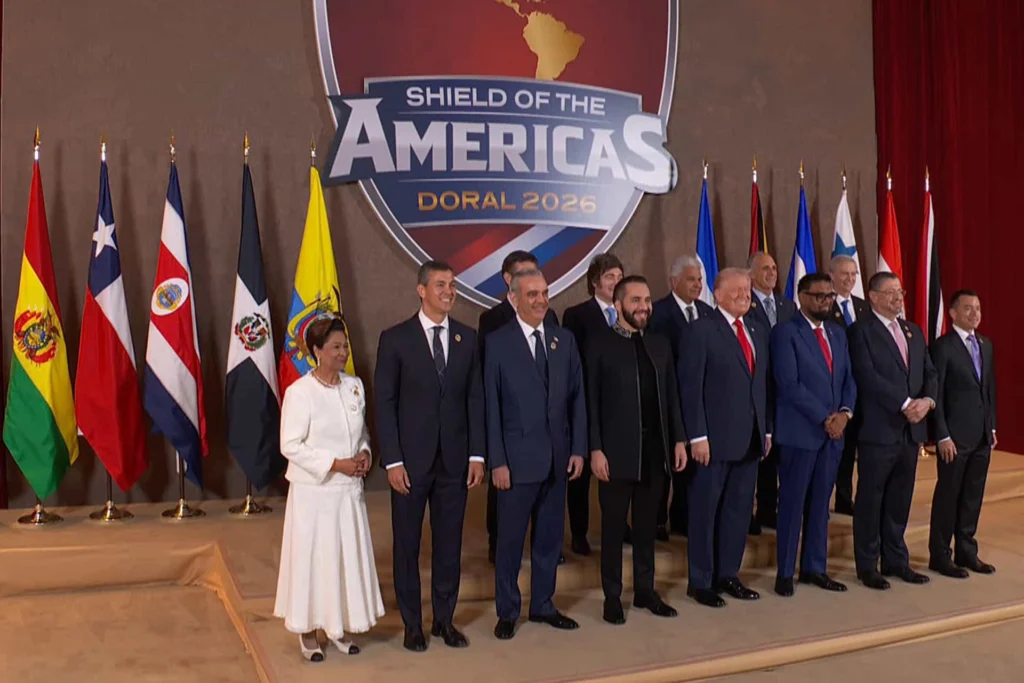
SOUTHCOM’s cross-border surveillance operations put LATAM security operations under Washington’s coordination.
The Shield of the Americas, operationally known as the Americas Counter Cartel Coalition (A3C), marks a shift in United States security policy across the Western Hemisphere.
RELATED:
Cuba Slams ‘Shield of the Americas’ as Threat to Latin American Sovereignty
Functioning under the operational coordination of the United States Southern Command (SOUTHCOM), the initiative establishes an international military, intelligence, and police designed framework, supposedly to combat transnational criminal organizations.
By combining military capabilities with cross-border intelligence networks, the program creates an integrated security structure across participating Latin American nations.
Analysts compare the Shield of the Americas to historical doctrines such as the Monroe Doctrine, Operation Condor, Plan Colombia, and the activities of the School of the Americas.
The strategic core of the initiative extends beyond standard law enforcement objectives. Rather than operating purely as a counter-narcotics treaty, the Shield of the Americas serves as an instrument to reassert U.S. influence throughout Latin America.
Launch Dynamics, Operational Architecture, and Key Promoters
The official rollout of the Shield of the Americas went on March 7, 2026, during an international security summit held at Trump National Doral in Miami, Florida. The event brought heads of state, foreign ministers, and defense officials from throughout Latin America.
The architect and promoter of the initiative is the U.S. administration under President Donald Trump. Key figures driving the alliance include Secretary of State Marco Rubio, Defense Secretary Pete Hegseth, Special Envoy Kristi Noem, and Treasury Secretary Scott Bessent.
Alongside Washington officials, right-wing regional leaders served as main proponents of the alliance, including Argentine President Javier Milei, Salvadoran President Nayib Bukele, and Ecuadorian President Daniel Noboa, who sought direct U.S. military support to address domestic security challenges.
The Shield of the Americas framework uses U.S. Space Force satellite intelligence through the Tactical Surveillance, Reconnaissance, and Tracking (TacSRT) program. This setup permits real-time intelligence sharing, joint maritime and aerial interdiction operations, and direct target acquisition against criminal networks.
The Washington Narrative
During the March 7, 2026 summit in Florida, in his inaugural address, President Donald Trump framed transnational organized crime as an existential threat to hemispheric stability, comparing the new security framework directly to previous international military campaigns.
Trump stated that just as a coalition was formed to eradicate ISIS in the Middle East, the same must now be done to eradicate cartels at home.
Highlighting Mexico as the geographic core of cartel operations, Trump asserted that Mexican cartels are fueling and orchestrating much of the bloodshed and chaos in the hemisphere, promising that the U.S. government will do whatever is necessary to defend its national security.
The discourse presented by Washington rests on several key pillars that alter the legal and operational status of counter-narcotics enforcement. A central tenet is the formal reclassification of transnational drug cartels as foreign terrorist organizations.
This designation provides the domestic legal rationale for kinetic operations, precision strikes, and extraterritorial military deployments against cartel infrastructure.
Furthermore, U.S. officials explicitly linked counter-narcotics enforcement to immigration policy and regional stability, highlighting statistics claiming a 67 percent reduction in illegal fentanyl flows crossing the U.S. southern border during the administration’s first year back in office while emphasizing the expansion of Safe Third Country agreements with regional partners.
Addressing regional leaders, U.S. officials declared that under this updated doctrine, Washington will not allow hostile foreign influence to gain a foothold in the hemisphere, explicitly referencing critical trade infrastructure such as the Panama Canal.
Defense Secretary Pete Hegseth reaffirmed this shift during military exercises in August 2026, emphasizing that the U.S. SOUTHCOM operates under a new mission focused on deploying hard military capabilities to deter and defeat threats.
Joint Statement by Members of the Shield of the Americashttps://t.co/2G04cwJQn0
— Secretary Marco Rubio (@SecRubio) July 10, 2026
Participating Nations and Regional Alignment
The inaugural summit brought together representatives from 17 nations, establishing an alliance composed primarily of right-wing administrations across Central America, South America, and the Caribbean.
The initial group of summit signatories included Argentina, Bolivia, Costa Rica, the Dominican Republic, Ecuador, El Salvador, Guyana, Honduras, Panama, Paraguay, Trinidad and Tobago, and the United States.
Six additional nations, the Bahamas, Belize, Chile, Guatemala, Jamaica, and Peru, signed on to the initial Joint Security Declaration, with Colombia formally joining as the 19th member in August 2026.
Pointedly absent from the launch were the progressive administrations of Latin America’s largest economies, including Mexico under President Claudia Sheinbaum and Brazil under President Lula da Silva.
Spokespeople and leaders from participating nations framed their alignment as a pragmatic necessity to combat escalating gang violence and secure U.S. economic and military backing.
President Daniel Noboa of Ecuador publicly endorsed the military partnership by stating that organized crime had for too long believed that America was its territory where drugs, weapons, and violence could be moved across borders without consequences, asserting that such an era was over.
In South America, President Javier Milei positioned Argentina as Washington’s primary geopolitical partner in the region, advocating for full military interoperability and intelligence sharing under U.S. command.
The justification put forward by participating governments relies heavily on the assertion that unilateral national law enforcement is inadequate against multi-billion-dollar transnational syndicates.
Imperial Resurgence and Sovereignty Risks
The establishment of the Shield of the Americas has generated sharp political and geopolitical criticism throughout the hemisphere. Critics argue that behind the counter-narcotics rhetoric lies an explicit reassertion of U.S. military hegemony through Latin America, characterized as an operational update to the Monroe Doctrine.
By embedding U.S. SOUTHCOM directly into the intelligence and operational matrix of participating nations, the program creates a structural dependency that compromises national self-determination.
A primary concern centers on the erosion of national sovereignty through the extraterritorial deployment of military and intelligence assets. The integration of U.S. Space Force satellite tracking under the Tactical Surveillance, Reconnaissance, and Tracking program grants Washington real-time surveillance oversight across foreign territories.
Legal scholars point out that permitting cross-border kinetic strikes and U.S. military coordination within domestic borders establishes a dangerous legal precedent, bypassing national constitutional frameworks and shifting command authority away from local civilian institutions toward foreign defense officials.
Decades of empirical data show that deploying regular military forces for domestic policing and counter-narcotics fails to address the underlying economic structures of organized crime. Instead, military-first strategies historically correlate with severe human rights violations, extrajudicial operations, and the displacement of civilian populations, while leaving cartel financial networks intact.
The deliberate ideological exclusion embedded within the alliance has also drawn substantial criticism for fragmenting regional unity. Rather than fostering a broad consensus through established multilateral forums, the U.S. selected aligned right-wing governments while excluding major sovereign regional actors.
Responding to Washington’s military proposals, Mexican President Claudia Sheinbaum reaffirmed her administration’s refusal to permit foreign military operations on Mexican soil, stating that while Mexico collaborates on intelligence, all domestic operations are strictly conducted by Mexican forces.
Sheinbaum stressed that meaningful progress requires Washington to stem the illegal outflow of weapons, noting that U.S.State Department figures acknowledge that 75 percent of the high-powered arsenal seized from cartels in Mexico originates legally from U.S. arms manufacturers.
Yes, Latin America in danger
The United States is creating a narco-corridor through violence, repression, and fraud.
The new corridor of the U.S. mafia in Latin America, Part III — Shield of the Americas: Washington’s military offensivehttps://t.co/BuIuVkRERE… pic.twitter.com/EUHNOdxUDD— Clafe (@Clafe64) June 9, 2026
Structural Assessment and Alternative Paths Forward
The Shield of the Americas represents a reorientation of hemispheric relations, transforming a supposed fight against drug trafficking from a collaborative law enforcement effort into a centralized military coalition under U.S. Southern Command.
While participating governments frame the agreement as a mechanism to obtain tactical hardware, satellite intelligence, and financial backing, empirical evidence demonstrates that kinetic military intervention alone cannot resolve complex transnational criminal dynamics.
As long as high consumer demand persists alongside unchecked arms exports and pervasive socioeconomic inequality, militarized interdiction simply displaces smuggling routes without disrupting the lucrative global drug trade.
Ultimately, the initiative operates less as a neutral solution to regional insecurity and more as a geopolitical strategy designed to reassert Washington’s sphere of influence while weakening independent Latin American integration structures.
Sources: teleSUR – U.S. Department of State – BBC – Xinhua – CGTN – Radio del Sur – France 24 – Democracy Now – CIPER Chile – El Ciudadano – El País – El Tiempo – El Espectador – El Orden Mundial – La Base América Latina
From teleSUR English via This RSS Feed.