


Nobody likes being slapped with a fine. Your diligent reporter got slapped with a parking council fine while covering the historic Makerfield by-election. That’s £45 I would much rather not have forked up. (Luckily, I could.)
In the North, there’s an entire social media genre that has sprung up of vigilant citizens saving their compatriots from needless fines. Many involve simply telling people to “walk away”, often leaving the fine enforcers looking a bit forlorn. Councils outsource the fining under the name of “environment enforcement“.
But not all council fines are equal. Yes, some stretch way beyond £45 (or £90 if I dithered for 14 days). But for many of us Brits, we don’t consider what that fine could mean if we weren’t already guaranteed certain rights.
The Canary spoke with multiple Chinese migrants and students about their experiences of council fines. (Their names have been altered to preserve their anonymity.) Alongside reports on Chinese social media site Xiaohongshu, aka RedNote, they tell a tale of cold, sometimes Kafkaesque council behaviour. Insistences on heavy fines for minor infractions show a desperately cruel, money-grubbing state.
For many migrants living, working and/or studying in the UK, those fines can represent something far worse. They’re a collision-point with a state infrastructure which, increasingly, acts hostile to your very presence.
Raging at EU fines, Elon Musk pretends to be pro-free speech again
Geese, bread, and pleading: the reality of council fines
Chinese migrant and student Jessica had been in the UK less than a year when she landed an internship teaching at a west-London school. On her lunch break, she took a sandwich to the park, like anyone else.
So just like lots of parks in London, there are lots of wild geese [in Feltham Green] and they just walk around. And people are feeding, you know, I see people feeding pigeons all the time. And I was eating my sandwich, and I dropped a piece on the floor. If I drop it on the floor, I’m not going to eat it, so maybe I’ll leave it for the geese. So I pick it up and throw it to the geese.
And then all of a sudden, a woman just rushed out from the bush from nowhere and shouted at me, saying “Eh! You now violate this rule and this law because you’re feeding wild animals in in the public space so therefore I’m gonna fine you!” It’s definitely a number I cannot afford, could be up to £500 or more.
In these situations, especially for someone relatively new to the country and unfamiliar with some laws or rules, that scenario can be very intimidating. What seems like an absurd interaction can be “terrifying.”
It also feels very targeted at people these enforcers deem to be “vulnerable,” some migrants say. Jessica shared how she felt being put in that position. The woman was wearing a uniform and camera, too.
I don’t even know what happened. I just feed animals, just like everyone does. … Is it what she said true? Is there a real law that I cannot feed any animal in a public space? Or she’s a scam?
She said “I had the camera, I recorded everything you did. And whatever you say, I’m not going to respond but the camera records everything you say, you can go to the court and talk to them…” I was terrified.
It’s terrifying and she has a really really aggressive attitude as well. So she starts to question my ID, question my BRP [British Residency Permit, a physical manifestation of a visa], my identity card…
That’s where it feels particularly threatening for someone not granted leave to remain by default:
She was asking about my visa… It’s just a very sensitive thing in that situation, to add some fuel to the fire, make you feel like the punishment is going to relate to my visa.
Reform councillor fined £40,000 for hiring ‘illegal’ workers
Not all escapes are equal
Luckily for Jessica, while she dodged the aggressive woman’s charges and thought up excuses, a passerby was watching. The other, friendlier woman came and told her to just leave and “run away” with her.
That’s everyday migrant solidarity in practice. Thanks to her help, Jessica escaped without having handed over her details. But the experience left her shaken.
The woman’s attitude is so aggressive and I’m alone in the park there are few people around…
I’m just lucky I didn’t give my name, and someone came to help me.
Speaking long after the event, Jessica feels much more confident about her position. But it makes her all the more aware, retrospectively, of how vulnerable she felt in that moment.
I know how it works now after two years… I’m more confident about “Oh, I wouldn’t give anyone my information unless they have a right to do so.”…, I know we have the right to not speak to them, how to protect yourself when the police or these kind of people go after you. But at that point, I didn’t know. And I believe I’m just one of those, maybe thousands or millions, international students only staying in the UK for less than one year.
It’s not lost on Jessica that such fines, even as absurd as geese eating bread, don’t carry the same weight for everyone. They’re felt acutely by people who lack the birth rights citizenship affords us.
If I’m a British, I will have unlimited time and patience to argue with them, to go to the court with them, to debate for myself about the ridiculous rules. I can prove to everyone that the rule, the law they were saying is ridiculous and speak sense.
But as an immigrant, what if I have to apply for new visa soon? I have to pay the fines because if I don’t pay, a very simple thing will happen. I might not get visa from the government in time because I have a kind of record and it will take me a long time to eliminate. I won’t be able to find a job here. I won’t be able to stay with my family, because just because I drop bread on the floor.
To her, it feels like opportunism from the council.
The council use it as a way to get some income for them. They hire private companies, they abuse the rules to make more income for themselves. But the whole infrastructure is designed… what hurts certain groups more than another. … Immigrants are always more vulnerable because the simple, very simple rule behind this is you can’t get any record of yourself because you don’t want to risk. You have the right not to pay, but do you have the time to take the consequences? They might not give you visa next time.
Everyone knows how ridiculous it is.
Kensington council ‘can’t find address’ to fine Mandelson for public peeing
Fighting the f-ing council fines
I asked whether Jessica thought ‘Know Your Rights’ trainings would be helpful for migrants in similar situations with council fines and more. It seems like there could be blind spots, in both directions, about these situations.
Definitely yes, because I believe that knowing your rights is very important, although lots of people don’t think so until they experience it. … [They think,] “I’m just be a normal student, I wouldn’t cause any trouble, so I don’t have to learn this.” But things happen quickly, without expectation. So yeah, definitely. I think lots of people start after this… sharing their experience on RedNote. It’s how we usually get our knowledge to navigate local life. People will tell you, “see this is what I experienced.” And afterwards I learned a lesson, that we shouldn’t give our information.
There’s one glaring blind-spot for Jessica: the universities who invite students here by the thousands. They apparently do very little to actually inform those students about what their rights are in such situations.
It’s probably something universities should do as well. … Especially [if] you say you’re very ‘inclusive’, there’s so many international students….
Jessica’s certainly not alone. Another Chinese migrant, Wendy, received an eye-watering £1,000 fine through the post from Enfield council in May. Wendy says the letter, giving her just seven days to respond, alleged
that a cardboard box bearing my name and address had been found next to the communal rubbish bin we use and that I was suspected of fly-tipping/littering.
I had just travelled home from work when I opened the letter and was extremely distressed. …
There was also a confusing date on the letter — it was issued as April 20, while the photographs appeared to relate to May 13.
She first spoke to the council about the date confusion and to request an extension. Then she tried Citizens’ Advice and a local legal outfit but had no luck. Eventually a solicitor advised her:
to answer all the questions to the best of my knowledge. I explained that I could not remember exactly what had happened to that particular box, but that my normal practice was to dispose of household waste in the communal bin provided for residents.
Then she found some key evidence: she wasn’t even in London at the time that the cardboard had been found. As it turned out, the cardboard had fallen off the bin, where she’d left it on top. Why? Because Enfield Council hadn’t been emptying the bins regularly enough, so the cardboard recycle was full.
Despite this, I later received a Fixed Penalty Notice requiring me to pay £500, reduced to £250 if paid within 14 days. At that point I was very close to simply paying it because I was exhausted from weeks of anxiety. However, after speaking to the payment helpline, I learned that I could make a formal representation without losing the discounted amount while the case was being reviewed.
I decided to challenge it and submitted my travel records, evidence of the communal waste problems, and an explanation of my circumstances. About a week later, I was informed that the FPN had been cancelled.
UEFA fines Macabbi Tel Aviv and issues fan ban for racist chanting — someone show Starmer
Are Chinese communities targeted?
Despite beating the council fine, Wendy still felt that the whole ridiculous ordeal put her under undue stress. It’s made all the worse by suspecting that your name’s been singled out for some reason.
I’d say that throughout this case, I felt I was placed in a very unfair and disadvantaged position. The council can put you under enormous pressure by warning that you must respond within seven days, while at the same time making basic mistakes such as getting the issue date wrong.
The enforcement was also outsourced to a third-party company. I felt that the focus was more on issuing a penalty than properly considering the evidence and my explanations.
The lack of affordable legal advice left me feeling completely helpless. I understand that free legal services have limited resources, but ultimately I was left with very little guidance beyond simply being told to remove my name and address from cardboard boxes in future.
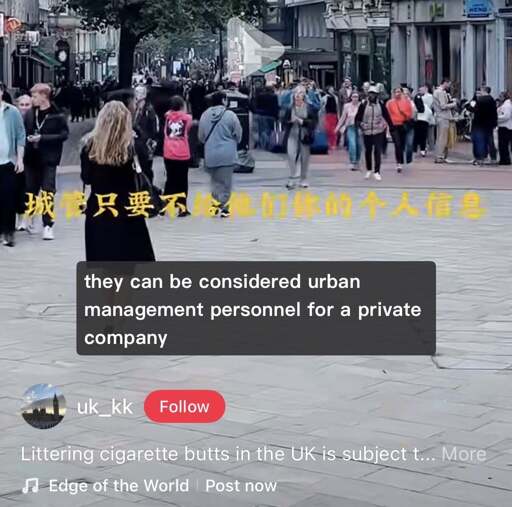
Outside of London, RedNote users allege that Manchester’s Chinatown is targeted for these fines. It could be owing to Chinese men’s’ famous love of cigarettes. But it also feels to many like targeting. Yu Liuyue shared their experience online of being “harassed” over a cigarette butt she didn’t drop:
We were sitting right next to the bin — not even 20cm away. Why would we litter? He never explained a single law or regulation to us.
My friend and I are Chinese international students who’d done nothing wrong — if this isn’t bullying people because we’re vulnerable, discrimination, then what is it?
This isn’t just about a fine anymore… he was using our unfamiliarity with the city to deliberately target and harass us. It’s not about the money — I could afford it. It’s the psychological toll and the damage to my sense of dignity. If you see someone in that kind of vest in the city centre, steer clear.
Another commented underneath that they’d had the same experience not long before:
The council’s broke — lately they keep targeting Chinatown, catching people and fining them. They wear body cameras; demand the footage. Don’t let it go.
Two later commenters say the identical scenario happened to them too. That makes it seem like a pattern, rather than an isolated incident. In another post supporting that idea, user Xun Lu wrote:
What I’m really afraid of is not being able to re-enter the UK. But in the moment, I was the only one fined — there were other Brits dropping cigarette butts right next to me at the same time, and he didn’t touch them. Just feels unfair.
In a Britain where bike theft occurs en-masse unchecked, phones are snatched by the dozen daily and waste piles up in toxic dump heaps, it’s hard not to feel like these “enforcement” grabs are wildly misplaced. Add the regular insults of rip-off energy and polluted waterways, and it’s even more infuriating.
Instead of targeting these often insecure migrants for quick cash, maybe councils and police should get serious about the crimes — environmental and otherwise — that really offend people. But as they say in Chinese: they’re only interested in squeezing the softest persimmon. (專挑軟柿子捏)
Rupert Lowe thinks Britain was built by the British, not those nasty immigrants
From Canary via This RSS Feed.