

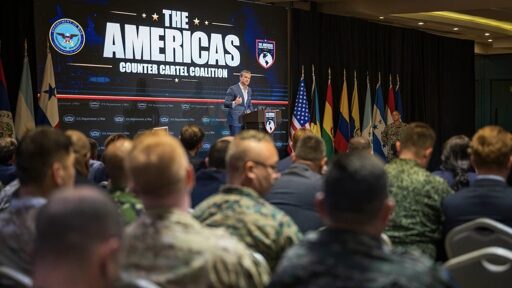

On August 12, US Secretary of War Pete Hegseth visited Panama, where he attended the Coalition of the Americas Against Cartels (A3C). There, he met with ministers, deputy ministers, security and defense chiefs, and several high-ranking military officers from the Shield of the Americas, the new Washington-led regional coalition focused on “combating narcotrafficking”.
In addition to the United States, member countries include Argentina, Bolivia, Costa Rica, Ecuador, El Salvador, Guyana, Honduras, Panama, Paraguay, Chile, Guatemala, Peru, and the Dominican Republic (and, more recently, Colombia, following the change in government), all of which have declared their political and economic alignment with Washington.
Thus, for a few days, Panama became the hub for planning and meetings among the new international cooperation initiative led by the Trump administration, which has stated that its primary goal is to combat organized crime and cartels.
Following the start of Trump’s second term, the Panamanian government under José Raúl Mulino has aligned itself with Washington’s stance, even going so far as to distance itself from agreements with China regarding the Panama Canal, which Trump himself has threatened to “take back.”
In this regard, Hegseth, on his second trip as Secretary, said: “I look forward to strengthening our partnership to keep the Panama Canal secure and disrupt cartel operations throughout the region.”
However, not all Panamanians welcomed Hegseth’s second visit with open arms. One such group was the National Front for the Defense of Economic and Social Rights (FRENADESO), which rejected the US military presence in their country. “Panama cannot once again become a military platform for any power. We do not want bases, enclaves, or facilities that could use our territory as a springboard for aggression against other peoples and nations. Nor do we accept that decisions made by others turn Panama, its people, or the Canal into military targets in conflicts that are not our own. Our security does not lie in militarization or in subordinating ourselves to the geopolitical interests of a superpower,” FRENADESO stated.
In the statement, FRENADESO also said: “[We must] defend our sovereignty, neutrality, independence, and self-determination, and maintain relations of respect and cooperation with all the peoples of the world. Panama, a land of peace and sovereignty! Neither a platform for aggression nor a military target! Respect for the self-determination of peoples!”
New attacks announced
During his visit to Panama, Hegseth reported that his government plans to launch “ground” attacks against “drug traffickers and terrorists” with the approval of the member governments of Shield of the Americas. This type of operation has already been seen in Ecuador, when US forces claimed to have carried out an attack on Ecuadorian soil alongside the Ecuadorian armed forces.
Furthermore, it is important to recall that the United States has already carried out several attacks in the Caribbean Sea and the Pacific Ocean, where it has sunk over 60 vessels allegedly carrying drugs, resulting in the deaths of over 200 people.
Hegseth warned that attacks could occur “anywhere” drug trafficking groups operate. He stated that US forces hope to deploy, alongside their allies, “an operational capability like the one you saw in the attacks on drug boats [in the Caribbean and the Pacific]… We are working with Ecuador, Colombia, and other partners to take the fight to DTOs (designated terrorist organizations) on land.”
In addition, Hegseth stated that the attacks will be carried out precisely to avoid a judicial process and take direct action: “We’re not going to put them through a judicial process where we know they’ll be released. We’re going to destroy these networks using all the capabilities of the US government,” said the Pentagon chief, perhaps in response to the criticism his administration has received over alleged extrajudicial killings.
The press has reported that, for now, Hegseth has reached agreements with Colombia and Ecuador. Regarding the former, Colombia’s Minister of Defense requested the deployment of US troops on Colombian territory.
“Through the newly inaugurated president… Colombia has already requested that the War Department join Colombia in its fight against narco-terrorism, authorizing joint military operations to destroy terrorists and terrorist networks,” said the Pentagon chief.
According to the Ecuadorian Ministry of Defense, the agreements with Ecuador – though still confidential – aim to establish a framework for the participation of US forces in the South American country.
In this way, the United States plans to expand its presence in Latin America not only through diplomatic and economic channels, but also through military means. The effects that this new series of US military operations will have on the region remain to be seen, and it will be a wait marked by the smell of gunpowder and a great deal of controversy.
From BT News via This RSS Feed.