

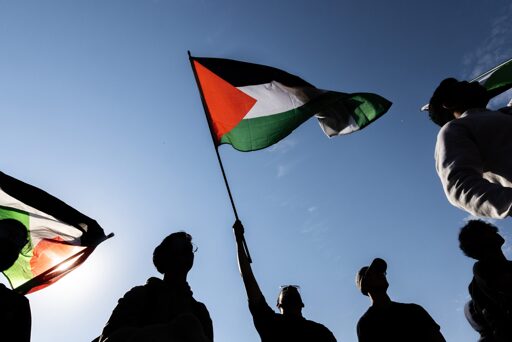
In 2024, at the height of Israel’s US-backed genocide of Palestinians in Gaza, one of the most widespread waves of college campus protests since the Vietnam War exploded across the United States. Then came the repressive backlash. Over the past two years, we’ve seen a harrowing assault on free speech and the right to protest from the federal government and Zionist organizations, and universities themselves have ramped up their own internal surveillance and repression machines, weaponizing them against their own students, grad students, and faculty.
Life, learning, and activism on American college campuses looks very different today than it did in 2024, but the student-led Palestine solidarity movement is not going away. As a new school year begins, we speak with four students at different college campuses across the University System of Maryland (USM), who are all organizers and members of the USM Divestment Coalition for Palestine, about how the movement is maintaining its demands and adapting its tactics in 2026.
Additional links/info:
- USM DIvestment Coalition for Palestine website, Instagram, and Linktree
- Diamondback Staff, The Diamondback, “USM students call for divestment from defense companies at Board of Regents meeting”
Credits:
- Audio Post-Production: Alina Nehlich
Transcript
The following is a rushed transcript and may contain errors. It will be updated.
Maximillian Alvarez:
Welcome back to the Real News Network. I’m Maximillian Alvarez. Two years ago at the height of Israel’s US-backed genocide of Palestinians in Gaza, we witnessed one of the most widespread waves of college campus protests in this country since the Vietnam War. Student-led Palestine solidarity encampments exploded from Columbia University in New York to UCLA to right here in Baltimore. And as we’ve been covering continuously here at The Real News, what we’ve seen since then has been a harrowing assault on free speech and the right to protest from the federal government and Zionist organizations. And we’ve also seen universities themselves, private and public, ramp up their own internal surveillance and repression machines and weaponize them against their own students, grad students, and faculty. Life, learning, and activism on America’s college campuses looks very different today. And today we’re talking with a number of student organizers across our home state of Maryland about how they are adapting their tactics today to continue their struggle to end the slaughter and ethnic cleansing of Palestinians and to hold supporters and enablers of the genocide accountable, including their own universities.
And I am really grateful to be joined today by four students from different institutions across the University System of Maryland who are all also organizers with the USM Divestment Coalition. Thank you all so much for being here. Please introduce yourselves to our listeners.
Khadeeja:
Hi everyone. We’re so excited to be here today and grateful for the opportunity to share a little bit about what the University System of Maryland Divestment Coalition does. My name is Khadeeja. I’m a student within the USM system. I’m also a member of the USM Divestment Coalition and I’m a former member of UMBCSJP. The USM Divestment Coalition is an organizing body of students, faculty, staff, alumni, and community members of the USM and the broader Maryland community organizing for the end of our university system’s complicity in violating Palestinian human rights and upholding the settler Zionist state. Hey
Zyad:
Everyone. We’re really grateful to be here. My name is Zyad and I’m one of the members of the USM Diveston Coalition and a former member of the UMDSJP. I got involved with the coalition after we at UMD finally had successfully achieved a divestment win via our referendum in the student government elections, which over 3,000 students voted in favor for calling UMD to divest from companies complicit in the genocide in Palestine. The university refused to take action on this. However, we knew that the power of divestment was really at the USM level and recognized this led to where we are today with multiple USM schools part of the coalition.
Mohammad:
Yeah. Hi, my name is Mohammad. I’m also a student at the University of Maryland College Park, involved in the SJP. Don’t want to reiterate what Zyad said too much, but similarly, we saw that there was only so much we could do at the school level. We’ve been meeting with our school administration for years and they would always just point their fingers and say, “Hey, we don’t have power over divesting the USM’s $2 billion endowment from weapons manufacturers and companies enabling the genocide in Palestine.” So yeah, that’s why we got involved just to shift the pressure onto the people who actually have decision-making power and to hopefully shift all of our activism back to gain back the momentum that we had during the encampments and actually start negotiating with the people that have the power to divest rather than just screaming it into a vacuum.
Fi:
My name is Fi. I am Towson YDSA’s incoming co-chair. I’m a Towson University student, and I got involved with the USM Divestment Coalition following a teach-in that they had at our university.
Maximillian Alvarez:
Well, thank you all so much for being here. It really, really is incredible to have you all here on the same call together. And I wanted to ask if y’all could just explain a little bit more for our listeners what this Divestment Coalition is, how it came to be, and how you personally got involved in it.
Khadeeja:
Yeah, so I was actually one of the founding members of this Divestment Coalition around two years ago, post-October 2023. A few of us started attending Board of Regents meetings to clarify how the university system of Maryland structure works. Essentially, there’s 12 Maryland public state universities, and they’re governed by one body, which is called the Board of Regents. And these are 21 governor-appointed individuals. So they’re not elected and they’re not necessarily paid for their positions by the state, although we can kind of elaborate further on how they benefit from the structure later. But essentially, they sit above the president. So most people think that university presidents actually control all university operations, but the presidents merely form one of multiple advisory councils to this Board of Regents that ultimately have final say. And these Board of Regents also govern over a $2 billion pooled endowment that is shared between all the schools.
So essentially in that first year, post-October 2023, a few of us started attending Board of Regents meetings and speaking during the public comment portion. And in the past year, we have done a lot of outreach and organized much more with Towson and UMD students. And we’ve developed a lot more internally and externally with a social media presence, as well as developing internal and external goals, increasing our presence at board meetings, and really built up a dedicated organizing body overall.
Fi:
I do want to say one small thing. Although this coalition has sort of united around the issue of Palestine, and that will always remain the core goal is liberation of the Palestinian people and the Palestinian cause. Divestment from weapons manufacturing is an issue that has much broader implications with other imperialist struggles in the world. In countries such as the Philippines, weaponry manufactured by Lockheed Martin, a corporation that the university does a lot of business with, has sort of been used to target certain student activists that have done work in the Philippines, humanitarian work in the Philippines, which I think we’re going to elaborate on more. But divestment is an issue that has very wide-reaching implications, and we are fighting for freedom for colonized and oppressed peoples around the world.
Maximillian Alvarez:
Well, let’s talk a bit more about that and what the USM Divestment Coalition does and why. From the organizing and advocating that y’all are doing on a week-to-week campus-to-campus basis to these larger actions and campaigns like the People’s Tribunal that y’all held earlier this year. Tell us more about what this coalition does and tell us how your universities have responded to the coalition and your demands.
Mohammad:
So I was talking before about how the divestment movement has been around on USM campuses for over a decade now. There have been huge pushes. I have friends who are around now who used to come to these divestment meetings urging the USM to divest from Israel back when they were in middle school. So it’s been going on for a while, but during the encampments era, it escalated and we got to the point where the university couldn’t ignore, or at least not entirely ignore, the calls of its students who overwhelmingly wanted to divest. And at first, the way that manifested was they established an inquiry process. So before, there was no formal way to request that the USM divest its endowment from anything, but they established an inquiry process where every semester there’s a deadline and you can submit something. Usually it’s like a student government at the university that’ll submit a resolution calling on them to divest from anything, whether it be fossil fuels or from Israel, from weapons manufacturers.
Unfortunately though, it wasn’t really legitimate. It was more so just a formal way for them to tell us no, and it wasn’t really being taken. We still weren’t being taken seriously at that point, which is why I think the coalition needed to be formed because all of us, we had the three biggest universities in the USM, University of Maryland College Park, UMBC and Towson University, all pass resolutions calling on the USM to divest, and they were still ignoring it. At that point, you have a substantial portion of the 180,000 students that you represent telling you that they want you to divest, and we still weren’t actually having negotiations with them or having the demand seriously considered or given a reason as to why we can’t divest. So the USM Coalition was basically just a way for us to bridge those concerns that people had and the call for divestment to the people who actually have the power to make it happen.
And we can talk more later about how the response has been on campuses to those calls and the repression we’ve seen. Yeah, essentially what we’ve seen is just them trying to give us more creative ways to deny the calls for divestment. Yeah.
Zyad:
And to add on to that, I think Mohammed mentioned and other people mentioned it as well, and I did as well, but I want to talk more specifically about UMD, at least at UMD and the divestment campaign there, which has a history dating back to actually 2017 where the calls for divestment and specifically for Palestine were made. So it’s clear that the organizing that we’re doing now isn’t new, it’s just how the strategy has shifted. For years, organizers would bring divestment bills to the Student Government Association. And again, like mentioned before, this was done at UMD, at Taos, and then also at UMBC. But at least at UMD, they were blocked by legislatures who weren’t willing to take the stance and didn’t have any morality because they were in there for their political gain. However, like I mentioned before, in spring of 2024, the strategy changed in the sense that instead of trying to persuade the legislatures that didn’t represent the opinions of the students, at UMD, at least we ran a pro-Palestine slate that ran strictly on being pro-Palestinian and being pro-divestment, and basically almost sweeping the entirety of the student government elections and building what became the first pro-Palestine super majority in UMDSJ history.
So with that super majority, we passed our BDS resolution, which went more specific into the other aspects of BDS, boycott divestment and sanctions that followed the demand from the referendum that over 3,000 students voted for. And like we kind of mentioned before, the administration acknowledged the referendum and the resolution, but choose to ignore both. That being because of how the structure is, they actually generally don’t have the power to divest, at least at the system level. And with that, the coalition, the form of the coalition, it was a necessity because the money wasn’t sitting in a place that each individual university has a say over. In fact, the investments are managed through the USM Foundation and the Common Trust Fund, which are governed, like we mentioned, by unelected board of regents that are appointed by the governor. So the campus organizing, the campus wins, they’re real, and we saw a lot of that post-October 2023 and post the encampments because of the escalate organizing that was done specifically with the genocide in Gaza and seeing that escalate.
And over the last two and a half years, we see these wins, but the actual target this entire time was the system itself.
Khadeeja:
So I did my first two years of my undergraduate degree at University of Maryland, Baltimore County, and I spent two years heavily involved in the SJP there. UMBC was always heavily invested in divestment efforts post-October 2023 as the genocide against CASDA accelerated and public consciousness simultaneously was raising. UMBC is actually a minority-serving institution, so the majority of our student body are minorities. So we did receive a lot of support amongst the student body for divestment, and we were the first university within the system to pass a divestment resolution within the Student Government Association. And it explicitly used the Palestinian Boycott Divestment Sanction Movement Framework, which was definitely a big win, and I think set UMBC apart early on within the USM. Not only that though, hundreds of students also signed a petition urging the university’s career center to stop inviting defense contractors to recruitment events.
And two of the main war profiteers in America, Lockheed Martin and Northrop Grumman, actually did stop coming to our career fairs in 2024 and have continued to stop. So UMBC’s student population has always been relatively easy to organize around. That being said, administrations are separate from the student body. We are lucky at UMBC. We’re definitely a bit better off than UMD. UMD is definitely more repressive. Our administration was definitely willing to hear us out a little more and even remove sober homeless off campus. So that was a BDS win. However, they did charge the students wrongfully with student conduct violations in 2024, although they lost the case. The students won that case, but they did release interim time, place, manner policies, which all the universities around that time actually released post-encampments across the nation. So there’s collaboration between universities across the nation and also between the states.
So universities serve as a mouthpiece of the state to repress us. And we saw that at a national scale after the encampments, despite these restrictive efforts, the student movement is constantly adjusting and growing despite their efforts to stall our clearly winning movement. In terms of, I mentioned the Sobrahamus and other divestment efforts at UMBC, but along with divestment also comes the academic and cultural complicity that our universities play in upholding the Zionist settler ideology. So for example, at UMBC, a couple of the campaigns that we are still working on is one of the professors, his name is Eli Lieberman. He teaches Jewish studies and has taught courses that are explicitly biased against the Palestinian people and their struggle for self-determination. He has released papers on deterring terrorism where he compares Palestinian people directly to terrorist groups. There has been a call to remove him, which has not happened yet.
The administration has largely ignored those calls. And then lastly, and also very horrible and shamefully, UMBC has been in a partnership with Israel’s Minister of Agriculture for an aquatics research partnership. And like I mentioned earlier, part of the divestment within the coalition is not only cessation of financial complicity, but also a cessation of academic complicity in the apartheid occupation. So UMBC students have been appealing to university admin to end this partnership. This minister, current minister has called the current genocide in Gaza as rolling out the second NECBA, which the NECBA was the expulsion of over 600,000 Palestinians from their homes in 1948. But regardless, the university has made no effort on that.
Fi:
I can say on Towson University’s campus students, there was one specific instance of students facing very clear repression for exercising their right to free speech, being attacked under these time, place, and manner policies. A die-in was organized shortly after October 7th where students mourned in the University Square and they were threatened with disciplinary action and some were even tracked to their vehicles as they were leaving. And recently there was an IDF soldier came to Towson’s campus unregistered. They showed up, they set up a table in a kind of Kirkian way, just sort of had this sign that was like, “I’m an ex – IDF soldier, ask me anything.” And they were able to bring their own security detail that was not vetted by the university. Their presence themselves was not vetted by the university. And it was a presence that was clearly very intimidating for Arab students.
And yeah, the university responded to. They have not released a statement on this as I am aware. And even in the moment, they did not kick him off campus even as he was in violation of the same sort of jurisdictions that caused very intense discipline to students for exercising similar rights. They just allowed him to be moved back to a different area a little further off campus. So there was very little solidarity for students and tolerance for this kind of rhetoric as well.
Maximillian Alvarez:
Let’s take a step back and put all of this in the context of the past few years. From the genocide in Gaza to the student encampment movement, to the wave of repression from the Biden and Trump administrations and from university administrations themselves. Firstly, I wanted to ask y’all if you could just describe for people out there who aren’t living or working on a college campus right now, what is it like to be a student and a student activist in the US in 2026? And what does the emergence of the USM Divestment Coalition say about the evolution of tactics and goals and strategies of the student movements against war and genocide and censorship?
Mohammad:
Yeah, of course. So I think the way that we’ve seen it at USM schools, and I would say College Park is probably the worst campus when it comes to repression, is they’ve done it very sneakily. So the Maryland SJPs didn’t host an encampment on any of their campuses. They participated in the DMV wide one, which was on a DC campus. So our universities didn’t have, I don’t think they had the same pretext as many other universities did to go in and directly suppress or ban any SJPs like we saw at other campuses. So the way that they went about it, as Katija mentioned earlier, was with these time, place, and manner restrictions that they rolled out on all campuses. But like I said before, College Park probably being the worst example. Yeah, I mean, just to give a few examples, amplified sound isn’t allowed at all.
During the week, you can only use it over the weekend. That obviously makes it harder to protest. You can’t have a group of over 10 students gathering together without a reservation made because it’s then considered an event and you need a reservation to be able to do an event. You’re not allowed to talk unless outside of three designated areas on campus, and you’re not allowed to put stickers up on university property. And what’s more disappointing than just the policies themselves is how selectively enforced they are. If you take a walk around the College Park campus, you’ll see stickers for just about everything. Lots of organizations create stickers. You’ll see them all over the place. Political, not political. It is a very casual thing. But I know personally of two students who put up stickers that actually had their faces covered, but were investigated and the university tracked them down just based on their height and their skin color.
So that’s how seriously they take it when it’s a pro-Palestine sticker is they’ll track the person down, give them student conduct charges, but any other type of sticker, it’s not treated as a big deal because it shouldn’t be a big deal. And obviously we’ve called the university out on this. Why did these really strict policies come about around the same time as the encampments were blowing up? And they have claimed that it isn’t indirect response to it, but we know it is. And we see it in other places. Even in my orientation when I was preparing to. I hadn’t even had my first class on campus yet. This was my first time summer before my freshman year. And for context, I was a freshman after the encampments. And we had the police talking to us, again, first day on campus about how they had prevented any of the.
They didn’t use the word encampment, but the chaos that they saw in other campuses, they were bragging about how they prevented it at UMD and how they wouldn’t let it happen. So it was very explicit. There’s also been repression when we actually go to Board of Regents meeting, this was more recently once who created the USM coalition, which I think Tadija can speak to.
Khadeeja:
Yeah, just really briefly, I’ve been attending the Board of Regents meetings since November 2023. I’ve attended eight Board of Regents meetings and these meetings, the Board of Regents are extremely inaccessible. They basically never meet with students, the Board of Regents and the chancellor. Even though that they’re in these public serving positions to serve the students, they never meet with us. But regardless, their meetings have a public portion, the beginning section, and then they have a public comment section. And people are limited to three minutes, which I know people who have attended meetings before we started attending, and they said that they never saw the time limit being enforced. We would go up there and they would stand behind us with a timer. They would cut us off if we spoke on anything that wasn’t explicitly on the agenda for that day. And mind you, again, these are 21 people, 21 adults, grown-up adults who are meant to serve the students.
And these are young 18, 19-year-olds coming with a prepared speech just for three minutes to talk about something that they care about, something that’s an ethical concern, which the USM claims to have a commitment to global justice. So this should be directly aligned with their mission and values, but it’s become increasingly apparent in the way that they have engaged with us at these meetings that it hasn’t necessarily been in good faith. Also, their security measures have amped up. So they always have security, but they have started searching through our bags, requiring us to open any posters that we have, searching through every single pocket, turning students down from speaking just because they got there a few minutes late. Just things like that have definitely been, I wouldn’t say discouraging, but definitely disappointing.
Zyad:
Back in October 2024, the UMDSJP were planning on organizing an AXGA vigil for the martyrs in Ghaza. And that was faced by a lot of backlash from the Zionist community of UMD, which is really large. And even threats were made to the president of the university threatening to lynch him and his family using racial slurs in emails sent to him unless the event was canceled. And again, this is a peaceful vigil that was being held, not even a protest, honoring the martyrs in Ghaza. And the university folded to the threats claiming that it was not safe for the students to organize that event, which in response to that, they created a blackout date to be held instead. So no student organizations were allowed to have any event regardless of what it was about, which is obviously repressive in the sense of the Palestinian organizing, but also repressive in the forms of freedom of speech.
Any other student organization wanted to have an event they were not allowed to. And this has never been done before. There’s never been a day where you’re not allowed to have an event at all. So the response with that was that UMDSGP sued the school and it’s turned out to be the UMDSGP won the lawsuit and ended with a $100,000 settlement with majority of that being donated directly back to Gaza and the people there. And then I also wanted to mention about doxing, which is very prevalent at UMD. It’s happened at UMBC as well. I’m not too sure in terms of Taos and how common it’s there, but doxing is a method used by Zionists students and just general Zionists to target students that are speaking out against the genocide and speaking against the apartheid system. This has been something that’s been done for almost 10 years now.
And students who were on student government like myself voting for divestment were doxed. Actually, I was doxed over a resolution that condemned the university for allowing the university to host three IOF soldiers who participated in the genocide in Gaza. And for the purpose of the event was to talk about their experience committing a genocide, which was appalling. The university claimed that this was not a security threat or safety threat to the students, but having a peaceful vigil was. And it shows you that clear bias that they have against Palestine. And so in response to that, calling for the university to change their policies to not allow people that have been complicit in genocide and war crimes to be banned from university resulted in being doxed. And many other students have been doxed as well. I think actually one of the people that leads the doxxing campaigns on a popular site that is used for doxing called Canary Mission actually was a UMD alumni.
So it kind of shows you those ties that it’s peer malice targeting students who are just speaking against genocide. And I also kind of want to touch upon the Board of Regents meeting. Hadijah touched on a lot of it, but just to say for any other students here, the meetings that they do are held on Fridays at 8:30 AM. I don’t know about you, but most students are not up at 8:30 AM on a Friday, let alone being held at different campuses. So students who want to raise their voices to the Board of Regents, the people that represent them, they have to wake up at 8:30, figure out a way, drive or figure out their own transportation to get to wherever they’re holding the meeting just to speak to them, which even that is limited. Before there wasn’t a time limit, but when in past and we have spoken, we’ve been given three minutes for time limit that actually moved down to two minutes for one of the meetings for no reason at all.
And they block out only 15 minutes to hear from the people that they represent. So that kind of shows you how they use their oppression, the tactics in terms of saying that there’s only 15 minutes allocated to that, that we’re going to only allow those students to speak for that long. And there’s also double standard in terms of any other people testifying to the USM where they have allowed speakers to go beyond the time as allocated for them. Whereas when students speaking out for divestment, speaking out for the university to cut complicity with the occupation and weapons manufacturers, they are not faced with that same opportunity. And
Fi:
Zaya did bring up Towson and the use of doxing over there. Although I can’t off the top of my head name any direct examples of doxxing. During testimonies for a SGA resolution calling for a divestment, an ex-faculty member named Richard Vatz, who actually has an auditorium named after him, testified against the resolution and advocated for doxing of students, which is incredibly. It’s a very bad look for the university to say the least. And the kind of message that it sends that an ex-faculty member who the university holds very dear is willing to advocate for the doxing and potentially putting these students in real harm underlines how unprotected students are who advocate for this cause.
Mohammad:
Yeah. And I think another important thing to highlight is just that as the student movement has been more successful, I think it’s really done a good job just exposing the underlying racism and agenda that the university upholds. As a Palestinian student myself, I can speak to just the double standards in how the university functions in terms of the curriculum that’s offered. There are no classes at UMD talking about the Palestinian experience. The closest thing there is there’s a class talking about the experience of the minority of Palestinians who live under Israeli society and have Israeli citizenship. So the only class even mentioning Palestinians is taught in the context of a very biased pro-Israel perspective of a specific portion of Palestinians who live with Israeli citizenship. We have Israel studies, Hebrew studies, and Jewish studies, but there isn’t anything about. There’s Arabic studies, but there’s no, like I said before, there’s just a lack of coverage of the Palestinian story and then Palestinian voices in the academics and even looking at the guest speakers that departments invite.
The business school has regularly invited. They’ve made it almost an annual thing at this point. They invite Israeli politicians and staunch pro-Israel advocates to come speak. And actually the one time that they did invite Palestinians, it was the two most sellout one in a thousand worst of the worst Palestinians that they could find. So they just have refused to platform Palestinians in academia in general while not just normalizing, but promoting pro-Israel narratives. And then I think the other area that we see a lot of bias is in their response to hate bias incidents. So they created after October of 2023 when they observed a rise across Across the country in both Islamophobia and antisemitic hate crimes. They created one committee to address both antisemitism and Islamophobia, but there was very clear bias. I’ve spoken to people on the committee who’ve talked about this. And also reading the report they published, they published a 60-page report and in it there was a list of antisemitic incidents.
They have a list of all the hate crimes. Of course, none of the many, many instances of Palestinian students being regularly harassed by Zionist students who were listed. Any Palestinian can speak to that. It is unfortunately very commonplace, but you had a long list of incidents that were literally a sighting of a free Palestine sticker or someone hearing someone else chant free Palestine. And students would call the police and report that and label it as an antisemitic hate crime. And the police not only kept a record of that, which was crazy in and of itself, but they published it somewhere in the 60-page report. So the fact that they’re associating these very mundane examples of people expressing their opposition to the genocide and support for Palestinian people with antisemitism is alarming. And when there’s a very real rise in anti-Palestinian racism and Islamophobia on campus, we see absolutely nothing.
Actually, in the last few weeks of just this past semester, we had two very good examples that highlight just that. So there was an instance of someone who did make an antisemitic post featuring a Jewish student’s face and posting it online with antisemitic symbolism in the back. And the school responded to that very quickly and with heavy condemnation. Within 24 hours, the president of the university had sent an email to everyone. The police department had sent an email to everyone saying that they were actively investigating it. And then not even a week after that, there was a pro-Israel influencer on campus who posted a Muslim girl’s face, visibly Muslim girl. She was wearing a hijab. He posted her face and called her a terrorist and posted it online. This wasn’t an anonymous post like the other one. This was on his personal account. We know who the student is, and multiple people reported this to the administration and were told nothing could be done.
We asked them, why did you just a week ago loudly and openly condemn an antisemitic post featuring a student’s face? But now a very similar incident is happening to a Muslim student and you’re doing nothing. And the explanation was that one was a hate bias incident and one was a hate crime. So it’s using this vague technical language to justify doing nothing when Muslim, Palestinian, Autumn students are being victimized and not necessarily for others. And that same student who posted the Muslim girl’s face went and did it again a week later to another Muslim girl calling her a terrorist and posting it online, which was, I mean, no need to say it is unacceptable, but the university has been unable to condemn or even acknowledge it outside of closed door meeting. So there’s that very clear inequity in how they address that. And aside from the administration, even just the Zionist presence on campus that Zaya talked about before has just got a lot more animalistic in the past two years.
They’ve gotten a lot more bold. There are too many examples to name, but I mean just walking around on campus with a kefia on or being visibly Palestinian or talking about Palestine, I have friends who’ve been shoved, physically attacked. I personally, during my freshman year, a group of friends and I were harassed by a group of 20 Zionists who came up to us because we were playing Arabic music on a speaker and leaving notes on our backpacks, accusing us of having ties to foreign terrorist organizations, even university officials. So for example, the director of Hillel, multiple Palestinian girls specifically have spoken out about being harassed by him at protests to the extent that UMPD, the police department has had to go and talk to him and tell him to stop coming to SJPA events, which to my knowledge he has since, but the fact it got to that point was insane.
And the university allowed him to maintain his position as an adjunct professor at the university. So he still teaches a class. Last semester, there was also a case where a business professor who was organizing an event where she invited some pro-Israel speakers, was confronted. And she actually, to my face and in front of other students, was accusing us of taking money from Iran and then foreign terrorist organizations. So these are people with faculty appointments in the university. It’s not just outside agitators or even random students. These are people who the university has direct ties to going and being able to say whatever they want. And disappointingly but unsurprisingly, the university does nothing, doesn’t treat those incidents the same as they treat others. And it’s really just a general lack of, I can’t even say lack of initiative, just lack of care when it comes to addressing the needs of students who are actually being targeted, whose families are being genocided overseas.
And yeah, I guess that’s just the student experience on campus over the last few years.
Maximillian Alvarez:
Well, let me ask y’all before we have to wrap up, where do things stand now with this coalition and where do they go from here? What are your ultimate goals and what do you think it’s going to take to achieve them?
Khadeeja:
Yeah, I would say at a broader scale, student organizers across the nation have become increasingly more aware of the university system structures and how they all nationally function as an arm of America’s military industrial complex. And that has created the need for centralized campaigns. I would say this is widely reflected within the USM Divestment Coalition. It was the decentralization of all of our university’s separate divestment efforts combined with a greater understanding of the system itself that revealed the necessity for us to shift our strategy. And that was the motivating effort for us coalescing our efforts. Not only has combined efforts strengthened our campaigns through numbers and resource sharing, but this formation of a coalition has allowed us to begin actively archiving our work. Students are only part of the system for around four years, give or take, and the structures are intentionally complicated. So it’s necessary that we have increased our internal research, we’ve increased our political education, we’ve increased our base building with other USM schools, as well as local Maryland campaigns such as the Break the Bonds campaign, which was recently successful that we were an official endorser of.
We’ve collaborated with unions and the broader community at large. And along with doing that work, we’ve institutionalized all of that. We’ve institutionalized the research, the education, and the relationship so that we are not reinventing the wheel every few years. And this strategic shift has allowed us to progress beyond the post-encampment stall where many student organizers were kind of left picking up the pieces and trying to figure out how to emulate a spark, but we’re not trying to do that. Ultimately, we’re concerned with our university’s material function as financial backers of genocide, and we’re strategizing how to achieve material wins because thus far the winds have been largely symbolic. To build off of that, I think as students, like I mentioned, we understand that our universities, they serve as landlords, they serve as extensions of US capitalist imperial society and to reproduce that. They were built on stolen land and they’re sustained on the extraction and exploitation of the global community.
I think it’s important and necessary that we recognize the systems for what they are and that we reject some of the social norms that come with it. And unless we reject them, we can’t really move forward. So although the material aspect is the most important, I mentioned earlier that the US is also uniquely complicit in the Zionist state and that it’s upholding it in a way beyond material, but also ideologically and culturally. Universities are not exempt for that, and so our complicity is unique as a result. So we recognize that true divestment means a dismantling of many of these structures as we currently know them. It would mean a dissolution of the Board of Regents, for example. It would mean the replacement with a popular elective body. It would mean the end of the university’s current volatile investment structure that prioritizes growth at any cost over human rights.
There was recently a position paper put out by National SJP. It’s only about 70 pages. I recommend anyone and everyone to read it. It’s called The University and the Reproduction of Capitalist Imperial Society. It’s publicly available, but it expands upon this idea of the so-called good student where students accept their own subordination within the system and keep their head down so that they may be accepted and receive the material and social benefits that come from the university. It is ultimately our responsibility to disrupt that structure. We are aiming to empower the student and broader community. We want to understand that there’s power within us. We don’t need to rely on the structures as heavily as we have before. And lastly, I want to mention in part of moving forward is, like I mentioned, empowering the student community, but also the larger, broader community. So if the USM, when we say that they control the universities, that really does affect all of us.
So the USM has recently put forth a proposal for a over $300 million development contract basically to turn the surrounding area of UMB, so University of Maryland, Baltimore, to gentrify, essentially to turn it into a college town. An interesting link is that Steven Sabell, who sits on the Board of Regents, is one of the, I think, main financial partners for, I think it’s called Caves Valley Partners, which is I think the largest gentrifier of Baltimore. That’s not a coincidence. There’s a reason that Lockheed Martin is one of the largest employers of the USM and recruiters, and that simultaneously the chair of the Board of Regents, Linda Gooden, is the retired VP of Lockheed Martin. Lastly, also that relates to Baltimore and the broader community. There was a proposal to spend over $300 million, again, on a COP training facility at Coppin University, which is an HBCU, which just further increases the over-militarization and criminalization of the Black community and marginalized communities in Baltimore.
So divestment truly involves all of us. It’s not just the students. It’s truly all of us, students and non-students alike, and the system benefits from us not interacting with each other and not recognizing that our struggles really are interconnected.
Zyad:
Yeah, to go off of that, like I was mentioned before, we are a coalition consisting of organizations across USM, and we really won’t stop until we reach each school and all types of organizations because we know that our demands are connected and that we will continue until demands a reality. In May, we saw the system-wide student council pass a divestment resolution, which was the first of its kind in the entirety of the US, calling for the divestment of arms manufacturing. And we know that the arms manufacturing that we’re targeting don’t only supply the IOF who have been committing an escalated genocide for the last two and a half years, legally stealing land and creating settlements. But these are the same companies that are supplying the human rights violations in Sudan that are armed by Saudi Arabia and other parties by companies like Lockheed Martin or in the Philippines.
And in the Philippines, we want to name this because of people like Chantal Anikoche, who was a UMBC alumni who was kidnapped by the AFP or the Negros 19 who were murdered by weapons used, weapons made by Lockheed Martin and other manufacturing. The weapons economy that killed them is the same economy that the endowment dollars are financing through the USM Common Trust. When we stay divest, we’re not making a statement about only one particular cause. We’re withdrawing material support from a global system of militarized violence. That is a long-term project, not just resolution. It’s not just one board meeting, it’s not just one disruption, but building a coalition of students, faculty, union, and community members who understand that these struggles are structurally connected and refuse to let our institutions be complicit in any of them.
Fi:
And to piggyback off what Zyad and Khadeeja have been saying about the material consequences of the investments that the USM is making into arms manufacturing, not only does this have international ripples in the human rights violations in Sudan and Palestine and the bombing of Mindoro and capture of Chantal and Akoche by the AFP and the murder of 19 activists in Negros in the Philippines, but even domestically, the USM is making decisions that financially disadvantage their workers and the people that are keeping these institutions going. Divestment is an issue that is for the workers as well. We’re advocating for more transparency of where the money is going. I believe it was AFSCME is a faculty and staff union that just suffered mass layoffs across the USM system. And at Bowie State University, they’re in a huge deficit right now due to a misappropriation of funds that haven’t been going toward upkeeping positions for workers that have been working there for a long time, but the creation of newer higher paid consultant positions that are sort of just replicating that sort of anti-worker pro-capitalist establishment where there’s this whole class of consultants and people who are getting paid these large amounts of money and disenfranchising the people that actually run to keep this university going.
We’re talking about healthcare professionals or students with mental health problems. We’re talking about cultural centers such as Norrenborough at UMD, which has faced ongoing structural issues and has consistently been advocating for reallocation of funds to create a more sustainable university that reflects the future that the students are advocating for. And the Board of Regents as an unelected body consistently again and again with the way they allocate the funds of the USM system show very little interest in representing the people. And yeah, it’s about time that students come together and form these strong coalitions. And we stand in solidarity with unions as well that are also getting screwed over by these same misappropriations and unethical decisions. Yeah, the issue of divestment, it’s very all-encompassing.
Mohammad:
Yeah. And I think just to round that out, you described it very well. When you look at it from a broader view tying in what Zaid and Fi said, when we’re talking about divesting for Palestine, obviously that is a moral obligation in itself. We should not be financing the suffering of any people overseas, but the same endowment that is being used to reinforce the suffering of Palestinians is upholding systems of oppression all over the world. And the same Board of Regents members claiming that they can’t pay their own workers despite being allocated money by the Maryland State legislature to do so are claiming they can’t. And all of this just ties back to the issue of the American universities in general, but we can see it very clearly here in the USM, which is that we have a for-profit university system. Even though these are our public institutions, they’re supposed to serve the people of Maryland.
They do not. If you look at the makeup of the Board of Regents, it’s not made up of academics or former university administrators or leadership. All of them are business people. The head of the Board of Regents, she was the former vice president of Lockheed Martin. The chancellor currently, well, he actually was an academic, but his legacy was a partnership program he established with a medical school in Israel. And all of the Board of Regents members, most of them are really just wealthy people who were appointed not to advance the university’s mission or to benefit the people of Maryland, but just to uphold our university’s corporate ties and make sure that we’re still doing research to help develop weapons for Lockheed Martin and Northrop Garden to make sure that we aren’t divesting our endowment from war profiteers, to make sure that we’re still inviting IDF soldiers and not taking a public stand against the suffering that our university is complicit in.
And that’s just why it’s important for us to fight on the USM level, as we’ve been saying before. We are still very optimistic. I mean, if you look at where the movement is now compared to two years ago, students would’ve been shocked that we passed resolutions at all. But now we’ve passed resolutions at the SGA level. The students have made very clear where they stand. We’ve gotten around all the red tape that was set in place. We’re escalating it at a higher level now. There’s the Break the Bonds campaign that Khadija mentioned. We’re seeing divestment actually happening and taking shape now, which is why it’s just more important than ever for us to continue pushing just as hard, harder than we ever have been and making noise.
Maximillian Alvarez:
Thank you for listening to this episode of the Real News Network Podcast. And thank you to our panel of guests, Khadija, Zaid, Mohammed and Fi, who are all student organizers with the University System of Maryland Divestment Coalition. If you want to get more coverage and hear more important conversations just like this, then we need you to become a supporter of The Real News Now. Share this podcast with people in your circles, your friends, your family, your coworkers. Sign up for the Real News newsletter so you never miss a story and go to therealnews.com/donate and become a supporter today. I promise you guys, it really makes a difference. For the Real News Network, this is Maximillian Alvarez signing off from Baltimore. Take care of yourselves and take care of each other.
From The Real News Network via This RSS Feed.