

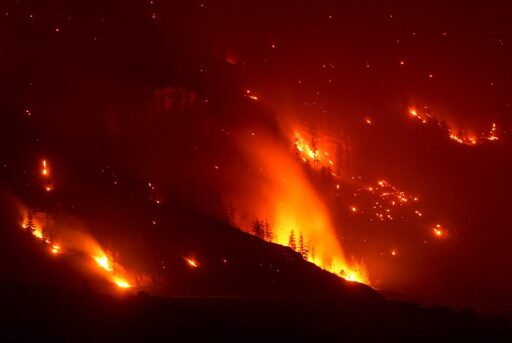
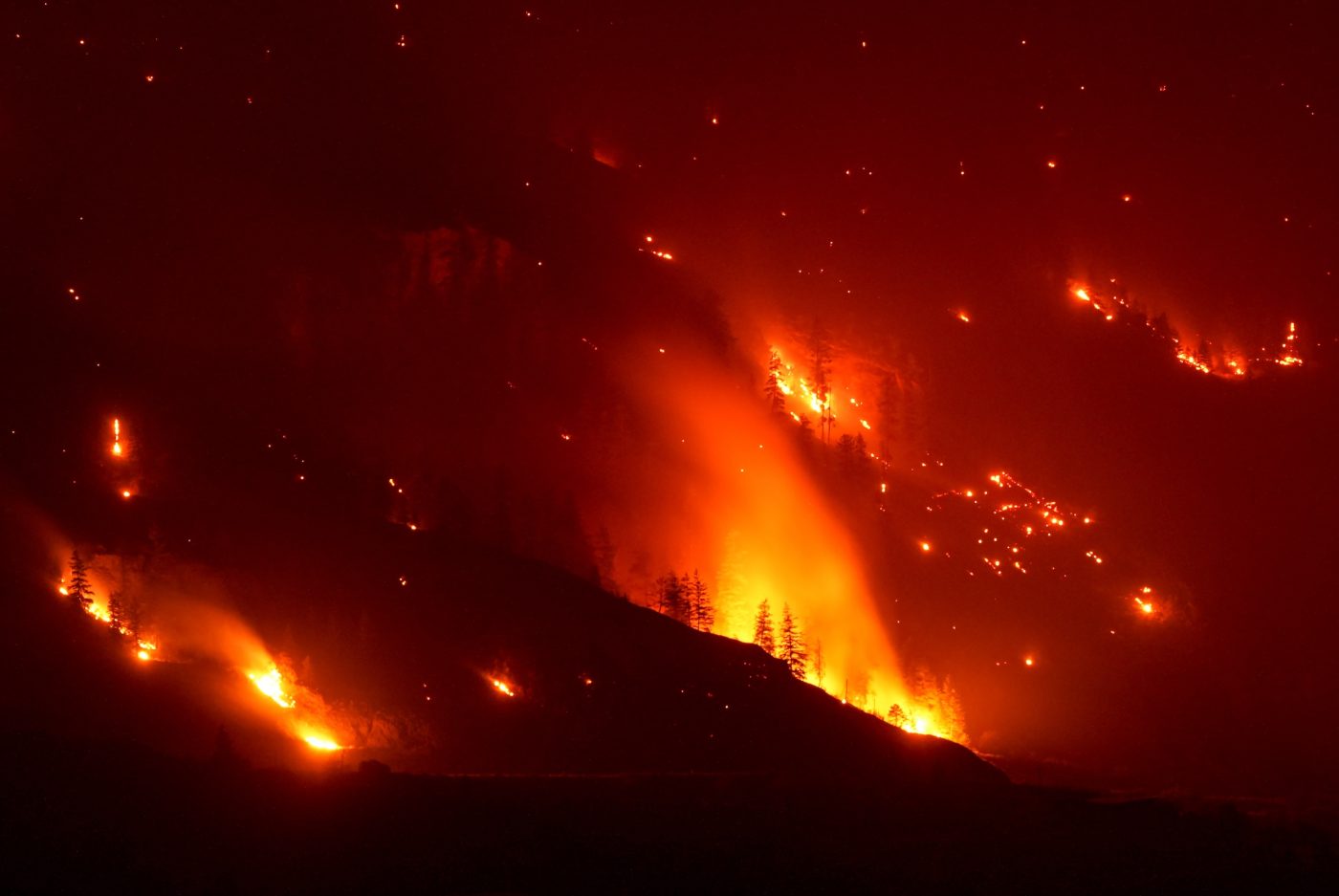
Photo: Darry Dyck / The Canadian Press
The wildfire that tipped B.C. into a state of emergency this August was described as “a bomb going off” to Premier David Eby by a fire official. Flames from Bald Range, in the interior of the province, grew to heights of 90 metres as the fire spread rapidly after igniting on Aug. 7. More than 20,000 people in the region were evacuated. At least one person died while trying to flee. And all of that is due to just one of more than 100 fires burning across the province.
Experts around the world have called extreme fire weather our “new normal”, and Eby even used the term at a press conference earlier this week. But as fire scientist Mike Flannigan looks at B.C.’s wildfires of the past, he rejects the term. “We’re moving into uncharted territory. This is our new reality. Some people might say ‘normal,’ but to me, normal sounds like a plateau. We’re on a trajectory, and it’s downward.”
Flannigan is a professor of wildland fire at Thompson Rivers University in Kamloops whose expertise has earned him the BC Innovation Research Chair in predictive services, emergency management and fire Science. He’s been studying fire for decades. He recently spoke to The Narwhal from Kamloops and shared some data that showed a dramatic increase in area burned across the province in the last 10 years compared to the previous six decades. We asked him to break down what this all means for the future of wildfires in B.C. and the country.
This interview has been edited and condensed for length and clarity.
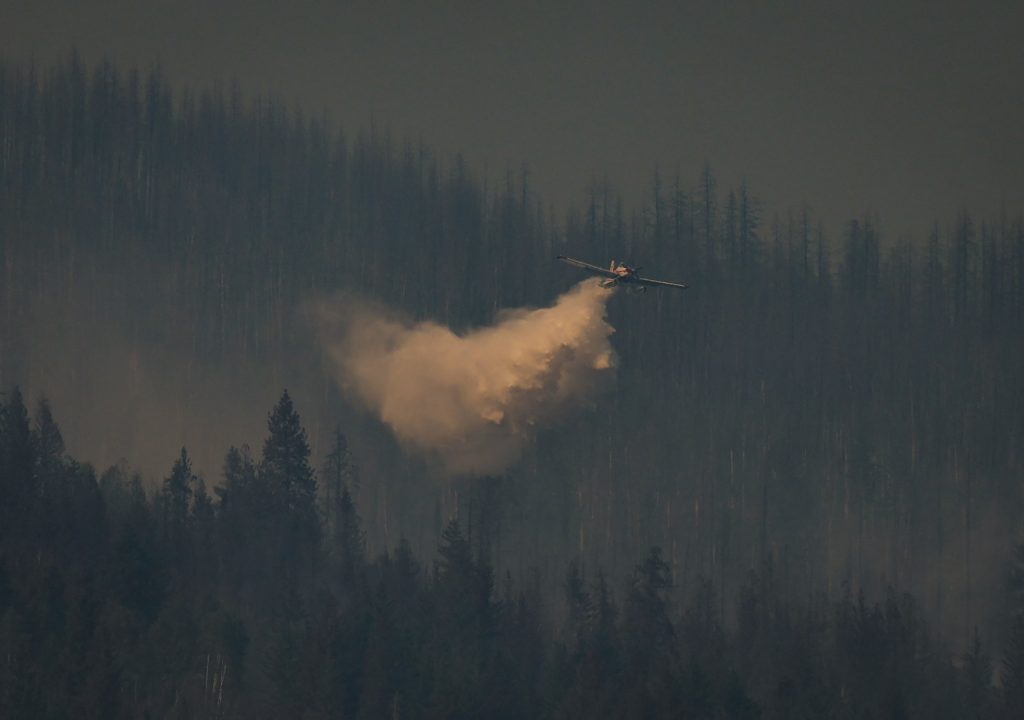
A water bomber fighting the Bradley Creek wildfire near the Okanagan Indian Band in Vernon, B.C., on Aug. 4. Chief Dan Wilson said at the time about 230 homes were destroyed in one of the worst wildfire losses in recent Canadian history. Photo: Darry Dyck / The Canadian Press
What are the conditions in Kamloops right now? How’s the air quality there?
We got a bit of relief today. It’s better. I went out without a mask today because it was good enough. But the last week has been horrific. Just awful, awful air quality. I’m sick and tired of this smoke. You want to enjoy summer, and it’s hard to enjoy it when you’re either trapped indoors or choking on smoke.
We’re in mid-August and there are currently more than 100 wildfires burning across the province and thousands of people have been evacuated. What are you thinking as you look at Canada and B.C. right now?
We’ve had three bad fire seasons in Canada immediately prior to 2026. About eight per cent of our forests burned 2023 to 2025, and there’s no modern analog for this. We’ve never had three fire seasons like we’ve just seen.
And my narrative up to now has always been: yes, there’ll be bad fire seasons, but there’ll be cooler, wetter years, and the fire season will be quiet. I still believe that regionally. Like, Ontario’s had a bad fire season this year. Next year may be really quiet.
But nationally, we’re such a big country that every year, somewhere we’re going to see this combination or episodes of dry fuels, ignitions and hot, dry, windy weather. You get all three, you have fire.
In Canada, about three per cent of fires are responsible for 97 per cent of our area burned. Much of this happens on a relatively small number of days of hot, dry, windy conditions. We call them ‘spread days,’ and that’s when you see explosive fire growth, like we saw in the Bald Range fire.
It’s really important people report fires right away if they see a wildfire, because all fires start small and that’s our window. If you don’t get on top of it within 30 minutes, the horse has left the barn.
What causes ‘spread days’?
What we’re seeing is a lot more extreme fire weather in large measure due to climate change. And I’ll be even more specific: human-caused climate change. A warmer world for Canada means more fire.
The warmer we get, the longer the fire seasons are and we’re seeing that across Canada.
Second, the warmer we get, the more lightning we expect. Now, in Canada, just over half of our fires are started by lightning, but they’re responsible for about 92 per cent of our area burned.
(function(){function e(){window.addEventListener(message,function(e){if(e.data[datawrapper-height]!==void 0){var t=document.querySelectorAll(iframe);for(var n in e.data[datawrapper-height])for(var r=0,i;i=t[r];r++)if(i.contentWindow===e.source){var a=e.data[datawrapper-height][n]+px;i.style.height=a}}})}e()})();
(function(){function e(){window.addEventListener(message,function(e){if(e.data[datawrapper-height]!==void 0){var t=document.querySelectorAll(iframe);for(var n in e.data[datawrapper-height])for(var r=0,i;i=t[r];r++)if(i.contentWindow===e.source){var a=e.data[datawrapper-height][n]+px;i.style.height=a}}})}e()})();
The third reason is probably the most important. As the atmosphere warms, the ability to suck moisture out of dead forest floor fuels increases rapidly. The forecast for the future is we’re not going to see enough rain. Bottom line? It means more of that fuel on the forest floor has dried out and is available to burn, which leads to these higher intensity fires that are difficult or impossible to extinguish.
I would argue that B.C. is the pointy end of the climate change spear in terms of fire in Canada. We have seen an abrupt increase.
To me the big driver is extreme fire weather and ignitions. I have lots of colleagues who want to blame what we see on land management, forest management, fuel build-up. They are playing a role, but they’re really minor. It is extreme fire weather conditions.
Recent studies suggest more than 1.5 million people prematurely die every year globally due to wildland fire smoke, and that number is only going to increase as we see more larger populations impacted by smoke.
You recently looked at how much area has burned in B.C. going back to the 1950s. What did you notice?
There were big years in the past. 1958 was an active year. 2003 was an active year. The Barriere fire in 2003 devastated part of the town. Kelowna had a number of homes lost. But more area has burned this year than in 2003. That was really a big fire year in those years. Now it’s considered not that much.
In 2017 it’s like somebody flipped the switch. It was record-breaking. Followed by 2018, which was record-breaking. Then came along 2023, which said, ‘Oh, I’m going to almost double you’ and broke a record. 2023 the whole province was on fire. 2024 and 2025 were active in the northeast, not so much down south.
2026 is mostly the Cariboo and southern regions that are seeing the fire. If you look at a drought map, you’ll see that’s where the drought is. Drought doesn’t guarantee fire, but sets the stage for an active fire season.
(function(){function e(){window.addEventListener(message,function(e){if(e.data[datawrapper-height]!==void 0){var t=document.querySelectorAll(iframe);for(var n in e.data[datawrapper-height])for(var r=0,i;i=t[r];r++)if(i.contentWindow===e.source){var a=e.data[datawrapper-height][n]+px;i.style.height=a}}})}e()})();
Is there a way to contextualize how much area in B.C. burned in 1950 to 2016 compared to 2017 to 2026?
A fair bit more area burned between 2017 and 2026 than the previous 67 years, 1950 to 2016.
2026 is still burning as we speak. To put the numbers in context, the area burned in the first 67 years — 1950 to 2016 — is just over twice the size of Vancouver Island. Whereas the last decade is trying to approach three times the size of Vancouver Island in 10 years versus 67 years.
What are the most urgent takeaways this data is showing?
It is showing that the impacts of climate change on fire activity are here and are worsening. There’s a couple ways they’re worsening.
Historically, nighttime temperatures went down, relative humidity went up, the wind generally went down. The fire would go quiet, firefighters could catch their breath and prepare for the next day. Now we’re seeing fires burning into and through the night. Fire management, to their credit, has responded by fighting fire at night. They have night vision helicopters in places like B.C., Alberta, California. But that’s one challenge.
An even bigger challenge is we’re seeing the intensity of these fires increase. There are recent studies showing globally where the increases are occurring, and western North America and the boreal forests are playing a major role.
Many of these are what we call pyrocumulonimbus, fire-generated thunderstorms. These are monsters. Fire management cannot fight these. The only strategy is to get out of the way.
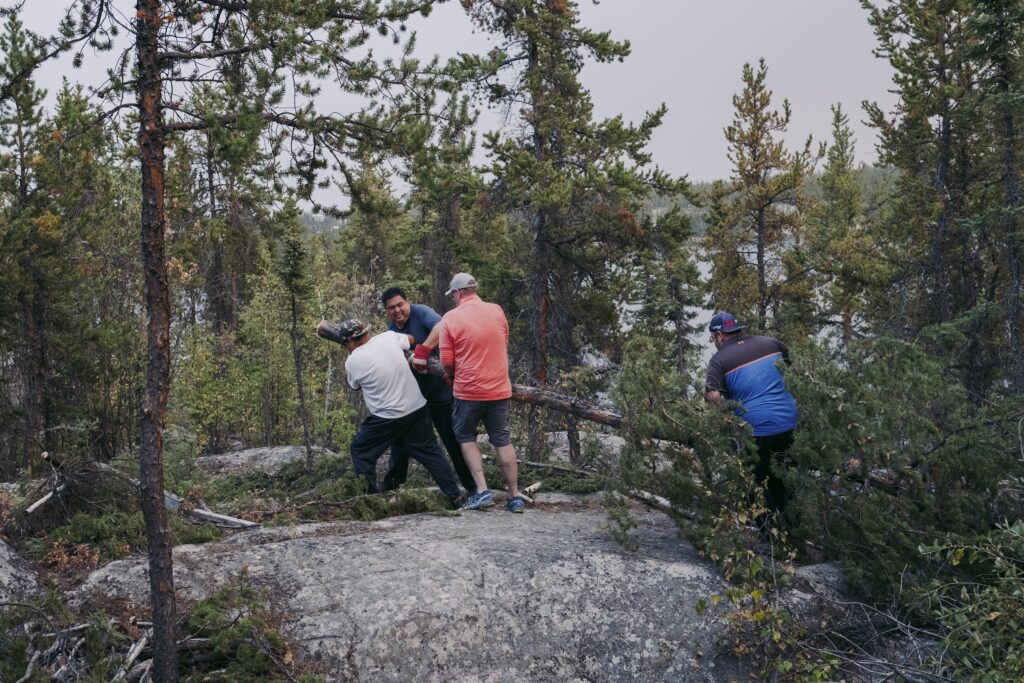
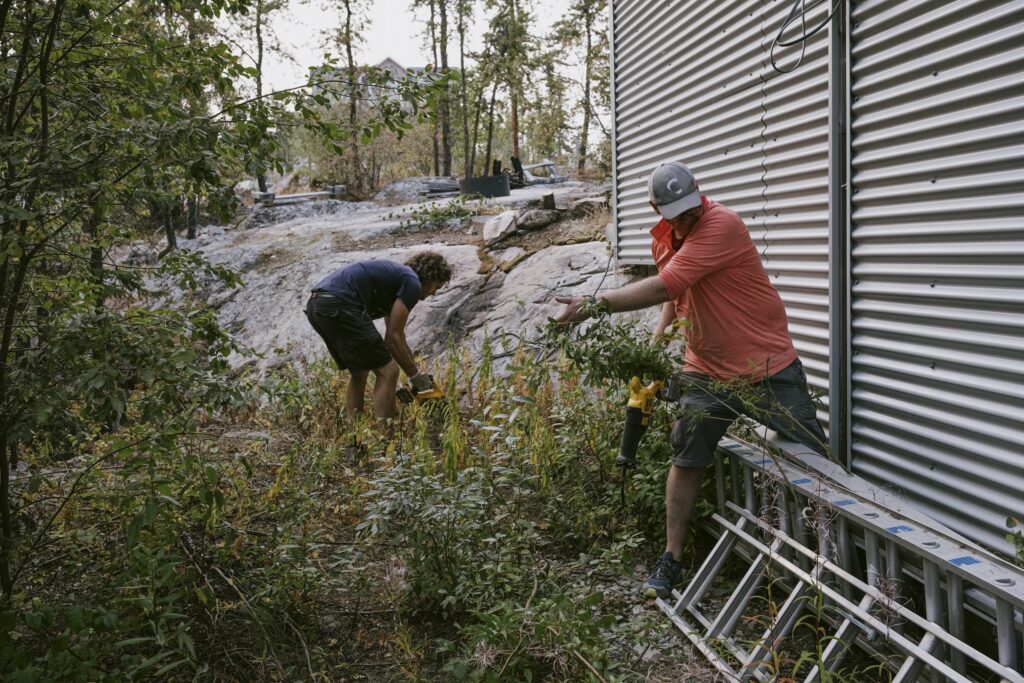
Yellowknife residents clear trees and brush near homes a day after a nearby wildfire led to a state of emergency in 2023. FireSmart guidelines are that a 1.5-metre zone around buildings should be non-flammable. Photo: Pat Kane / The Narwhal
How can looking at the past six decades help us today?
I would say we need to look even farther back in time. We’re in uncharted territory. There is no historical analog for this kind of rapid increase in fire activity.
We’re in uncharted territory. There is no historical analog for this kind of rapid increase in fire activity.
There’s a recent paper by Chelene Hanes and others that looks at changes in the fire regime from 1959 to 2024. We’re seeing larger fires and we had been seeing lightning fires increase, but human-caused fires were going down. We were all patting ourselves on the back, saying, “Hey, you know education’s working. Fire bans are working.”
But this most recent study is now detecting an upswing in human-caused fires. Are people becoming more careless? I don’t think so. It’s because the fuels are drier that it’s more receptive whether it’s lightning strikes or human activities. Most fires are accidental. Arson does play a role, unfortunately, but typically a fairly small number of fires are started by arson. There’s other things that start fires like our infrastructure, power lines, railways, burning trash, agricultural burning, four-wheel vehicles and quads.
Another tool is forest closures. In some years, you may never have to close the forest, but when it’s extreme, you should close the forest. Unpopular, of course, with industry and people who want to do recreation, but it’s a very effective tool, and allows fire management.
What questions should emergency management and researchers be asking when looking at these numbers?
How can we be better prepared for the future? Every community should have an emergency management plan for fire and floods, but include climate change. Metro Vancouver has a really good emergency management plan. Not only does it deal with fire, but also talks about climate change and the expected increase in fire activity.
We should be looking at FireSmart, making it mandatory in high-risk locations to protect homes and buildings. We should be providing funding or incentives to make that happen. It’s kind of happening through insurance already.
I’ll give you another positive example. Jasper is rebuilding and they’re making two FireSmart principles mandatory: using non-flammable building materials and making a 1.5 metre buffer zone around your home non-flammable. Fire typically enters a community through a rain of embers — burning bits of twig, bark, sometimes even pine cones — and it’s probing. It’s opportunistic. It’s looking for something to burn. It lands on mulch or a conifer shrub right beside your home. Your home catches fire and then your neighbour’s home catches fire. Domino, just the whole block goes.
Continuing to educate the public is also a path forward.
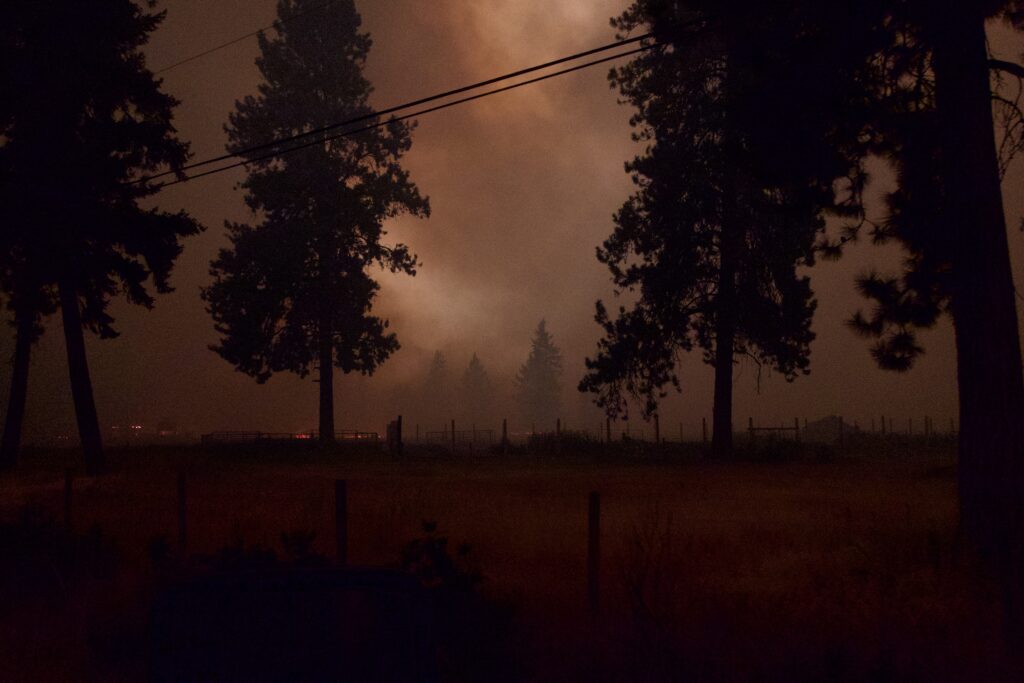
A B.C. wildfire in 2023, the year “the whole province was on fire,” according to fire scientist Mike Flannigan. Photo: Mike Graeme / The Narwhal
I also advocate for a national firefighting force. In the last three years, about two-thirds of the days in 2023 to 2025, we did not have enough resources in Canada, so we called on the United States. This year, the United States is having a very active fire season having nothing to spare. Right now, we have firefighters from Mexico, New Zealand and Australia. There’s talk about the Canadian Armed Forces. We should have a FEMA-type agency, a Federal Emergency Management Agency, to deal with fire, floods, earthquakes and hurricanes. We’re the only G7 country without one.
We have an early warning system for hurricanes. Why can’t we do that for fire? I am doing fire weather outlook right now as a first step in our early warning system. It’s a research project that is publicly available. We have models to predict fire occurrence, lightning, and human caused. So, if we know where the extreme fire will be, and if we know where the new fire starts will be, we should be moving resources proactively ahead of time to those locations. It will cost money, absolutely. But if it saves one Jasper, one Fort McMurray, one Summerland, it kind of pays for itself.
Looking at this data, it can feel pretty bleak. Are you feeling any hope?
I used to be more optimistic than I am. Our track record with dealing with greenhouse gases is abysmal. Building another pipeline is like adding a nail in our coffin. We really have to get off fossil fuels. I don’t know what else I can say. I just see, “drill, baby, drill” and “build, baby, build” and rather than a serious thoughtful conversation of, ‘How can we build a better Earth for the next generation?’ ’’
We need to do something as a global society, and not just for fire. I would like to leave the place better than we found it, and we’re not doing that. We’re making it much worse than what we found it. People can change behavior. We can change.
The Narwhal’s reporters are telling environment stories you won’t read about anywhere else. Stay in the loop by signing up for our free weekly dose of independent journalism.
From The Narwhal | News on Climate Change, Environmental Issues in Canada via This RSS Feed.