

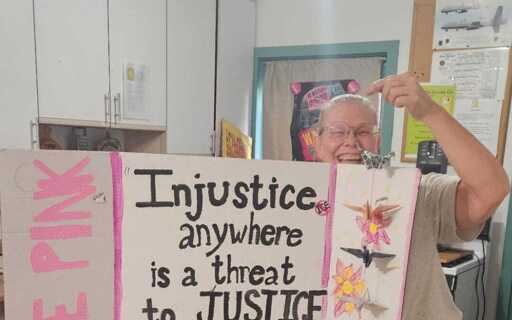
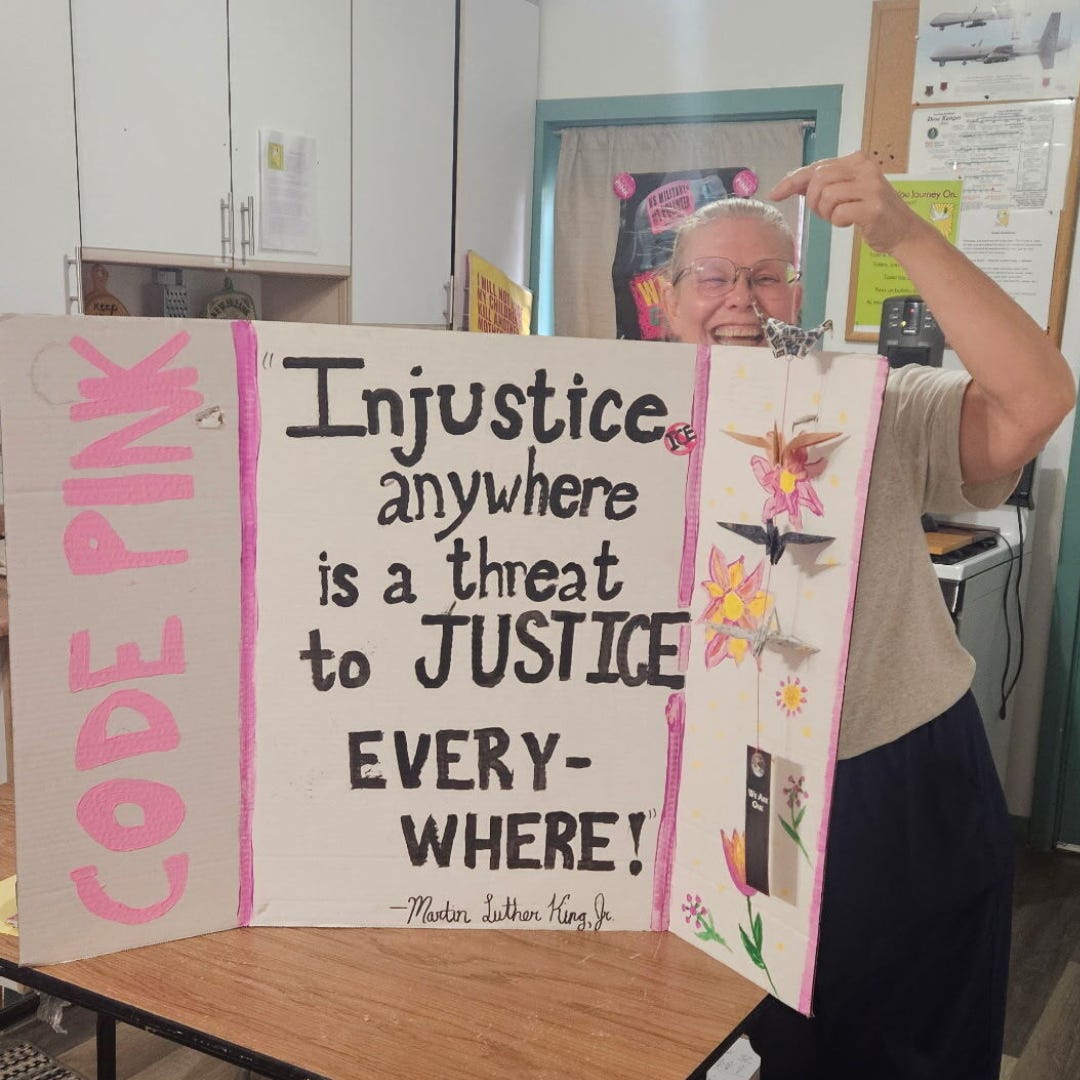
We met inside a small room at the Nevada Desert Experience, the fans blasting to try to keep the room cool on a 115 degree summer day. I sweated still. Everything happens so fast these days, and I am an American–I have no true respect for time. I arrived 15 minutes late. On the Lord’s holy day of rest, I am still rushing from one thing to the next–grabbing a new friend and speeding down the highway. Karen, CODEPINK Las Vegas’s lead organizer, gave me a warm welcome anyway, and a cool glass of water.
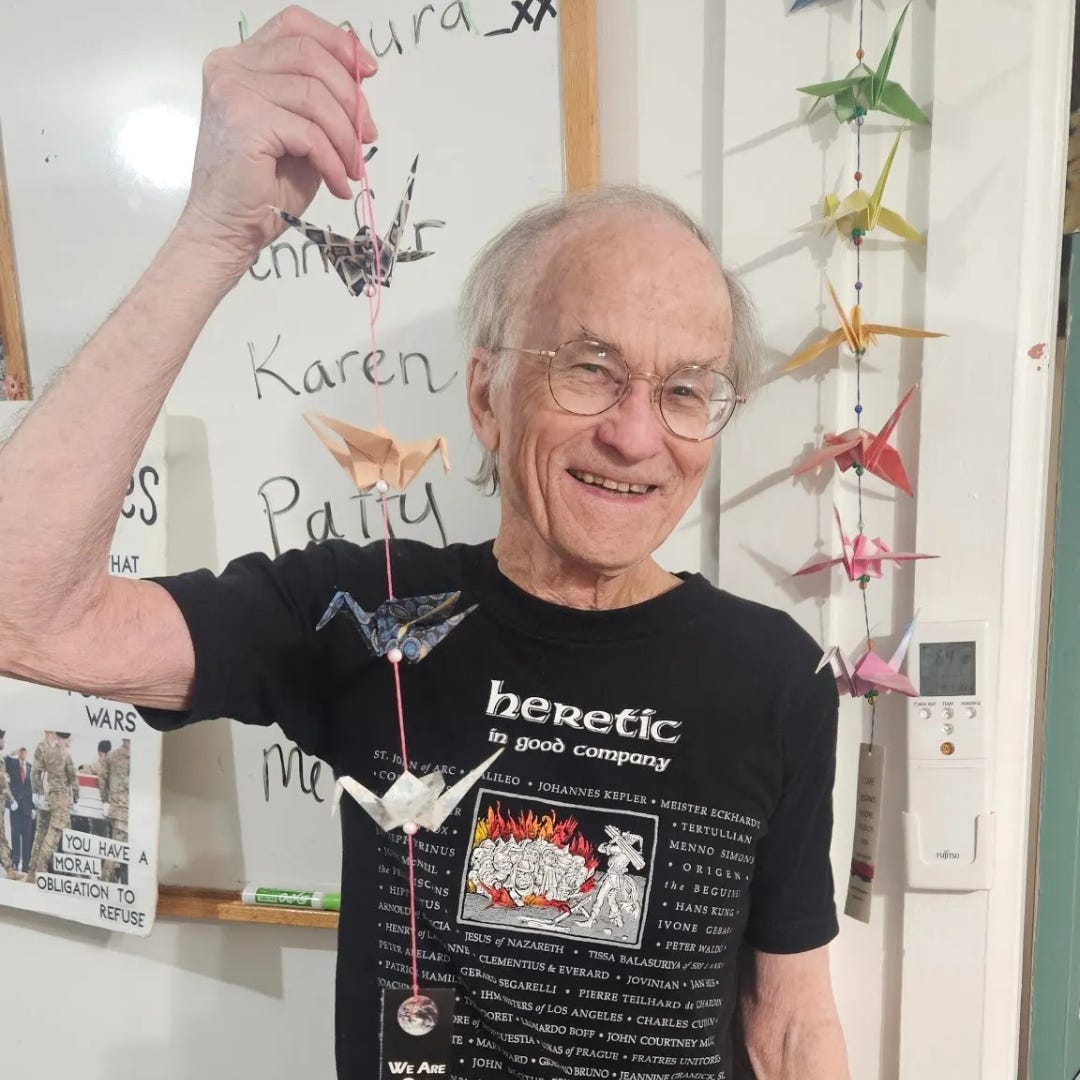
Before me lay pastel sheets of square paper and folding directions. I chose a baby lavender sheet with a pattern of white tentacles. Karen graciously helped us catch up on the craftwork they had already started. I fold one crane, finding a quiet bliss in this hyperfocused moment I was allotted. “Origami is slow, meditative work,” a community member reminded her peer. Precision and intention is important, not speed. But I am still answering texts in between folds. Where is it that I have to be?
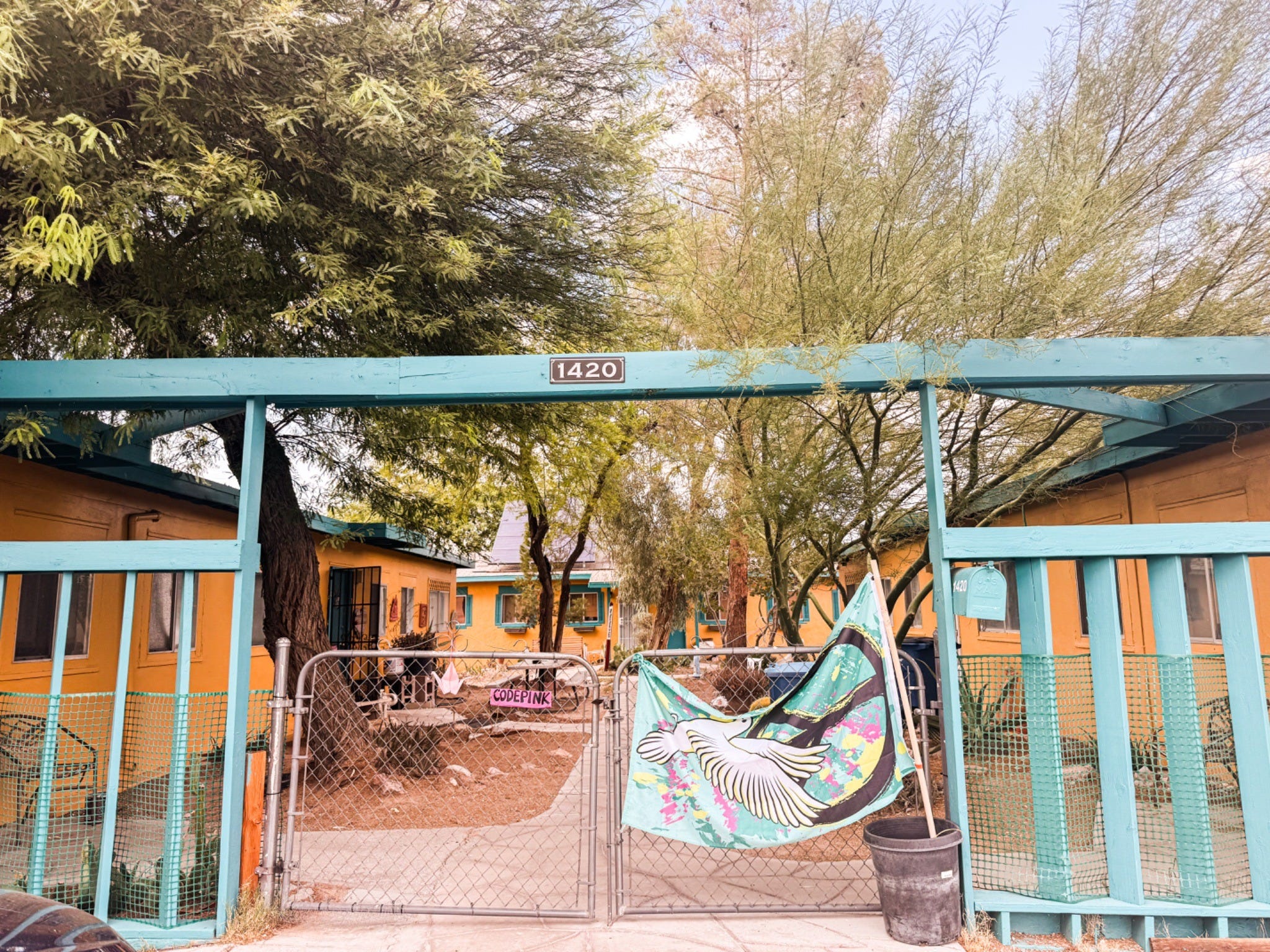
Our attention is redirected to a powerpoint presentation on a small TV screen in the room. Quickly–everything so quick–I learn of Sadako Sasaki’s name, of Hiroshima, and two bombs that changed everything:
August 6 1945. ‘80,000 people killed instantly in Hiroshima,’ the powerpoint says, and countless conditions and diseases afterwards–of course–then it switches to the next slide:
August 9 1945. Three days later. Another 60,000 to 80,000 killed in Nagasaki.
“We all know about this right?” says the presenter, who is no longer Karen in my mind, but “the presenter,” her presence fading next to the bright white powerpoint flashing 15 second facts about death through my mind. Another click turns to the next slide, and we are on to the next campaign.
But wait. I think it, but I don’t say it. I know, yes. But I don’t know, no. How could I possibly know? I think it but I don’t say it–because I care–I really do–it’s just that I have somewhere to be soon anyway, so it’s fine.
And that is how it was done. That is how it was done then and how it is done now, I’m sure of it.
160,000 human beings are killed by American bombs in just two powerpoint slides, in just three bullet points, in less than a minute of our attention on a Sunday. On the Lord’s holy day of rest, we are rushing through the stories of our unhonored dead.
Sadako Sasaki was two years old when the United States dropped the first atomic bomb on Hiroshima. The bombs do not kill everything instantaneously after all. Don’t we know? Yes, of course. But no, we don’t. How can we possibly know? There are people left– left half-burned, black and charred, more dead than alive. Left trying to live on. For the sake of living on. Even the flowers come back, trying to break through the toxic soil after a time–after a lot of slow, painful time. What words can come in that moment of unimaginable grief? What tears can be shed in the face of such pain? Where in the world is there to be but right there, in the bleak brutality? In the neverending now. And how can we possiblythink we already know?
Everything is not instantly dead. Children still play in school yards, still dream of future days. Sadako Sasaki was one of these children. Up until 6th grade, she was a normal energetic child, her father says. And then she was diagnosed with leukemia. Years later, the radiation took what the bomb did not. But even sick children still believe in myths, in divine beasts or the grace of gods, in goodness slowly worked for, and gifts earned with time.
The crane is a sacred creature believed to be able to live 1,000 years, I learn. So it is said that when a person folds 1,000 origami cranes, the devotee is granted their heart’s wish. After her diagnosis, throughout her hospitalization and treatment, and with careful dedication, Sadako folded more than 1,000 cranes–wishing for the extension of her own life and for peace in the world. Sadako died at just 12 years old, but her cranes, her patient act of devotion, and her heart’s wish live on.
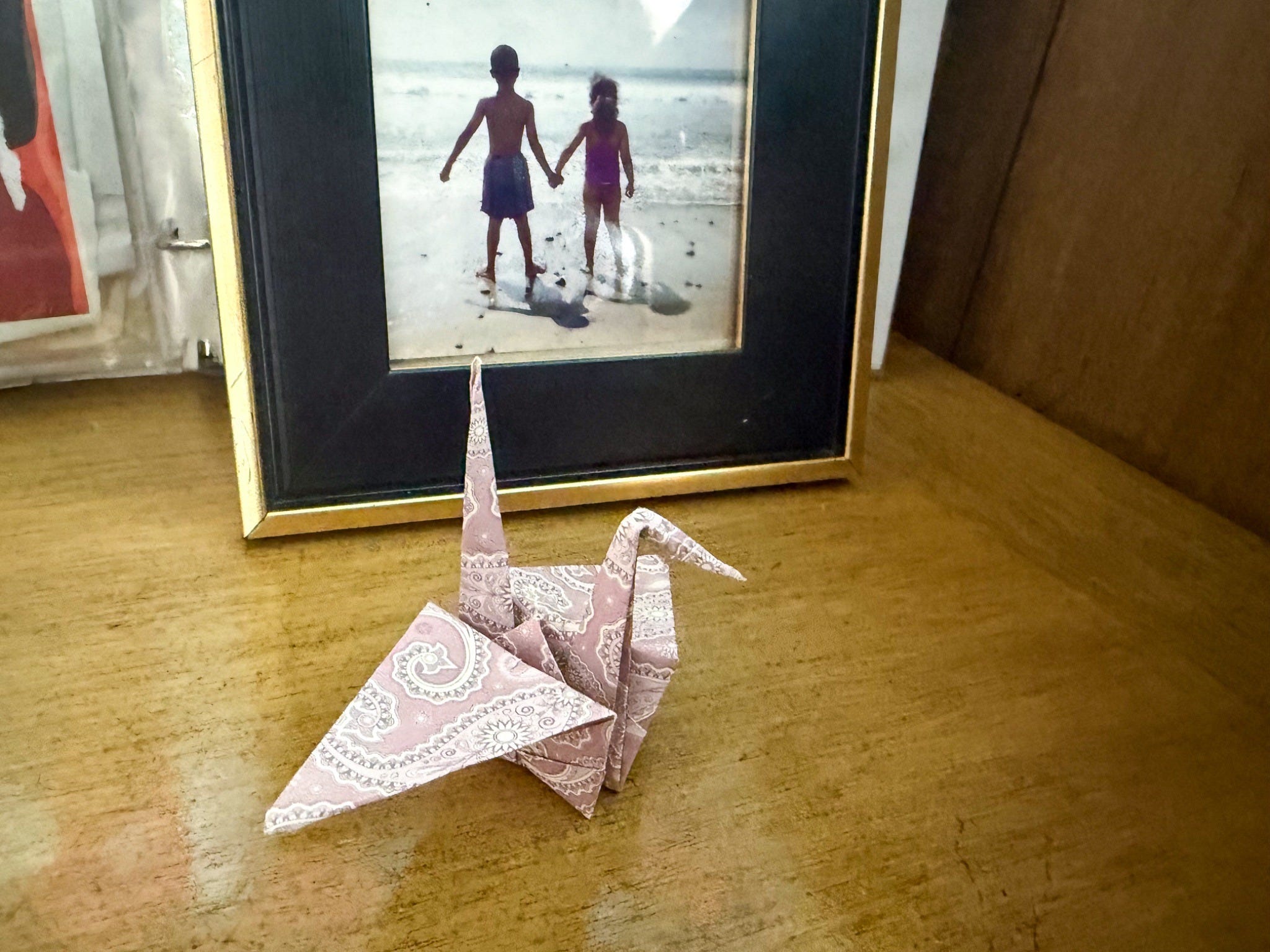
I sit in that room, mind buzzing with plans and purposes and places to be. I fold one crane. I start another, but then I stop halfway, at the making of its wings. I look at my phone once more. I have to go. I am on to my next campaign. What time does a dying child have that I do not?
I force myself to slow down. Before dawn, I visit Wetlands Park, where Nevada’s own cranes find rest. I breathe in the cool air. I sit and meditate as a red sun rises behind the palms. I say a prayer to any God, in any name, who might preserve the children through our bombs and our blockades. I push myself to believe as Sadako Sasaki does: in the wisdom of animals, in the divine in the mundane, and in goodness slowly worked for and whispered into, folded intentionally by my own small hands– over and over and over again–in unfettered, unknowable time.
“I will write peace on your wings, and you will fly all around the world.”
- Sadako Sasaki
What could we fund instead of more bombs and destruction? Tell us!
Mercedez is CODEPINK’s Campaigns Assistant.
Mercedez is a community organizer and storyteller devoted to building culture, connection, and collective action through narrative. Her work spans environmental justice, political organizing, media, and the arts, with experience in grassroots organizing, advocacy, outreach, and community storytelling.
CODEPINK Substack is a reader-supported publication. To receive new posts and support our work, consider becoming a free or paid subscriber.
From CODEPINK Substack via This RSS Feed.