

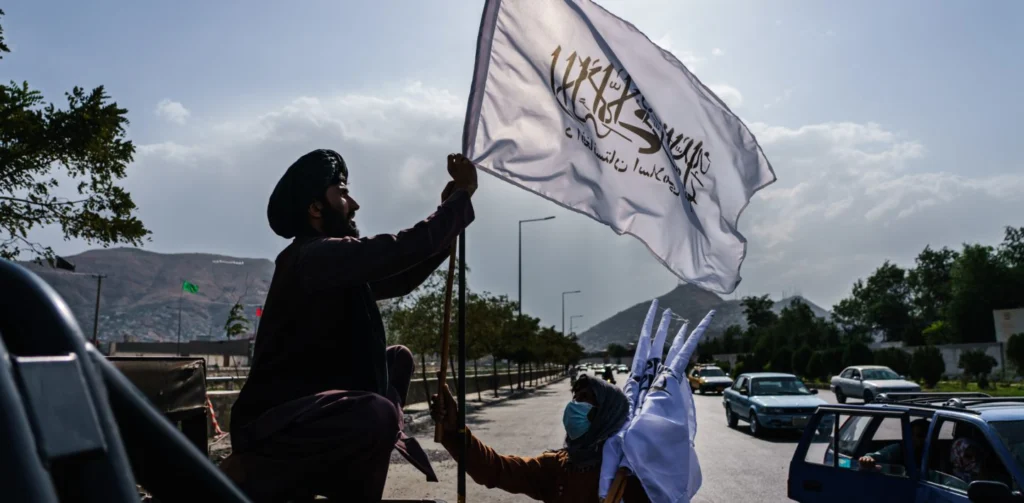
The Taliban regime in Afghanistan is preparing to commemorate the fifth anniversary of its return to power in Kabul this Saturday, amidst a consolidation of territorial control and attempts at diplomatic rapprochement with the international community.
RELATED:
Pakistan Orders Mass Detention of Afghans and Accelerates Deportations
The de facto government has filled cities throughout Afghanistan with Taliban flags, lights, and banners with messages such as “Congratulations, Victory Day!”, according to local reports. The Taliban Olympic Committee announced sporting events for the day, and high-ranking Taliban officials and provincial authorities are expected to deliver speeches as part of the celebration.
It is not yet confirmed whether a military parade will take place at Bagram Air Base, an event that has only been held once since 2021. This year’s preparations are significantly larger compared to previous years, in the context of a recent resurgence of armed opposition groups in different parts of the country.
The commemoration coincides with a growing search for international legitimacy by the Taliban. Only Russia formally recognizes their government, while countries like China, India, and Uzbekistan have strengthened relations with the regime, even hosting its ministers. In New Delhi, for the first time, the Afghan embassy will publicly celebrate Victory Day next Monday.
The European Union has received a Taliban delegation to discuss the expulsion of Afghan citizens deemed a threat to its security. These contacts, while not constituting formal legitimization, imply a degree of acceptance in the name of realpolitik.
Afghanistan’s 2026 Humanitarian Needs and Response Plan is only 26% funded. Yet humanitarian partners continue to respond, doing all they can to reach vulnerable communities and sustain essential services despite shrinking resources.
#WhatItMeansToStay pic.twitter.com/ytJ5OLyhnR
— OCHA Afghanistan (@OCHAAfg) August 5, 2026
Humanitarian Crisis and the Situation of Women
The date marks five years since Taliban forces entered Kabul on August 15, 2011, following the hasty withdrawal of US and NATO troops, which triggered the collapse of the Western-backed government and the end of two decades of war.
Five years later, Afghanistan remains mired in a profound humanitarian and economic crisis. The country ranks 181st on the Human Development Index, equivalent to extreme poverty.
Afghan women remain subjected to a system of marginalization and exploitation described as gender apartheid, under a theocratic political regime. Territorial control is maintained through an alliance between the Taliban leadership and local warlords whose main source of income is opium poppy cultivation.
Analysts from various US administrations and independent institutions frequently warned that the implementation of a renewed political system barely extended beyond the capital. The Taliban’s occupation of Kabul in August 2021 confirmed what was described as a major failure of Western strategy in the country.
#Afghanistan | UN human rights experts are calling for gender apartheid to be recognized as a crime against humanity, five years after the Taliban returned to power.
They say systematic restrictions on women and girls have deprived them of fundamental rights, including access to… pic.twitter.com/2IAuQgVeGe— teleSUR English (@telesurenglish) August 13, 2026
From teleSUR English via This RSS Feed.