

By M.A. AL GHARIB
In a frightening escalation of the ongoing U.S.-Israeli war on Iran, Saudi Arabia and the United States on July 29 launched a joint drone attack on Iraq. The sites they targeted, they claimed, belonged to the Iran-aligned Popular Mobilization Forces (Quwwat al-Hashd al-Sha’bi or PMF). While the Saudis claimed that they seek no further escalation with Iran, their participation in the U.S. strikes was their first open entry into the war. With this attack, the U.S. has managed to draw a major Arab state into direct participation in its war of aggression. Militarily weak and politically marginal, Iraq is witnessing an all too depressing, and all too common, set of events that echo its experience in the near quarter century since the U.S. invasion of 2003.
Iraq’s many deep and ongoing crises are results from its unchosen role as an arena for proxy wars between the U.S.-Israel and Iran. That Iraq has managed to claw its way to a modicum of stability in recent years is to the credit of its workers’ and youth movements, who have waged heroic struggles over the past two decades against foreign interference, sectarianism, and the corruption of its comprador bourgeois class. It is only those forces—workers and youth—that can prevent Iraq from collapsing into another bloody period of proxy wars.
Increasing potential for a world war
The attack on Iraq highlights the fact that this U.S.-Israeli adventure is on the verge of becoming not just a regional war but a world war. The Saudis, for their part, did not clarify why they were “retaliating” by attacking Iraq. It has been the Iran-allied Houthis in Yemen who have launched attacks on Saudi energy installations, who have blockaded Saudi shipping through the Bab al Mandab, and who have attacked Saudi tankers, ports, and oil refineries.
In that regard, according to a July 30 report from the German socialist daily, Junge Welt: Satellite data indicate significant damage. Two major fires were detected on Saturday at the Yanbu (on the central Hejaz coast) facility of the Saudi oil company Aramco. Since then, the port’s loading capacity has dropped by around 40 percent. A refinery in Jazan (near the Yemeni border) had to be temporarily shut down following a fire.
The report continues that over the past few weeks, the Iranians have received 400 Chinese shoulder-fired anti-aircraft systems allegedly delivered to Tehran within weeks in a deal whose value is estimated to be $60–70 million. The deal was brokered by a Hong Kong-based firm (unnamed in the report), with weapons transported via western China and Pakistan**.**Both China and Pakistan have denied these allegations, based on unnamed sources. Chinese-Iranian arms transfers are not unprecedented. According to the Junge Welt report, the PRC has previously supplied Islamic Republic with anti-ship missiles.
At the same time, Syria and Jordan are demanding that Iraq prevent Iran-backed militias from launching cross-border attacks. Both have claimed that Iran-backed militias have been maneuvering close to their borders and both have indicated that they would respond militarily to any attacks. These warnings followed the interception by Jordanian forces of five Iran-launched missiles targeting sites in Jordan. The Iraqi government, in turn, issued a statement distancing itself from both the U.S. and Iran and reiterating its rejection of any use of Iraqi territory in regional conflicts.
The Popular Mobilization Forces (PMF)
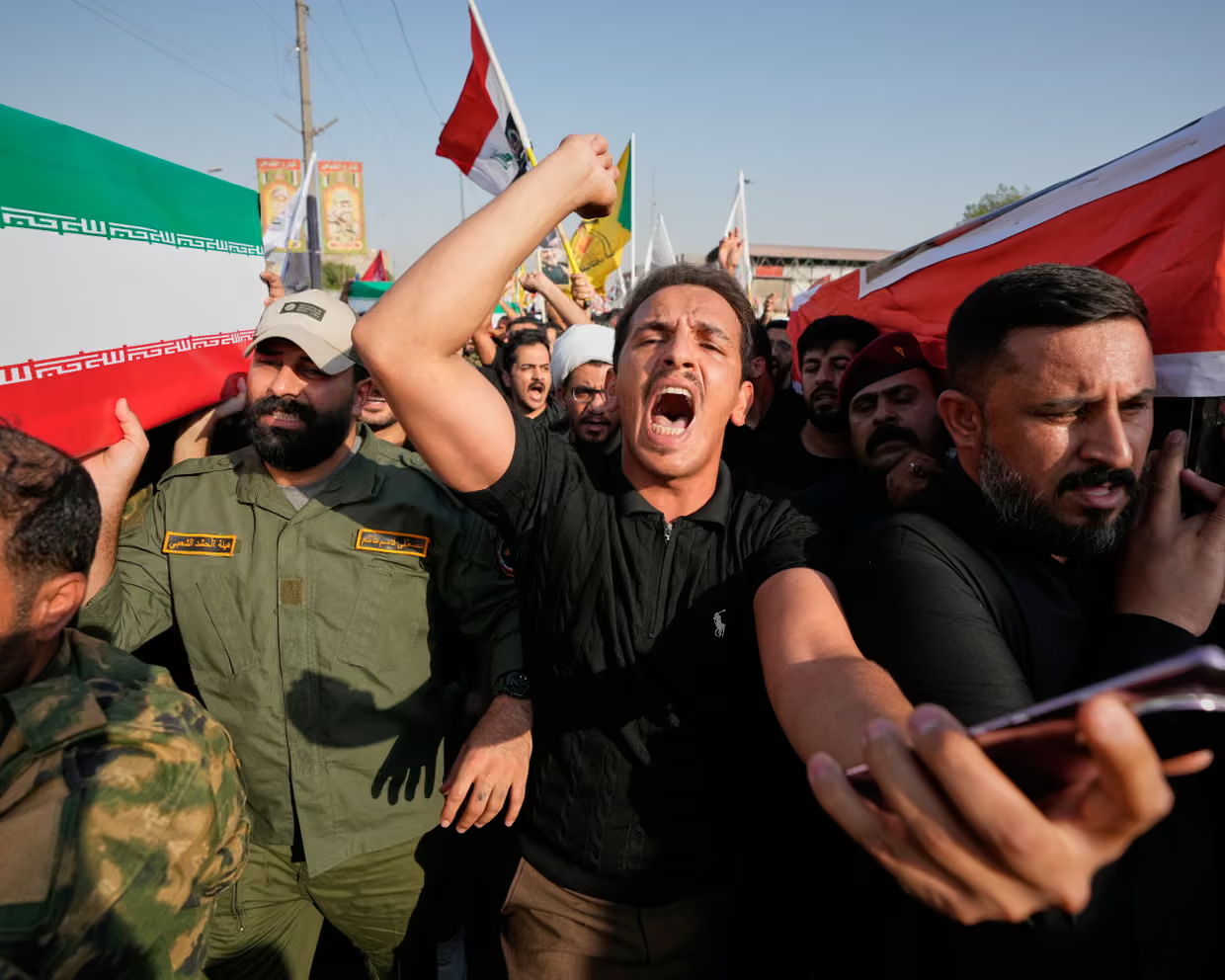
These are a group of militias whose composition is mostly of the Shi’a sect. While many formed in 2014 to counter ISIS incursions into Iraq, some groups were formed shortly after the 2003 U.S. invasion. The PMF were valued allies of the United States during the fight against ISIS, and the Iraqi state included them in the state security forces. However, in practice, they have largely operated autonomously and are allied with Iran. Indeed, since the beginning of the February war against Iran, the PMF have targeted US military bases, diplomatic facilities, and oil facilities.
This has put the Iraqi government in a bind. While it has condemned the Saudi – U.S. drone strikes of 29 July, it has also given the PMF until the end of September to disarm. The PMF has refused to do this.Ali Al-Zaidi, the Iraqi prime minister, considered by both the U.S. and Iran to be an acceptable Iraqi leader (in the jargon of the U.S. State Department, he’s a “consensus” politician), thus faces a dilemma similar to that confronting Lebanon’s leadership: disarming armed groups too quickly risks internal conflict, perhaps a return to civil war; delaying action vis-à-vis armed groups risks U.S.-Israeli military aggression, as already seen in Lebanon.
Legacy of U.S.-inflicted demodernization: 1990-2003
The PMF are reactionary, sectarian proxies, cultivated by Iran. But U.S. imperialist aggression has been their handmaid; it was the U.S. that was responsible, over the last nearly four decades, for the criminal “demodernization” of Iraq (to use geographer Stephen Graham’s term). This is what prepared the soil for Iranian intervention and for the sectarianism that has been ripping Iraq apart for so long.
While a summary of that demodernization is beyond our scope here, suffice it to say that when the U.S. invaded Iraq in 2003, it was doing so to a country that had already been laid waste by the previous Gulf Wars of the 1980s and early 1990s, along with merciless U.S. sanctions that led to the deaths of hundreds of thousands of children. Madeleine Albright’s ghoulish statement that the deaths of half a million children were worth this to “contain Saddam” should never be forgotten, and Iraqis don’t forget. The war against Iran in the 1980s was itself far deadlier and more protracted than it should have been because the U.S., France, and Britain saw Saddam Hussein’s regime as a useful proxy to exhaust the Islamic Republic of Iran. When Hussein invaded Kuwait in 1990, he fell from favor and sealed the Iraqi people’s fate to over 35 years (and counting) of indescribable suffering.
After the U.S. invasion of 2003, the Americans carried out “de-Ba’thification.” Referencing the de-Nazification of Germany after World War II, in practice what this meant was the Americans deploying an oversimplified notion of sectarian identity in their staffing of the post-Ba’th Iraqi state bureaucracy and in handing out positions of influence. Because Saddam Hussein was Sunni Arab and this group was, it is true, privileged during the time of Ba’th rule, the Americans equated Sunni Arabs with “elites” and even with Ba’thists. This was a false equation that would have catastrophic consequences for post-2003 Iraq, sowing the seeds of endless violence.
The U.S. rulers told the story, so dazzling to American liberals and neocons alike, that with this “generous” act of white saviorhood, the previously marginalized Shi’is and Kurds would now be afforded a modicum of historical justice. In fact, as many Iraqis recognized in 2003, this was just old-fashioned divide-and-rule colonialism. In reality, most Iraqi workers and indeed most citizens, regardless of religious identity, had no political influence during the Ba’th era. Though Sunni Arabs, unlike Kurds or Shi’a, were not subjected to genocidal campaigns such as the Anfal in 1988, Sunni Arabs, Shi’a, and Kurds alike who did not join the Ba’th party would be excluded from decent jobs, university positions, etc. The Ba’th Party, moreover, made no distinctions of ethnicity or faith when conscripting cannon fodder in the Iranian and American wars.
Likewise, the U.S.-dominated post-2003 regime’s cartoonish sectarian inversion in no way benefitted the majority of Shi’a or Kurds, who still remain, like their Sunni Arab compatriots, unemployed or underemployed workers in a neocolonial country that had been bled white by imperialist proxy wars, direct invasion, toxic violence, and deliberate, U.S.-inflicted demodernization, encompassing ecocide, urbicide, and scholasticide.
Resilience and mass militancy of a national movement: Iraq since the Arab uprisings of 2010-2011
Speaking to relatives living in Iraq during this most recent eruption of war into their lives, I could only come away with a sense of admiration bordering on awe at their resilience. In phone conversations, they spoke about continuing to lead their daily lives as if the bombs are not falling, about having been through worse in the past, and about their commitment to maintain their dignity and moments of joy as states much more powerful than theirs kick Iraq around like a football.
Resilience is, in fact, an inadequate word. Over the past 15 years, the Iraqi masses, with workers, students, and youth often in the lead, have risen in at least four major waves of mass resistance, in 2011, 2012-2013, 2015-2018, and the largest protests in Iraq since 2003, the October or Tishrin Uprisings of 2019-2021. The state, often with either the approval or the active participation of Iranian and Iranian-aligned forces, has not shied away from bloody repression of protesters and persecution of participants even years after the events. While these uprisings have displayed weakness, such as contradictory, at times performative and even reactionary politics, along with a lack of revolutionary leadership, millions of Iraqis have participated in them with great courage, refusing to hide in fear of state repression.
And they have achieved some important successes: experience with state repression has offered lessons in the dependency of the Iraqi state and the venality of the ruling class. Protests have also been a school in civil disobedience, as participants have engaged in a panoply of civil disobedience tactics, from sit-ins to building occupations, road blocks, and even attacks on the offices of Iranian and Iranian-aligned officials and militias.
There were also important differences between different protest waves, not only generationally but in terms of identity: the 2012-2013 wave was a largely Sunni Arab affair, a revolt against the Shi’a sectarianism of Maliki government, while the Tishrin uprising was a mass movement cutting across lines of ethnoreligious identity. Nevertheless, they have articulated similar and sometimes identical demands: against sectarianism and corruption, for serious state intervention to address unemployment, poor public services and safety, lack of clean water and electricity shortages, and for an end to Iranian, U.S.—and all foreign—interference.
It is these movements, and especially their youthful base, that have planted the seeds of an Iraqi national identity. None of the uprisings discussed have been revolutionary. They have lacked the clear-eyed leadership that might direct them both to face their contradictions and to understand what it would take to really put the question of workers power on the table. Nevertheless, they have represented a relatively progressive current in the context of the country’s recent history of sectarianism and have developed an Iraqi repertoire of civil disobedience and popular militancy. It is from such experiences that future generations may learn and develop the truly revolutionary socialist leadership necessary for a progressive resolution of Iraq’s deep crises.
Photo: Mourners in Mosul, Iraq, carry coffins draped in Iranian and Iraqi flags during a funeral for Popular Mobilization Forces fighters killed in U.S.-Saudi airstrikes in July. (Hadi Mizban / AP)
The post The long struggle against proxy wars in Iraq first appeared on Workers’ Voice/La Voz de los Trabajadores.
From Workers’ Voice/La Voz de los Trabajadores via This RSS Feed.