

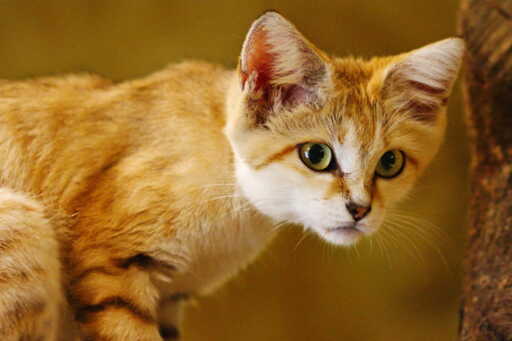
Muhammad Ali Nawaz didn’t expect to see so many cats. Nawaz, a wildlife ecologist at Qatar University, had set out to survey Qatar for the sand cat, a tiny, seldom-studied felid that lives in deserts across Southwest and Central Asia, northern Africa and the Arabian Peninsula. Though there were anecdotal reports of the species in Qatar — some cats photographed, some not — there were no systematic records. So, Nawaz and his collaborators set out an array of cameras and waited. “When I collected the cameras, it was a big surprise,” he told Mongabay on a video call. Between 2022 and 2025, the cameras photographed sand cats (Felis margarita) more than 100 times, all in Qatar’s Al-Ureiq Reserve — a protected area of roughly 55 square kilometers (21 square miles). Though it’s unclear how many individual cats triggered cameras, these images provide solid evidence of the species’ range and information on its habitat preferences, data that was recently published in the journal Frontiers in Conservation Science. “This is a remarkable kind of a discovery and gives hope for the terrestrial wildlife in the country,” Nawaz said. Photographs captured during this study provide solid evidence of the species’ range and information on its habitat preferences. Image courtesy of Muhammad Ali Nawaz. A resilient desert-dweller Sand cats are perfectly suited for their desert homes. These diminutive felids’ sand-colored fur provides stellar camouflage. Dense fur on their paws insulates against hot sand. Their keen hearing can detect prey underground. They eat small mammals,…This article was originally published on Mongabay
From Conservation news via This RSS Feed.