

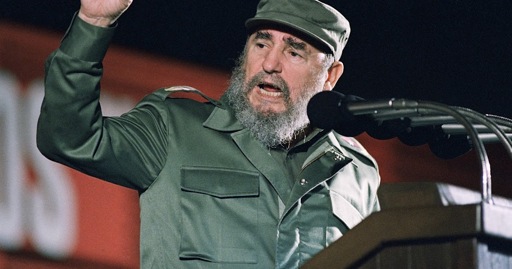

Intervention by Eliseos Vagenas, member of the CC of the Communist Party of Greece (KKE) and head of the Party’s International Relations Section, at the 1st International Colloquium “Fidel: Legacy and Future”, which took place in Havana from 10 to 13 August. Translated from Rizospastis (here in Greek):
"We thank the organizers for the invitation to participate in the 1st International Symposium “Fidel: Legacy and Future.” From this platform as well, we wish to express the profound solidarity of the Communist Party of Greece (KKE), and of all communists in Greece, with the heroic people of Cuba, who for decades have been in the crosshairs of U.S. imperialism.
The great Cuban revolutionary Fidel Castro devoted his life to the struggle for social justice and the well-being of the people of his country, as well as of all peoples rising up against imperialism. He dedicated all his strength to the victory and consolidation of the Cuban Socialist Revolution and to the defense of its achievements.
In this brief intervention, we would therefore like to highlight an important aspect of his personality and of his particular personal contribution to the International Communist Movement at a critical moment for all humanity, and especially for the world communist and workers’ movement. Such a moment was perestroika, which ultimately proved to be a vehicle for the counterrevolution in the USSR.
Fidel Castro was among the very few leaders of the socialist countries of that period who, while recognizing the great achievements of the Soviet Union, the decisive assistance it had provided to Cuba and to other countries seeking to build socialism, as well as the necessity of corrective measures within socialism itself, nevertheless expressed serious reservations about the course being followed by the Communist Party of the Soviet Union (CPSU).
Gradually, his position developed from deep skepticism into an openly critical stance toward the developments taking place in the USSR. This attitude undoubtedly helped many revolutionaries and communists throughout the world to orient themselves correctly in relation to the events of that period.
But what exactly was it about Gorbachev’s perestroika that disturbed Fidel?
Clearly, one of his main concerns was the slanderous offensive launched during the years of perestroika, “from within and from above,” against communist ideas, against the Communist Party itself and against the revolutionary history of the country.
As he stated in his report to the 4th Congress of the Communist Party of Cuba: “I saw the prestige of the Party collapsing, I saw the prestige of the state collapsing, I saw the history of the USSR being slandered, and that had nothing whatsoever to do with historical criticism.”¹
At that Congress, held two months after Yeltsin had banned the CPSU and two months before the formal dissolution of the Soviet Union, Fidel defended Cuba’s socialist path and the Revolution itself against the counterrevolution and against the overwhelmingly negative international correlation of forces then taking shape.
He also referred to his participation, in 1987, in a meeting of leaders of the Council for Mutual Economic Assistance (CMEA), where, as he recalled, the problems caused by distortions in the economy were common to a number of socialist countries.
In studying the causes of the overthrow of socialism in the USSR, the KKE has focused, among other things, on the so-called Kosygin economic reforms and on the mistaken decisions of the 20th and 22nd Congresses of the CPSU, policies that were also promoted in other socialist countries.
Fidel referred to these issues as well in his opening speech to the 4th Congress of the Communist Party of Cuba. He recalled what he had told the other socialist leaders during a round-table discussion:
“Try in the future to avoid this road, to avoid the alienation of people and the negative consequences it brings. They listened to me with great interest and, to tell the truth, many of them later told me: ‘You know, exactly the same thing happened to us.’ When I explained to them that many construction projects were left unfinished, when I explained that they sought to fulfill the plan on the basis of value indicators of production rather than on the basis of the necessary range of products, when I explained that enterprises which were supposed to produce spare parts manufactured only the fifty most profitable ones and did not produce the rest, and so on, some of them told me very frankly: ‘You know, exactly the same thing happened to us.’”²
Castro understood that the introduction of a series of market mechanisms and the weakening of central planning, which had begun in the USSR during the 1960s, could generate distortions, even social inequalities, and ultimately undermine the revolutionary course itself.
It was therefore no accident that, at precisely the same time that perestroika was unfolding in the Soviet Union, Cuba from 1986 onward pursued the policy known as the “Rectification of Errors and Negative Tendencies.” Certain measures adopted in Cuba moved in an entirely different direction from perestroika, reversing a number of market-oriented measures that had been introduced in previous years.
In conclusion, Fidel’s political sharpness rested on a deep conviction that he already held at that time. It was this conviction that enabled him, two and a half years before the dissolution of the USSR, in his historic speech of 26 July 1989 in Camagüey, to criticize perestroika and to foresee the possibility of the Soviet Union’s dissolution and even of civil conflict.
These words acquire particular significance today, when we see two fraternal peoples who lived and achieved great things together during the years of socialism now being slaughtered on the battlefields of the imperialist war in Ukraine for the interests of capitalists.
Many years later, in 2005, in a speech to students at the University of Havana, Fidel focused on problems such as weak social responsibility and consciousness, economic mismanagement, mistaken government decisions, individual and abusive appropriation of social wealth, corruption and other phenomena.
Speaking to young people and students, he began from the necessity of ensuring that Cuba would not repeat the course taken by the Soviet Union. He criticized “those who believed that socialism could be built using capitalist methods,” describing this as “one of the great historical errors.”³
In summary, Fidel Castro’s position toward perestroika and the triumph of the counterrevolution in the USSR highlights the importance, for communists, of ideological consistency and of making a timely political assessment of developments.
This historical experience remains a subject for study and reflection, and for drawing useful conclusions for the International Communist Movement."
References:
1.Fidel Castro Ruz, speech at the opening of the 4th Congress of the Communist Party of Cuba, 10 October 1991.
2. Ibid.
3. Fidel Castro Ruz, speech at the University of Havana, 17 November 2005.
From In Defense of Communism via This RSS Feed.
It’s interesting to read the opinion of such a distinguished person on these ambiguous events.